Topic Clusters vs Keywords: Which SEO Strategy Actually Wins
By RankTree Team · 2026-07-08 · Updated 2026-10-07
Part of the Keyword Clustering: The Complete Guide for SEO Success guide →
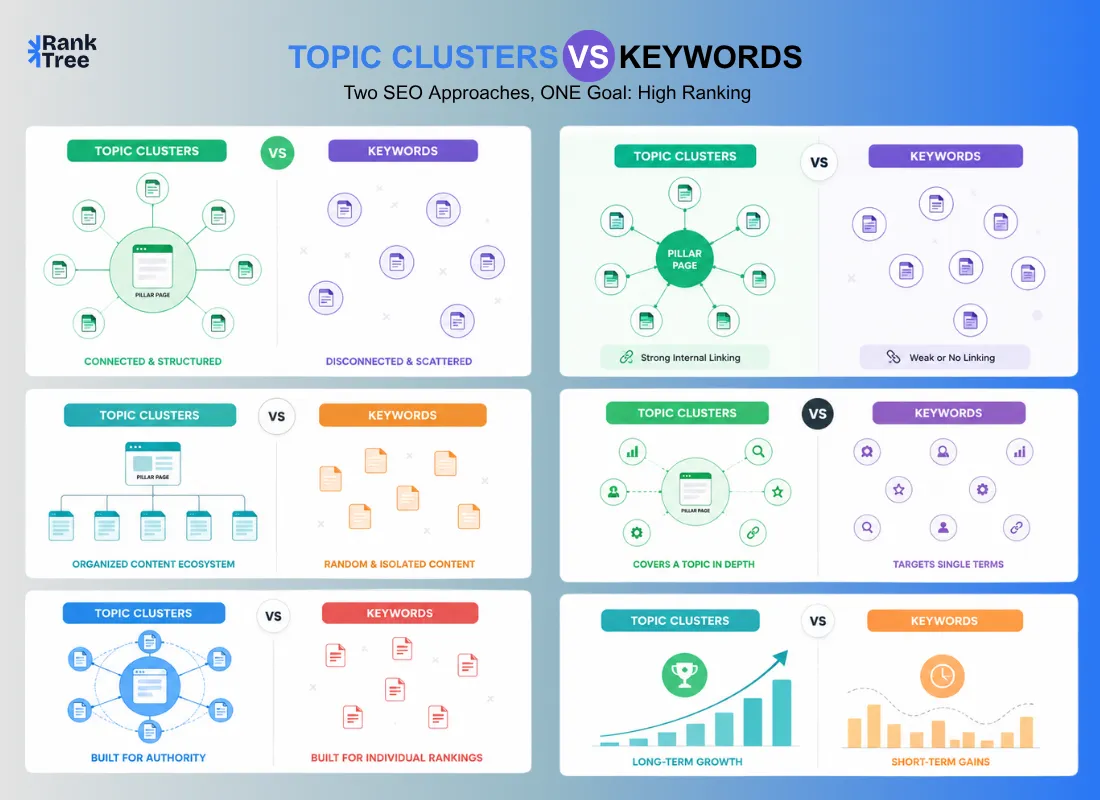
Topic clusters vs keywords is one of the most debated questions in modern SEO. The short answer: Topic clusters organize content around a core theme with a pillar page and supporting subtopics while traditional keyword targeting focuses on individual search terms in isolation. This structural difference changes how content is planned, linked and ranked.
Search engines have shifted from matching exact keywords to evaluating topical depth and context. Sites that organize content into clusters signal expertise more clearly than sites built around scattered keyword only pages.
Clustered content, structured around topic authority rather than isolated keywords, tends to earn more organic traffic and holds rankings more consistently than standalone posts that compete with each other for the same intent.
Many marketers still lean on keywords alone without thinking about how pieces of content relate to each other. That approach often produces thin content that fails to satisfy full user intent and struggles to rank as a result.
By the end of this guide you'll understand the real differences between topic clusters and keyword based SEO backed by data and how to combine both approaches effectively.
Topic clusters organize content around a core theme, using a pillar page, typically 2,500 to 4,000 words, that covers the broad topic, linked to 8 to 12 supporting cluster pages, usually 800 to 1,500 words each, that explore specific subtopics and link back to the pillar. Traditional keyword targeting instead builds standalone pages, each optimized around one or a few search terms in isolation, with little structural connection between pages. This difference matters because search engines have shifted from matching exact keywords to evaluating topical depth and context: clustered content signals expertise more clearly, tends to rank for a wider range of related queries, and holds rankings more consistently than scattered keyword-only pages that can compete with each other for the same intent. Topic clusters do not eliminate the need for keyword research; keywords still determine which subtopics to target, clusters simply organize that research into a connected, hub-and-spoke structure instead of isolated pages.
Topic Clusters vs Keywords: Quick Comparison
Topic Clusters | Traditional Keywords | |
Structure | Pillar page + linked subtopic pages | Standalone pages each targeting one term |
Focus | Broad theme + full search intent | Individual search phrases |
Internal linking | Built in hub and spoke model | Often minimal or ad hoc |
Authority signal | Strong shows topical depth | Weaker depth is hard to demonstrate |
Best for | Competitive evergreen topics | |
Maintenance | Ongoing (quarterly refresh recommended) | Lower but rankings decay faster |
What Are Topic Clusters?
Topic clusters are a content organization model built around a central theme. A pillar page covers the broad topic (typically 2500–4000 words) while cluster pages explore specific subtopics in more depth (usually 800–1500 words each) and link back to the pillar.
This structure helps both users and search engines understand how your content connects.
For example a pillar page on "Nutrition" might link out to cluster pages on "Vitamins" "Healthy Recipes" and "Diet Plans."
Most effective clusters include 8–12 supporting pages per pillar though HubSpot recommends starting with a minimum of 6–10 subtopics.
What Are Keywords?
Keywords are the specific terms and phrases people type into search engines. Traditional keyword based SEO optimizes individual pages around one or a few of these terms aiming to rank that page for that specific query.
It's simpler to execute but doesn't inherently demonstrate broader expertise on a subject.
The Key Differences Between Topic Clusters and Keywords
This build a network of interlinked content around a theme; keyword strategies target individual terms in isolation. This shifts the focus from ranking single pages to building topical authority across a whole site section.
In practice sites using topic clusters tend to rank for a wider range of related queries because search engines can see the full scope of coverage, not just one page's relevance to one term.
HubSpot, which helped popularize the topic cluster model, has publicly credited a large share of its own organic blog traffic to topic hub architecture — a well-known example of the approach at scale, even if exact current numbers aren't independently verifiable.
Keyword Based SEO vs. Topic Cluster Strategies
Keyword focused pages can win short term visibility but often lack the depth to sustain rankings or engagement.
Topic clusters by contrast are built for comprehensiveness which tends to produce better user satisfaction and stronger long term rankings since search engines increasingly reward structured high quality content over keyword density.
The Role of Authority in Search Engine Rankings
Search engines assess a site's expertise using signals like backlink quality, user engagement and content depth.
Because clusters cover a subject comprehensively they help build that authority faster than isolated articles. A well structured cluster on a competitive topic like "Mental Health" is more likely to outrank scattered single keyword posts from a similar authority site.
Implementing Topic Clusters in Your SEO Strategy
Identify core topics using keyword research tools Google Trends Search Console data and customer questions.
Map 8–12 subtopics per pillar each targeting a distinct angle or long tail query to avoid keyword cannibalization.
Build the pillar page as the comprehensive hub for the topic.
Write cluster pages that go deep on each subtopic and link back to the pillar with descriptive (not generic "read more") anchor text.
Audit the cluster at least twice a year for evergreen topics quarterly for fast moving or competitive ones.
Creating a Content Calendar
A simple tracking sheet or tool like Trello or Asana helps sequence pillar and cluster publication typically the pillar goes live first followed by 2–3 cluster posts per week. This keeps the buildout consistent and avoids content gaps.
Common Mistakes to Avoid
Weak internal linking. Every cluster page should link back to the pillar and to related cluster pages. Sites with poor linking structure between cluster pages typically see noticeably less traffic than properly interlinked clusters, since weak internal links dilute the topical signal Google uses to recognize the cluster as a unit.
Ignoring search intent. Clusters built without mapping to real user questions tend to produce high bounce rates regardless of how well they're linked.
Keyword cannibalization. If two cluster pages target overlapping intent they compete against each other instead of external competitors.
No maintenance plan. Stats examples and links need quarterly refreshes to hold rankings.
Tools for Building Topic Clusters
Research & planning: Ahrefs, SEMrush, Google Search Console Google Trends
Visualization: MindMeister or a simple spreadsheet tracker
CMS execution: HubSpot's native SEO/Topics tool WordPress with internal linking plugins
Conclusion
Topic clusters don't eliminate the need for keywords; they organize keyword targeting around real topical authority.
For competitive or evergreen subjects a pillar and cluster structure with strong internal linking consistently outperforms scattered keyword only pages both in rankings and in how well the content actually serves readers.
FAQ
Do topic clusters replace keyword research?
No. Keyword research still identifies which subtopics and search terms to target clusters just organize that research into a connected structure instead of isolated pages.
How many cluster pages does a pillar need?
Most effective clusters use 8–12 supporting pages though smaller sites can start with 6.
Are topic clusters still effective in 2026?
Yes. Clustered sites have generally continued to outperform standalone keyword-targeted pages following Google's core updates, since topic clusters directly address the helpfulness and topical-depth signals those updates reward.
Which is better for SEO: topic clusters or keywords?
Neither is better alone. Topic clusters build long term authority, while keywords help target specific search queries. The best SEO strategy combines both approaches.
Can keyword based SEO still work without topic clusters?
Yes, but results are usually limited. Without clusters, it becomes harder to build authority and rank for competitive topics.
Related reads
- Domain Clustering SEO: What It Is How It Works and How to Use It Strategically
- SERP-Based vs Semantic Clustering: Which Method Actually Builds Your Content Architecture?
- Semantic Search vs Keyword Search: The Complete Decision Framework
RankTree Team — The RankTree team writes about SEO strategy, keyword clustering, and topical authority to help you build content that ranks.