How to Use Ahrefs to Find Keywords (and Turn Them Into Clusters)
By RankTree Team · 2026-08-25 · Updated 2026-10-07
Part of the Backlink Gap Analysis: Find and Close Your Link Gaps guide →
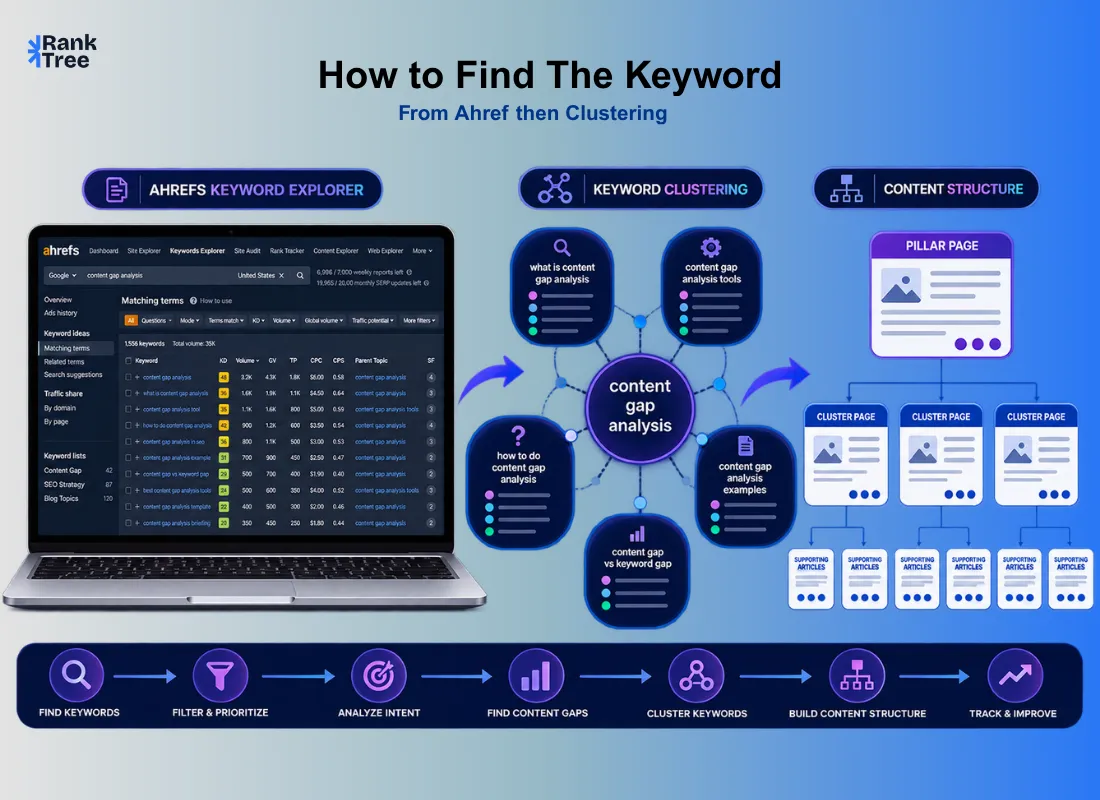
Finding keywords is easy. Building a strategy that actually ranks is where most people fail. You open Ahrefs, enter a keyword and suddenly you’re flooded with thousands of ideas.
But here’s the problem more keywords don’t mean more traffic. Without structure those keywords become noise not growth.
What if you could take those raw keywords and turn them into a complete content system that builds authority and drives consistent traffic?
In this guide you’ll learn how to use Ahrefs to find keywords and then transform them into structured clusters using a strategic approach. This is not just keyword research, it's a full workflow designed for scalable SEO growth.
How do you use Ahrefs to find keywords and turn them into a strategy? Start by entering a broad seed keyword into Ahrefs Keywords Explorer to generate thousands of keyword ideas, then filter by keyword difficulty, search volume, and clicks to isolate low to medium difficulty terms with real demand. Next, analyze the search intent behind each keyword by reviewing the top ranking pages Ahrefs surfaces, since matching intent is critical to ranking. Use Site Explorer's Content Gap feature to find keywords multiple competitors rank for that you do not, then export the full list. The step most people skip is turning that raw list into clusters: group related keywords by search intent, semantic similarity, and topic relevance, using a tool like RankTree, so one strong article targets a whole cluster instead of many thin pages competing against each other. Map each cluster into a pillar and supporting content structure, then track rankings with Ahrefs Rank Tracker and update underperforming pages.
How to Use Ahrefs to Find Keywords and Build a Content Strategy?
Ahrefs helps you discover keyword opportunities but the real value comes from how you process and organize that data into a strategy.
Most beginners stop at finding keywords. Professionals go one step further; they analyze intent, identify gaps and group keywords into clusters that build topical authority.
Let’s break this down step by step.
Step 1: Start With Seed Keywords in Ahrefs
The first step is to enter a broad keyword into Ahrefs Keywords Explorer. This is called a seed keyword.
Seed keywords are general terms related to your niche. For example if your topic is content gap analysis you might start with something like “keyword research” or “SEO keywords.”
Once you enter this into Ahrefs it generates thousands of keyword ideas based on real search data.
At this stage you’re not looking for perfection. You’re looking for volume a wide pool of keyword ideas to analyze further.
Step 2: Use Ahrefs Filters to Find High Opportunity Keywords
After generating keyword ideas the next step is filtering. Ahrefs provides key metrics that help you evaluate which keywords are worth targeting.
The most important ones include keyword difficulty, search volume and clicks. You should focus on keywords that have a balance between search demand and ranking difficulty.
Low to medium difficulty keywords with decent search volume are usually the best starting point especially for new websites.
Filtering helps you remove noise and focus only on keywords that have real potential to bring traffic.
Step 3: Analyze Search Intent Behind Keywords
Finding keywords is not enough. You need to understand why people are searching for them.
Search intent tells you what the user expects to see when they type a query into Google.
For example a keyword like “how to use ahrefs to find keywords” clearly has informational intent. The user wants a step by step guide not a product page.
Ahrefs helps you analyze this by showing the top ranking pages in the SERP. By reviewing these pages you can understand what type of content Google prefers for that keyword.
Matching search intent is critical if you want your content to rank.
Step 4: Use Site Explorer to Find Content Gaps
This is where Ahrefs becomes powerful. Instead of guessing what to write you can use the Content Gap feature to find keywords your competitors are ranking for but you are not.
You simply enter your competitors’ domains into Site Explorer and run a content gap analysis.
Ahrefs will show you keywords that multiple competitors rank for. These are proven opportunities because they already drive traffic in your niche.
This step ensures that you’re not missing important topics and helps you build a more complete content strategy.
Step 5: Extract and Organize Keywords
Once you’ve identified valuable keywords, export them from Ahrefs. At this stage you will have a large list of keywords. But this list is still unstructured.
If you publish content randomly based on this list you will struggle with rankings because there is no clear topical structure. This is where most people fail.
Step 6: Turn Keywords Into Clusters Using RankTree
Now comes the most important step clustering.
Instead of targeting each keyword individually you group related keywords into clusters. Each cluster represents a topic not just a single keyword.
This is where RankTree plays a critical role. You take your exported keyword list and organize it into groups based on:
Search intent
Semantic similarity
Topic relevance
For example keywords like:
how to use ahrefs
ahrefs keyword research guide
find keywords with ahrefs
All belong to the same cluster.
By grouping them together you can create one strong piece of content that targets multiple keywords instead of creating thin separate articles.
Step 7: Build a Pillar and Cluster Content Structure
Once your keywords are clustered you can create a structured content plan. Each cluster becomes a supporting article while a broader topic becomes your pillar page.
For example:
Pillar: Content Gap Analysis
Cluster: How to use Ahrefs to find keywords
This structure helps search engines understand your expertise in a topic. It also improves internal linking which strengthens your overall site authority.
Step 8: Map Keywords to Content
After clustering, assign keywords to specific pages. Each page should target:
This prevents keyword cannibalization and ensures each page has a clear focus. It also improves your chances of ranking for multiple variations of a keyword.
Step 9: Optimize Content for SEO
Once your keyword strategy is ready the next step is content creation.
Your content should:
Match search intent
Include primary and secondary keywords naturally
Cover the topic in depth
Provide real value
You should also use semantic keywords and related terms to improve topical relevance. This helps search engines understand your content better and improves rankings.
Step 10: Track and Improve Performance
SEO is not a one time process. After publishing your content use Ahrefs Rank Tracker to monitor keyword positions. You should regularly update your content based on performance data.
If a page is ranking on page 2 or 3 improving it can push it to page 1 and significantly increase traffic.
How to Map Keyword Clusters to Your Rank Tree?
Pillar Page → Cluster Page → Supporting Articles
Once your clusters are defined the next step is placing them inside your existing content structure of your RankTree.
A typical structure looks like this:
Pillar page (broad high level topic e.g. "Content Gap Analysis")
Cluster page (a specific subtopic e.g. "How to Use Ahrefs to Find Keywords")
Supporting long tail articles or sections that feed into the cluster page
Every cluster page should link back to its pillar and the pillar should link out to each of its clusters. This internal linking structure signals topical relevance to search engines and keeps users moving deeper into your content instead of bouncing after one article.
Why Most People Fail With Ahrefs Keyword Research?
Many users rely on Ahrefs only to find keywords. They ignore:
Search intent
Content gaps
As a result they publish content without strategy.
The real advantage comes when you combine keyword research with clustering and content planning.
Common Mistakes to Avoid When Clustering Keywords
Chasing volume over intent. A high volume keyword with mismatched intent will hurt your page's relevance and rankings more than it helps.
Making clusters too broad or too narrow. A cluster that's too broad becomes unfocused; one that's too narrow ends up cannibalizing an existing page.
Skipping the rank tree mapping step. Keywords without a clear home in your content structure tend to get written once and forgotten with no internal linking to support them.
Ignoring Parent Topic data. It's one of the fastest ways Ahrefs helps you avoid creating duplicate or overlapping content.
Final Thoughts
Ahrefs is a powerful tool but it’s only the starting point. Finding keywords is easy. Turning them into a structured content strategy is what drives real results.
By combining Ahrefs keyword research with clustering and content gap analysis you can build topical authority and rank consistently.
If you want long term SEO growth don’t just collect keywords. Organize them, structure them and execute with a clear plan.
FAQs
What is the best way to use Ahrefs for keyword research?
The best way is to start with seed keywords, use filters to find opportunities, analyze intent and then organize keywords into clusters for a structured content strategy.
Can Ahrefs find low competition keywords?
Yes Ahrefs provides keyword difficulty scores that help you identify low competition keywords with better ranking potential.
What is keyword clustering and why is it important?
Keyword clustering is the process of grouping similar keywords together. It helps you create stronger content that ranks for multiple terms and builds topical authority.
How does content gap analysis help in SEO?
Content gap analysis helps you find keywords your competitors rank for but you don’t allow you to target missed opportunities.
Should I use Ahrefs alone for SEO?
Ahrefs is powerful but combining it with a structured system like keyword clustering and content planning delivers better results.
How long does it take to rank using this strategy?
Ranking time depends on competition and authority but with proper clustering and optimization you can see improvements within a few weeks to months.
RankTree Team — The RankTree team writes about SEO strategy, keyword clustering, and topical authority to help you build content that ranks.