SERP-Based vs Semantic Clustering: Which Method Wins?
By RankTree Team · 2026-06-30 · Updated 2026-10-12
Part of the Keyword Clustering: The Complete Guide for SEO Success guide →
If you already understand what semantic keyword clustering is the next real question is: when do you use SERP-based clustering instead and why does choosing the wrong method waste months of content effort?
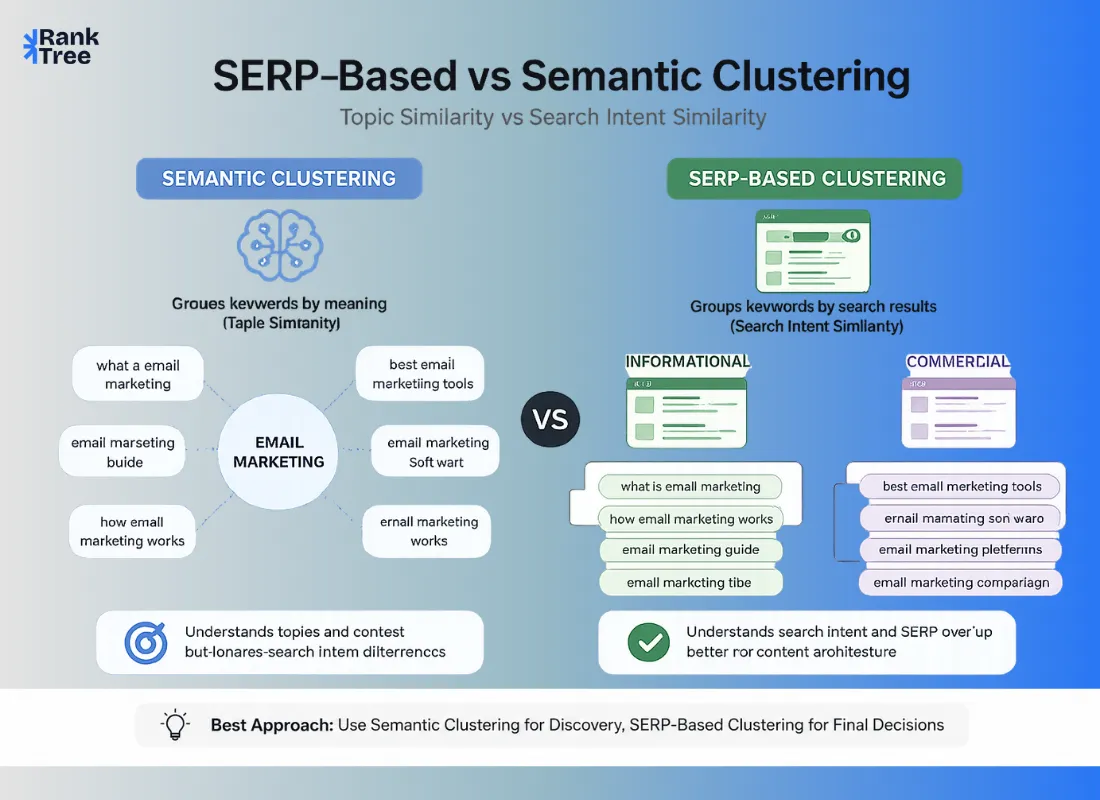
SERP-based clustering groups keywords based on shared Google search results while semantic clustering groups them based on meaning.
In simple terms:
- Semantic clustering = topic similarity
- SERP-based clustering = search intent similarity
For SEO content that ranks SERP-based clustering is more reliable because it reflects how Google actually groups queries.
Both methods group keywords. But they group them using completely different signals serving different stages of your SEO workflow and produce entirely different outcomes for your site architecture.
For SaaS websites picking the wrong method at the wrong stage is one of the biggest reasons content clusters fail to generate topical authority.
This article breaks down how each method works at a signal level where each one belongs in your workflow and how to combine them into a decision framework you can actually apply to your keyword list today.
SERP-based clustering groups keywords based on shared Google search results, while semantic clustering groups them based on meaning; semantic clustering measures topic similarity using NLP embeddings and cosine similarity, while SERP-based clustering measures search intent similarity by analyzing URL overlap in the top 10 results, typically using a Jaccard similarity threshold of 0.4 or higher to decide two keywords belong on one page.
Semantic clustering is intent-blind: it can group informational, educational, and transactional keywords like "what is a sales pipeline" and "sales pipeline software" into one bucket even though Google treats them as separate queries with different SERPs.
The most effective workflow uses both in sequence, semantic clustering first, to organize a large keyword list into broad topic buckets cost-effectively, then SERP-based clustering on each cluster's primary keyword to validate real search intent and make final page-level architecture decisions, since SERP data always overrules semantic similarity when the two disagree.
Factor | Semantic Clustering | SERP-Based Clustering |
|---|---|---|
Measures | Topic similarity (meaning) | Search intent similarity (SERP URL overlap) |
Method | NLP embeddings + cosine similarity | Top-10 URL overlap, Jaccard threshold ~0.4 |
Intent-aware? | No — intent-blind, can group different intents together | Yes — reflects how Google actually groups queries |
Best use | First pass: organize a large keyword list into broad topic buckets cost-effectively | Final validation: confirms which keywords actually belong on one page |
What Signal Does Each Method Actually Use?
Most comparisons explain what each method does but not why the underlying signal matters. These uses linguistic proximity. It groups keywords based on meaning using NLP embeddings.
Keywords with high cosine similarity are grouped together even if they don’t share exact words. For example “project management software” and “task tracking tool for teams” cluster together because they share semantic context.
SERP-based clustering uses Google’s ranking behavior. It analyzes the top 10 results for each keyword and measures URL overlap.
If “best CRM for startups” and “CRM software for small business” return similar ranking pages Google is signaling the same intent. This overlap is typically measured using Jaccard similarity.
The key insight: semantic clustering shows topic relationships while SERP clustering shows how Google interprets intent. These are not always the same. Two keywords can be semantically similar but still trigger completely different SERPs.
The Intent Blindness Problem in Semantic Clustering
Semantic clustering has one major weakness that matters enormously for SaaS content: it cannot distinguish between different stages of the buyer journey.
Consider these three keywords:
"what is a sales pipeline" (informational top of funnel)
"sales pipeline stages" (educational middle of funnel)
"sales pipeline software" (transactional bottom of funnel)
A semantic model will cluster all three together. They share overlapping entity relationships and sales pipeline stages. Linguistically they belong to the same topic bucket.
But Google treats them as three completely separate intents. The SERP for "what is a sales pipeline" returns educational blog posts and glossary pages.
The SERP for "sales pipeline software" returns comparison sites product pages and software review platforms.
Sending a user searching for software recommendations to a definitional blog post creates a mismatch that increases bounce rate and signals poor content relevance to Google.
If you build your content architecture purely on semantic clustering for a SaaS site you risk collapsing distinct funnel stages into a single page that serves none of them well.
Simple Example of SERP vs Semantic Clustering
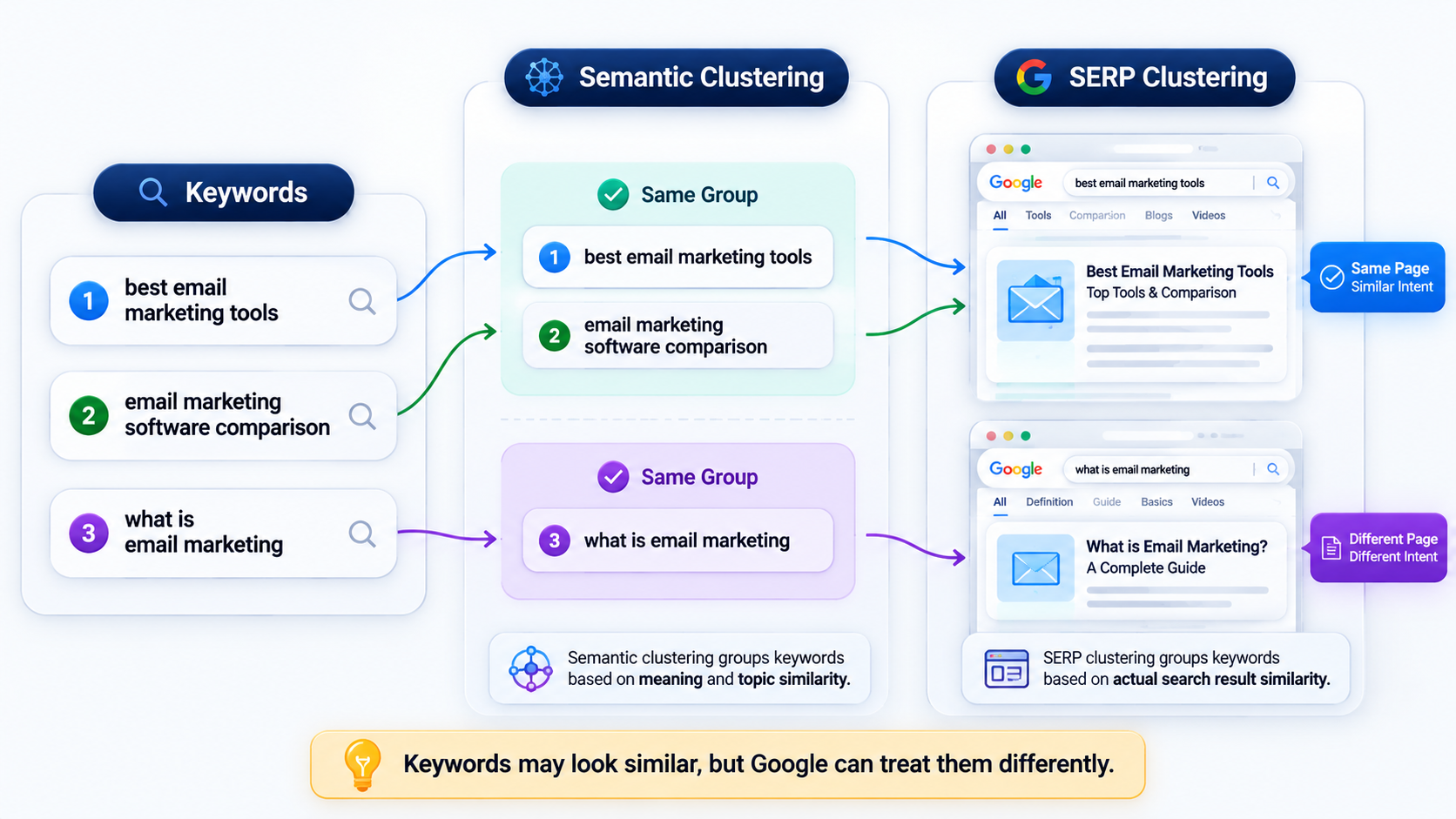
Let’s simplify this with a real example:
Keyword 1: "best email marketing tools"
Keyword 2: "email marketing software comparison"
Semantic clustering → Same group
SERP clustering → Same page (similar intent)
Keyword 3: "what is email marketing"
Semantic clustering → Same group
SERP clustering → Different page (different intent)
This is where most SEO mistakes happen. Keywords look similar but Google treats them differently.
Where SERP-Based Clustering Catches What Semantics Misses?
SERP-based clustering validates intent at the point where it matters most: your content architecture decisions.
The threshold most SEO practitioners use is a Jaccard similarity score of 0.4 or higher meaning at least 40% overlap in the top 10 results to decide that two keywords should target the same URL.
Below that threshold they likely need separate pages. For SaaS sites this has three practical applications:
1. Preventing cannibalization between feature pages and blog content
If your product page for “time tracking software” and a blog post like “best time tracking tools for remote teams” compete in the same SERP, SERP clustering will reveal it through overlapping URLs. Semantic clustering won’t catch this because both pages serve different purposes.
2. Validating pillar page scope
Before deciding whether “project management” should be one pillar or multiple pages SERP clustering shows how Google segments the topic. If subtopics share strong overlap with the main term one comprehensive page may work. If not, each needs its own page.
3. Identifying comparison page opportunities
“Salesforce vs HubSpot” and “HubSpot alternatives” are semantically close but can trigger different SERPs. SERP clustering shows whether they belong on the same page or represent separate content opportunities.
The Practical Workflow: Where Each Method Belongs
Neither method should be used alone. A common mistake is using SERP clustering for every keyword from the start which increases API costs and time or relying only on semantic clustering and ignoring real search intent signals.
The most effective workflow uses two stages:
Stage 1: Semantic Clustering for Scale and Discovery
Start with your complete keyword list even if it contains thousands of keywords. Use semantic clustering to group them into broad topic buckets.
This is cost-effective, can be done locally with pre-trained models and creates a manageable topic structure. At this stage the goal is not page-level planning but identifying which topics deserve deeper analysis.
Stage 2: SERP Clustering for Architecture Decisions
Take the primary keyword from each semantic cluster and run SERP-based clustering on those representative terms. This reduces API costs while providing Google validated insights for page-level decisions.
The result is a clear content map showing which keywords belong on the same page which need separate pages and where pillar cluster relationships exist.
For early stage SaaS websites this approach helps avoid over fragmenting content into multiple thin pages that may compete with each other before the site has enough authority to support them.
Which Clustering Method Should You Use for SEO?
Use semantic clustering for topic discovery and SERP-based clustering for final SEO decisions.
If your goal is to build a content structure that ranks SERP-based clustering should always guide your final page strategy.
Semantic clustering helps you understand what topics exist. SERP clustering tells you how to structure pages based on real search intent.
NLP Entities and Semantic Signals That Strengthen Both Methods
Regardless of the clustering method your content must cover the entities and semantic relationships Google associates with the topic.
For SaaS key entity categories include software types (CRM project management helpdesk tools) use cases (remote teams enterprises small businesses) outcomes (productivity efficiency ROI time savings) and integrations (APIs Zapier Slack native integrations).
Common LSI and co-occurring terms include free trial pricing plans feature comparison onboarding customer success churn reduction user adoption and subscription models. These are not for keyword stuffing they signal topical depth and relevance.
Search intent modifiers also guide which clustering method to prioritize. Terms like “best” “top” “vs” “alternative” and “review” indicate commercial intent and require SERP-based clustering.
In contrast queries like “how to” “what is” “guide” and “tips” align better with semantic clustering where broader topical coverage matters more than SERP similarity.
What the Hybrid Approach Looks Like for a SaaS Content Team?
If you're building a SaaS blog with limited time and resources a hybrid approach is often the most practical option.
Start by running your keyword list through semantic clustering. This will group related keywords into broad topics such as onboarding integrations pricing strategy feature adoption and customer success. These groups become potential pillar topics.
Next choose the main keyword from each group based on search volume and business value. Use SERP clustering on these key terms to see which related keywords should be covered on the same page and which need separate pages.
The result is a clear content structure where every page has a unique purpose. Pillar pages target the main topic while supporting cluster pages cover specific search intents that Google views as different queries.
This approach helps avoid a common SaaS SEO mistake: creating dozens of articles around the same topic that compete with each other divide internal link value and make it harder for Google to understand which page should rank for the primary keyword.
Common Mistakes When Choosing Clustering Method
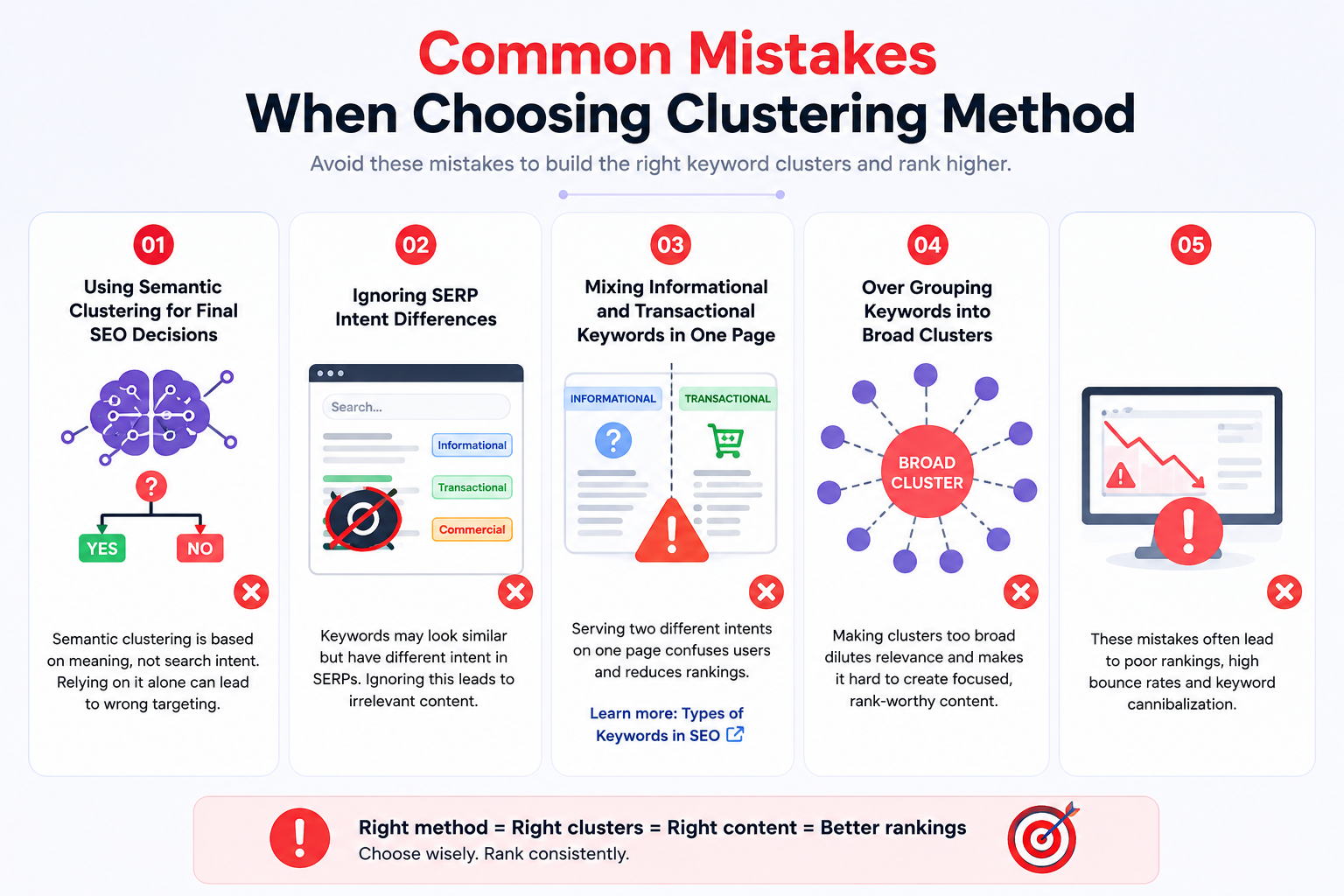
Even experienced SEO professionals make these mistakes:
Using semantic clustering for final SEO decisions
Ignoring SERP intent differences
Mixing informational and transactional keywords in one page. If you’re not sure how this types work you can check our guide on types of keywords in SEO.
Over grouping keywords into broad clusters
These mistakes often lead to poor rankings, high bounce rates and keyword cannibalization.
The One Question That Decides Which Method to Use?
When you're looking at two keywords and trying to decide whether they need one page or two ask this: Would Google show a user searching for keyword A the same results as a user searching for keyword B?
If yes same intent, same URL. SERP clustering confirms this with overlap data.
If no different intent, different URL. Semantic clustering would have grouped them but SERP data overrules it.
Semantic clustering answers: what is this topic related to?
SERP clustering answers: what does Google think this query is actually about?
For building content architecture that ranks the second question always takes precedence at the point of page-level decisions. Semantic clustering gets you to that decision point efficiently. SERP clustering makes the decision accurately.
Use both in that order.
FAQs
What is the main difference between SERP-based and semantic clustering?
SERP-based clustering groups keywords based on shared Google search results while semantic clustering groups them based on meaning. SERP reflects real search intent while semantic shows topical similarity.
Which clustering method is better for SaaS SEO?
A hybrid approach works best. Use semantic clustering for topic discovery and SERP-based clustering for final content architecture and intent validation.
Why is SERP-based clustering important for avoiding keyword cannibalization?
Because it identifies keywords that share ranking URLs helping you target them on a single page instead of creating multiple competing pages.
When should you use semantic clustering in your workflow?
Semantic clustering should be used at the early stage to organize large keyword lists into broad topic groups before applying SERP validation.
How do you know if two keywords should be on the same page?
If Google shows similar results for both keywords they can be targeted on one page. If the SERPs are different they require separate pages.
Related reads
Topic Clusters vs Keywords: Which SEO Strategy Actually Wins
Semantic Search vs Keyword Search: The Complete Decision Framework
Domain Clustering SEO: What It Is How It Works and How to Use It Strategically
RankTree Team — The RankTree team writes about SEO strategy, keyword clustering, and topical authority to help you build content that ranks.