Search Intent: How Google Understands What Users Really Want
By RankTree Team · 2026-07-16 · Updated 2026-10-14
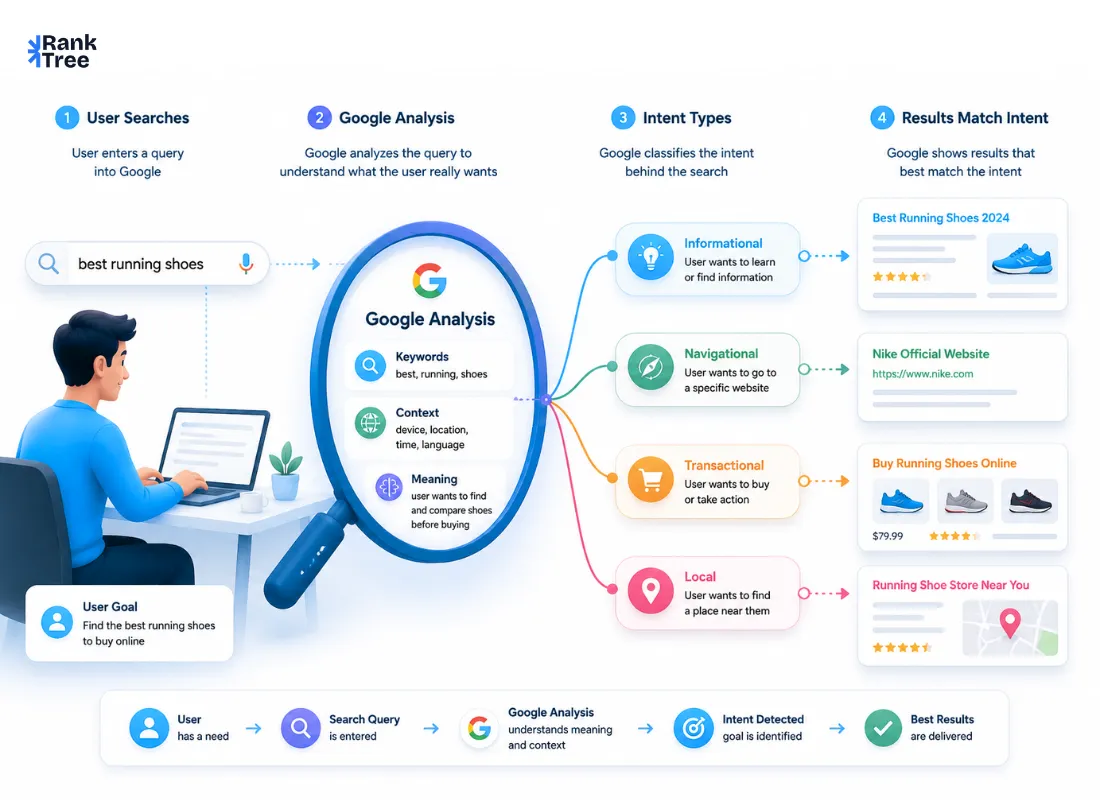
Every time someone searches on Google they are not just typing words they are expressing a goal. Before rankings backlinks or content quality are evaluated Google first tries to understand what that person actually wants.
This process is called search intent.
In this guide you’ll learn how Google interprets queries, how it uses context and behavior signals and how it decides what type of results to show before SEO even comes into play.
Search intent is the underlying purpose behind a person's query, a property of the searcher rather than the keyword itself, since the same words can carry different intent depending on who is searching and when.
Google establishes it before evaluating rankings, backlinks, or content quality: it parses the query, interprets meaning through semantic understanding and natural language processing rather than literal word matching, layers in contextual signals like location, device, time and search history, then classifies the result into one of four categories from its Search Quality Evaluator Guidelines, Know, Do, Website, and Visit-in-person.
Results are matched against that determined intent, not the query text, which is why two similarly worded searches can return very different result types.
Because intent is dynamic rather than a fixed label, ambiguous queries can produce mixed-intent SERPs blending guides, comparisons, and product links, and ranking volatility itself often signals that Google is still testing which content best satisfies an unclear intent.
What Is Search Intent?
It's important to be precise here: user intent is not a property of a keyword. It's a property of the person searching. The same string of words can carry different intent for different users in different moments in different contexts.
User goal is the human side of the equation what someone wants before any SEO classification is ever applied to it.
Google's own documentation on ranking systems states plainly that before it can return relevant results it first has to establish what the searcher is actually looking for. Everything else in the ranking process happens after that determination is made.
What Happens When Someone Searches?
To understand how Google analyzes intent it helps to walk through what actually happens in the few milliseconds after a query is submitted.
1. The query is parsed. Google breaks the search phrase down identifying individual words, their grammatical role and how they relate to each other in the sentence.
2. The meaning is interpreted not just the words. Rather than matching the literal text to pages containing those exact words Google's systems interpret what the phrase means including synonyms related concepts and common variations in how people phrase the same need.
3. Context is layered on top of the query. Google factors in signals beyond the words themselves: the searcher's location, the device they're using, the time of day, their language and where available their recent search history and interaction patterns.
4. Intent is classified. Based on the interpreted meaning and available context Google forms a working determination of what the user wants: to learn something to complete an action to reach a specific site or to find a physical place.
5. Results are matched against that intent not just the query text. Pages are selected and ranked based on how well they satisfy the determined intent which is why two searches with similar wording can return very different types of results.
This entire process happens before relevance authority or content quality are even evaluated. Intent detection is the first filter every search passes through.
How Google Analyzes and Interprets Intent?
Semantic Understanding
Google doesn't rely on exact keyword matching anymore; it relies on semantics and the interpretation of meaning. This allows it to recognize:
Synonyms and equivalent phrasing treating "affordable phone" and "budget smartphone" as expressing the same need
Disambiguation correctly identifying which meaning of an ambiguous word applies in context (e.g. "Java" as a place a drink or a programming language)
Entity relationships understanding how a brand person place or concept in the query connects to other related entities
Natural phrasing variation recognizing "how to fix a leaking tap" and "leaking faucet repair" as the same underlying request
This semantic layer is built using natural language processing (NLP) which allows Google's systems to interpret a query the way a person would read it as a sentence with meaning rather than as a string of disconnected keywords.
Signals Within the Query Itself
Certain words and phrasing patterns act as direct intent signals that Google's language models are trained to recognize:
Words like "how" "what" "why" or "guide" typically signal a desire to learn
Words like "best" "top" "review" or "compare" typically signal evaluation between options
Words like "buy" "order" "download" or "price" typically signal readiness to act
Brand names product names or phrases like "login" typically signal the searcher wants to reach a specific destination
Word order matters here too. "Ingredients for dog food" and "dog food ingredients" use nearly the same words but Google interprets them as reflecting different needs based on how the phrase is structured.
Contextual Signals Beyond the Query
Two people can type the identical query and still receive results shaped by different intent signals because Google also factors in:
Location plays a key role. A search like “coffee shop” on a mobile device often implies a nearby place, even without “near me.”
Device matters too; mobile searches are more likely to show local or action-based results compared to desktop.
Time influences intent searching “pizza places” at night suggests immediate action, while the same search in the morning may not.
Search history and session behavior help clarify unclear queries by using recent user activity.
User behavior data at scale also matters. Google analyzes clicks and engagement across millions of searches to understand which results best satisfy users and continuously refine its understanding.
Ambiguous and Evolving Intent
Not every query has a single stable intent. Google accounts for this in two ways:
Mixed intent recognition
When a query serves multiple goals Google shows different types of results on one page such as guides comparisons and product links. This reflects that users may want different outcomes from the same query.
Ranking volatility as an intent signal
Stable intent leads to stable rankings. But when intent is unclear or changing rankings fluctuate as Google tests which content best satisfies users.
The Categories Google Uses to Classify Intent
Google's Search Quality Evaluator Guidelines define four core intent categories that its systems and human evaluators use to describe what a searcher wants:
Know the user wants to learn something or find information
Do the user wants to complete an action or activity
Website the user wants to reach a specific site or page they already have in mind
Visit in person the user wants to find a specific business organization or physical location
These categories describe the searcher’s goal not a keyword label. The same query can have different intent depending on the user and context so Google applies this framework on a per search basis.
Visit in person intent is especially important because it reflects real world action. When detected Google prioritizes maps business listings and local pages over general content even if “near me” isn’t mentioned.
Search Intent vs. Keyword Intent: What's the Difference?
These two terms are closely related but describe different things and it's worth being precise about the distinction.
Search intent is the actual real time goal a specific person has at the moment they search the phenomenon Google is trying to detect and satisfy for every individual query using semantic context and behavioral signals as covered throughout this guide.
Keyword intent on the other hand is how SEO professionals interpret that intent when analyzing keywords and planning content.
In simple terms user intent is what users actually want while keyword intent is how SEOs interpret and apply that understanding in content strategy.
Understanding search intent is what makes keyword intent classification accurate instead of guesswork.
How Search Intent Shapes Google Rankings Before SEO Starts?
Search intent is the first filter in Google’s ranking system. Before evaluating content quality or backlinks Google determines what the user wants.
If intent is informational Google prioritizes guides and explanations. If intent is transactional it shows product pages or tools. If intent is local it shows maps and nearby results.
This means ranking is not just about optimizing content but about matching the intent Google has already identified.
Why This Distinction Matters?
Treating search intent as something Google actively detects and interprets rather than a static label changes how you think about search behavior:
The same query can represent different intent for different users which is why mixed intent and blended SERPs are common not exceptions
Context (location device time history) is often as influential as the words in the query itself
Intent isn't fixed it can shift over time as user behavior changes which is part of why Google continuously re evaluates ranking volatility for ambiguous queries
Search engines are increasingly interpreting entire natural language requests not isolated keywords which is accelerating with the rise of AI driven search and conversational queries
How AI Is Changing the Nature of Search Intent?
With the rise of AI assistants and AI Overviews the way people express intent is evolving. Users now rely more on longer natural language queries that combine multiple goals in a single request.
For example asking an AI tool to compare products and recommend the best option blends learning and decision making together.
This doesn’t change what query intent is it’s still the underlying goal behind the request. What’s changing is how that goal is expressed and how complex it has become.
Systems now need to interpret layered conversational inputs and identify multiple intents within one query instead of classifying short keyword based searches into a single category.
Final Thoughts
Search intent is the reasoning Google performs before anything else happens in the ranking process reading meaning into a query layering in context and forming a determination about what a real person actually wants.
It's a dynamic per search phenomenon rooted in semantic context and behavior not a static label attached to a keyword.
Understanding it at this level how Google actually detects and interprets intent is the foundation everything else in search behavior is built on.
FAQs
Is search intent the same as keyword intent?
No. User intent is the real time goal behind a search. Keyword intent is the SEO practice of labeling keywords based on what most users are likely looking for.
Can the same search have different intent for different people?
Yes. Because Google factors in context like location device and search history identical queries can be interpreted with different intent depending on who is searching and when.
How does Google know what a user wants without them stating it directly?
Through a combination of semantic analysis (interpreting the meaning of the query) contextual signals (location device time history) and aggregated behavioral data from how searchers have historically interacted with results for similar queries.
What are the four categories Google uses to classify intent?
Know Do Website and Visit in person corresponding to learning something completing an action reaching a specific site and finding a physical location respectively.
Why do some search results show a mix of content types?
Because Google has recognized that the query carries mixed intent, different searchers typing the same words are likely looking for different things so Google blends result types to satisfy the range of goals behind that query.
What's the difference between "search intent" and "keyword intent"?
As covered above, they're related but not identical: search intent is the user's actual real-time goal, while keyword intent is how SEO professionals label and interpret that goal when analyzing keywords and planning content. "Keyword search intent" is usually just another way of saying "the intent behind a keyword." Whichever term you use, the same four categories (Know, Do, Website, Visit-in-person) apply, and clustering keywords by that shared intent — not just by shared words — is what determines whether one page can rank for all of them.
In this guide
- Transactional Intent Keywords: Find, Target & Convert Them
- Informational Intent: The Complete Guide
- Navigational Search Intent: How to Identify and Optimize It
- Generative AI Intent: Understanding AI-Driven Intent in SEO
- Commercial Intent Keywords: The Complete Guide
- Local Search Intent: What It Is and How to Optimize for It
RankTree Team — The RankTree team writes about SEO strategy, keyword clustering, and topical authority to help you build content that ranks.