Content Gap Analysis: How to Find & Fix Missing Content
By RankTree Team · 2026-08-10 · Updated 2026-10-14
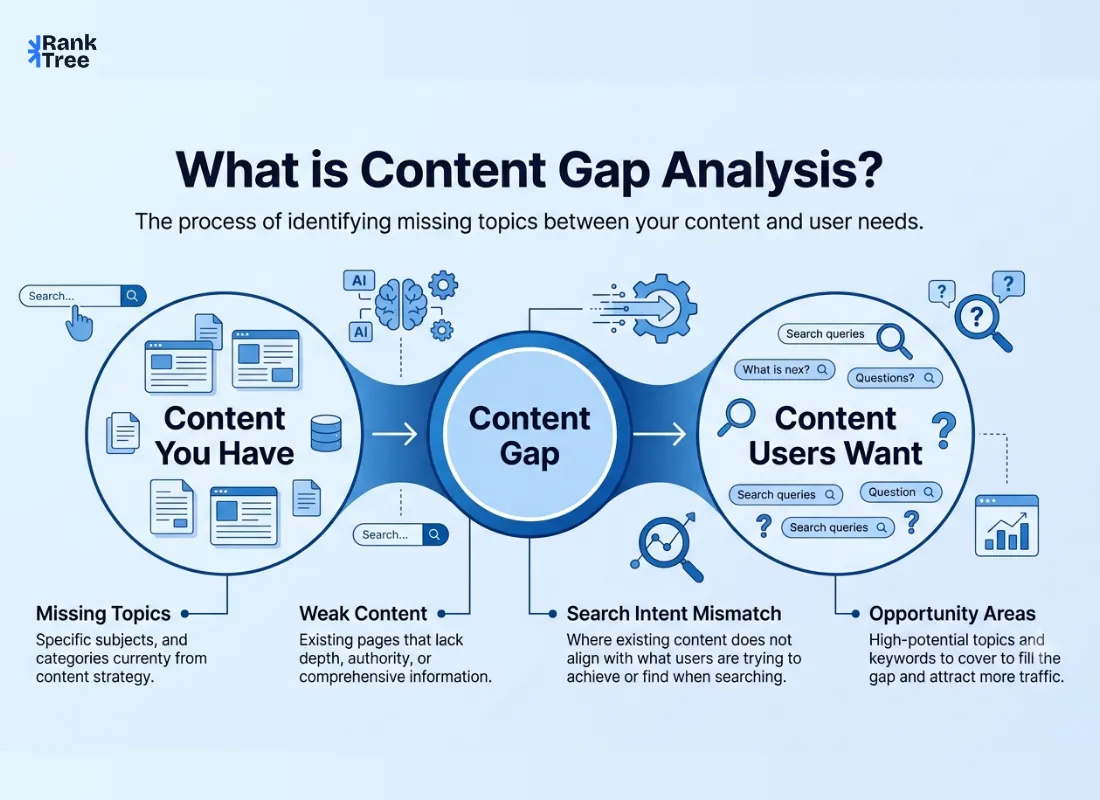
Most content gap analysis guides assume one thing: you already have a large content library. They tell you to compare pages, run reports and fill in missing keywords, often treating it as a basic step before creating a proper content brief.
But what if your site is new? What if you don’t have enough content to audit? In that case traditional methods don’t just fail, they mislead you.
This guide solves both problems. You’ll learn how to run a content gap analysis whether you have hundreds of pages or you’re starting from zero.
You’ll also learn how to prioritize gaps, identify structural weaknesses and uncover opportunities beyond traditional search including AI driven visibility.
A content gap is a topic, subtopic, or search intent that your competitors cover and your audience searches for but your own site doesn't address or covers too thinly to rank.
Content gap analysis is the process of finding and fixing those gaps systematically: analyzing competitor coverage identifying missing or weak pages checking search intent against what's actually ranking, auditing AI visibility in tools like ChatGPT, researching real audience language from forums and reviews, evaluating content structure and checking for originality.
Gaps are prioritized using Score = Demand × Competition Weakness × Business Fit, so a moderately searched topic with weak outdated competition and strong product relevance can outscore a high-volume topic dominated by established competitors.
It sits in the SEO flow after keyword research and clustering but before writing a content brief, and should be rerun quarterly since competitor coverage and SERP feature ownership shift over time.
What Is Content Gap Analysis?
Content gap analysis is the process of identifying and fixing missing or weak areas in your content based on user intent competition and real search behavior.
If you want a deeper understanding of what a content gap actually is see our detailed guide on content gaps.
Why Content Gap Analysis Matters?
Content gap analysis is not just about finding missing topics. It directly impacts how well your content performs in search engines and AI generated results.
When done correctly it helps you:
Cover topics your audience is actively searching for
Improve existing content instead of constantly creating new pages
Increase your chances of ranking in Google
Improve visibility in AI tools like ChatGPT and Perplexity
Most importantly it ensures your content aligns with real user needs instead of just keywords.
How to Do Content Gap Analysis? (Step by Step)
Step 1: Find Content Gaps Using Competitor Analysis
Start by analyzing what your competitors are covering.
Look for:
Topics they rank for that you don’t
Pages that consistently appear in top results
Content themes across multiple competitors
This gives you a high level map of your niche.
Step 2: Identify Missing Content Gaps and Weak Pages
Now compare their coverage with yours.
Focus on:
Topics you haven’t covered at all (missing gaps)
Pages where you rank lower (quality or intent gaps)
Content that exists but performs poorly
These are your immediate opportunities.
Step 3: Analyze Search Intent to Find Hidden Gaps
Search your target topics on Google and study top ranking pages.
Ask:
What type of content is ranking? (guide list tool comparison)
What questions are being answered?
How detailed is the content?
If your content doesn’t match this intent, it won’t rank no matter how many keywords you add. That’s why it’s important to clearly understand keyword intent and how different keywords behave.
Step 4: Check AI Visibility Gaps
Search your topic in AI tools like ChatGPT or Perplexity.
Look for:
Which brands are mentioned
Which pages are cited
Whether your site appears
If you’re missing, compare your content with cited sources.
Often the gap is not the topic, it's clarity, structure or specificity.
Step 5: Research Real Audience Needs
Go beyond tools.
Use:
Forums and communities
Product reviews
Customer questions
Social discussions
Look for recurring problems, doubts and comparisons.
These insights often reveal gaps competitors are also missing.
Step 6: Evaluate Content Structure
Sometimes the problem is not what you wrote but how you wrote it.
Check:
Clear heading hierarchy (H1 → H2 → H3)
Direct answers immediately after headings
Easy to scan sections
If your content is hard to extract both users and AI systems will ignore it.
Step 7: Identify Originality Gaps
Compare your content with top ranking pages.
If your content says the same thing as everyone else it won’t stand out.
To fix this add:
Real examples
First hand insights
Data or case studies
Simple frameworks
Original value is often the difference between ranking and being ignored.
How to Do Content Gap Analysis for New Websites?
If your site has little or no content, skip traditional audits. Instead focus on building from scratch.
Start by mapping topics across competitors not copying them but understanding the full scope of your niche.
Then validate those topics using real audience language from forums and communities.
Finally prioritize opportunities where:
Competition is weak
Content is outdated
Coverage is shallow
For new sites low competition topics are far more valuable than high volume keywords.
How to Prioritize Content Gaps?
Finding gaps is easy. Choosing the right ones is the real challenge.
Use this simple scoring model:
Score = Demand × Competition Weakness × Business Fit
Factor | Description |
Demand | How much interest exists |
Competition Weakness | How strong current content is |
Business Fit | How relevant it is to your product |
Example:
High demand + weak competition + strong relevance = best opportunity
High demand + strong competition + low relevance = poor choice
This approach ensures you focus on impact, not just volume.
Where Content Gap Analysis Fits in SEO Strategy?
Content gap analysis is not the first step in SEO. It sits after keyword research and before content creation.
The flow looks like this:
Keyword Research → Keyword Clustering → Content Gap Analysis → Content Brief → Content Creation
Without this step you risk creating content that overlaps misses intent or fails to compete.
Turning Findings Into a Content Plan
Once gaps are identified and scored sort them into three action types rather than treating every gap as "write a new page":
New page: for topics missing entirely with a strong opportunity score
Expand or restructure: for pages that exist but are thin unstructured or hard to extract
Differentiate: for pages that are structurally fine but say nothing unique compared to what's already ranking
This turns a long list of gaps into an actual production plan instead of an undifferentiated backlog.
Don't Overlook SERP Feature Gaps
Beyond the ranked list of blue links most results pages now include features like featured answer boxes, question and answer accordions and image carousels and competitors can own these spots even on queries where your organic position is comparable to theirs.
When reviewing a topic note which SERP features currently appear and who occupies them.
If a competitor holds the featured answer box for a term you're both targeting, check whether their content uses a tighter, more directly answered format near the top of the page than yours does.
Winning back or capturing that feature often has more to do with how concisely the answer is stated than with adding more content overall.
Common Mistakes to Avoid
Many websites fail at content gap analysis because they:
Focus only on keywords
Ignore search intent
Copy competitor structure
Skip originality
Don’t prioritize effectively
Avoiding these mistakes gives you a major competitive advantage.
A Worked Example of the Scoring Method
Say a SaaS company evaluating topics for its blog has three candidates on the table:
Topic A: high search demand but the top ranking pages are thoroughly and recently updated and written by established competitors. Business fit is moderate. Score: demand 3 × competition weakness 1 × business fit 2 = 6
Topic B: moderate demand but the current top results are three years old and thin. Business fit is strong; it maps directly to a core product feature. Score: 2 × 3 × 3 = 18
Topic C: low demand, weak competition but only loosely related to the product. Score: 1 × 3 × 1 = 3
Topic B wins clearly despite lower raw search volume than Topic A because the combination of weak competition and strong business relevance makes it a far more efficient target for a smaller site trying to build early traction.
This is the kind of decision the scoring method makes explicitly instead of leaving to instinct.
Keeping This a Recurring Process
Treat this as a quarterly check rather than a one time project for two reasons. First competitors keep publishing so today's whitespace narrows over time.
Second, a page you wrote for a gap that existed six months ago can develop a new gap of its own if a competitor has published something more thorough on the same topic.
FAQs
Can a page have multiple gaps?
Yes. A page can be relevant but still thin, unoriginal or poorly structured. Fix structure first to identify the main issue.
Should a new site fix every gap before publishing?
No. Prioritize high opportunity topics using a scoring framework. Strong content momentum matters more than complete coverage.
Is search volume the main prioritization factor?
No. A high volume topic with strong competition may be harder than a moderate volume topic with weak competitors. Consider demand competition and business fit together.
What tools help in identifying content gaps?
Tools like Google Search Console, Ahrefs, SEMrush and RankTree help identify missing keywords, topics and content opportunities.
What is a content gap?
A content gap is a topic, subtopic, or search intent that your competitors cover — and that your audience searches for — but your own site doesn't, or covers too thinly to rank. Content gap analysis is the process of finding those gaps systematically, as covered above, so you can prioritize what to create next.
In this guide
- Keyword Gaps: Why Checking Only One Direction Misses Half the Picture
- Semantic Keyword Gaps in SEO: Fix the Missing Piece
RankTree Team — The RankTree team writes about SEO strategy, keyword clustering, and topical authority to help you build content that ranks.