Semantic Search vs Keyword Search: The Complete Decision Framework
By RankTree Team · 2026-08-01
Part of the Search Intent: What It Is and How Google Analyzes What Users Really Want guide →
Type "database slowdowns" into your search bar and expect results about "performance optimization." Type an exact product code like "SKU 2847 B" and expect that exact code not something similar.
Most search systems can't do both well and that single limitation is why so many teams end up rebuilding their search stack six months after launch.
Because search engines no longer rely only on keywords. They understand the meaning. This is where the real battle begins: semantic search vs keyword search.
If you don’t understand the difference you’ll keep missing rankings, traffic and authority.
In this guide you’ll learn exactly how semantic search and keyword search work, their differences and how to use both together to win in modern SEO..
What is Keyword Search?
Keyword search is a method where search engines match the exact words or phrases entered by the user with the content on web pages.
It is the traditional way of searching where if your content contains the same keywords as the query it has a chance to rank.
However, keyword search does not understand the meaning. It only looks for direct word matches which means similar phrases with different wording may not be recognized.
In simple terms keyword search focuses on matching exact words.
What is Semantic Search?
Semantic search focuses on understanding the meaning, intent and context behind a search query instead of just matching exact words.
It uses technologies like AI NLP and machine learning to analyze how words are related and what the user actually wants to find.
For example a query like “best ways to fix slow websites” can match content about “improving site speed” even if the exact words are different.
In simple terms semantic search focuses on understanding meaning rather than just words.
Semantic Search vs Keyword Search: Side by Side
Dimension | Keyword Search | Semantic Search |
Matching logic | Literal word/phrase match via inverted index | Meaning based match via vector embeddings |
Handles synonyms/paraphrasing | No | Yes |
Exact identifiers (SKUs IDs codes) | Excellent | Unreliable |
Determinism | Fully reproducible | Can shift with model updates/retraining |
Infrastructure cost | Low | Higher (embedding generation vector index often GPU) |
Latency at scale | Very fast | Fast with ANN (HNSW); slower with brute force |
Cross language matching | No | Yes |
Multimodal support (image audio) | No | Yes with the right embedding model |
Ranking method | BM25 / TF IDF | Cosine similarity / dot product |
Best environment | Internal tools compliance structured data | Customer facing search RAG conversational interfaces |
How Google uses semantic search in ranking?
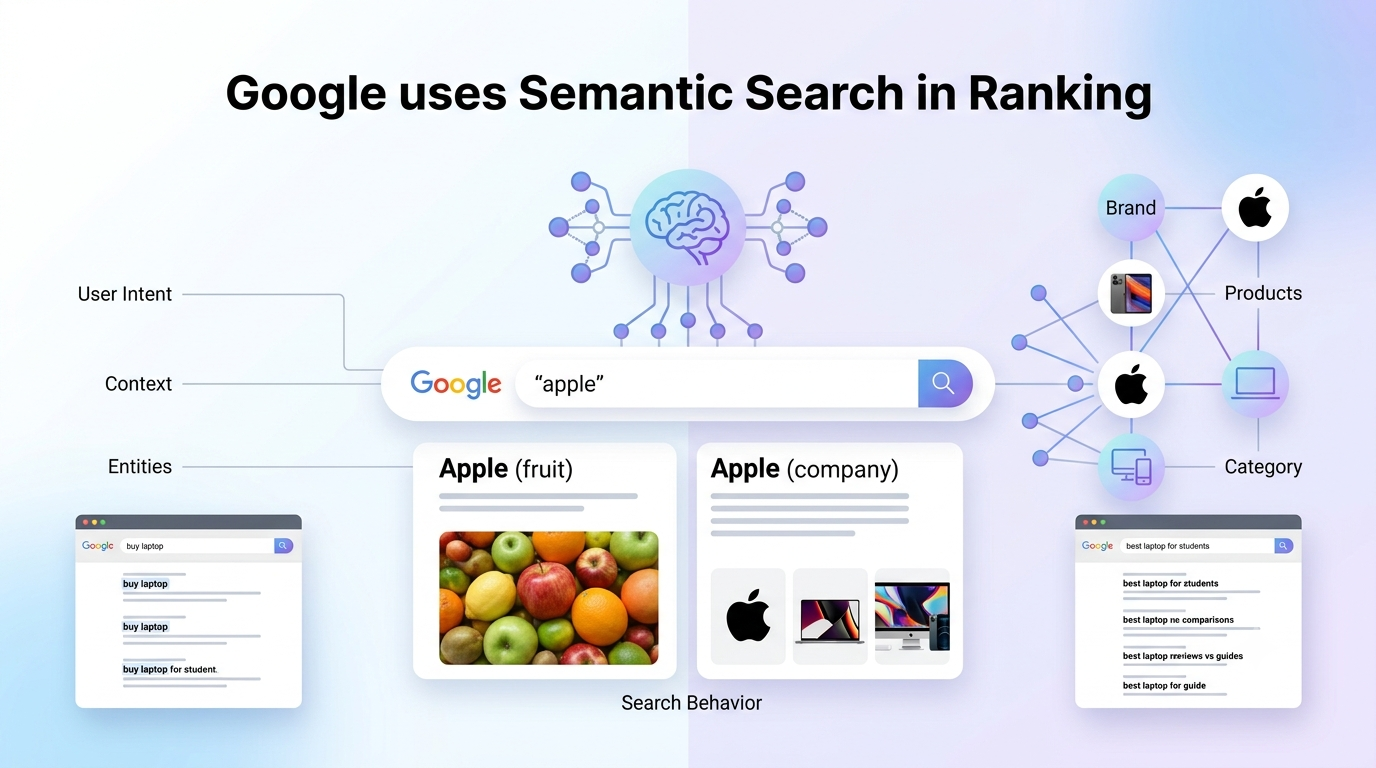
Google uses semantic search to understand queries beyond exact keywords and deliver more relevant results.
With updates like Hummingbird, RankBrain and BERT Google started analyzing search intent context and entity relationships instead of just matching keywords.
When a user searches for something Google evaluates multiple signals:
User intent behind the query
Context of the search
Entities and relationships between topics
Previous search behavior
For example if someone searches “apple” Google determines whether the user means the fruit or the company based on context. This is semantic search in action.
Google also uses knowledge graphs to connect entities like people, places , brands and concepts. This helps it deliver more accurate and meaningful results.
That’s why modern SEO requires content that covers topics deeply instead of just repeating keywords.
Real Query Walkthroughs
Query: "best restaurants open near me right now" Semantic search interprets "near me" using location cross references "right now" against business hours and understands "best" as an implicit quality signal combining several contextual layers keyword matching can't touch.
Query: order_id: 48213590 Keyword search wins outright. This is a literal identifier; semantic similarity adds nothing and can actually hurt precision by pulling in "similar looking" but wrong order IDs.
Query: "why is my Redis instance running out of memory" Semantic search connects this to documentation about eviction policies and maxmemory configuration even if the article never uses the word "instance" or phrases things exactly this way.
Query: report Q3 2024 Keyword search retrieves only documents containing that literal phrase it won't find a document titled "Third Quarter Summary 2024" unless hybrid or semantic methods are layered in.
When to use semantic vs keyword search in SEO?
Both semantic search and keyword search have specific roles in SEO and understanding when to use each is critical.
Keyword search works best when precision is required. It is useful for targeting exact queries like product names, SKUs, technical terms or specific phrases.
Semantic search works best when users search in natural language. It is ideal for blog content informational queries and broad topics where intent matters more than exact words.
In SEO strategy keyword search helps you identify target queries while semantic search helps you expand those queries into topics, entities and related concepts.
If you only focus on keyword search your content will be limited. If you only focus on semantic search you may lose precision. The real power comes from combining both.
Semantic search vs keyword search for content strategy
In modern content strategy semantic search vs keyword search is not a choice. It is a combination.
Keyword search is used to find primary keywords search volume and ranking opportunities.
Semantic search is used to build topic depth, cover related entities and improve relevance.
For example if your primary keyword is “SEO tools” keyword search gives you the main term.
Semantic search expands it into:
best SEO tools for beginners
SEO tools for keyword research
technical SEO tools
AI SEO tools
This creates a complete content ecosystem instead of a single page. This approach improves topical authority which is a major ranking factor in Google.
It also increases your chances of appearing in AI search results like Google AI Overviews and ChatGPT answers.
Why modern SEO needs both (Hybrid approach)?
Modern SEO works on a hybrid model that combines semantic search and keyword search.
Keyword search ensures your content targets the right queries. Semantic search ensures your content satisfies user intent and provides complete answers.
When you combine both you create content that is:
Relevant to search queries
Optimized for user intent
Rich in entities and context
Structured for AI understanding
This hybrid approach is what allows websites to rank higher, get featured snippets and appear in AI generated results.
Search engines today reward content that is both keyword optimized and semantically rich.
Common mistakes in semantic search vs keyword search
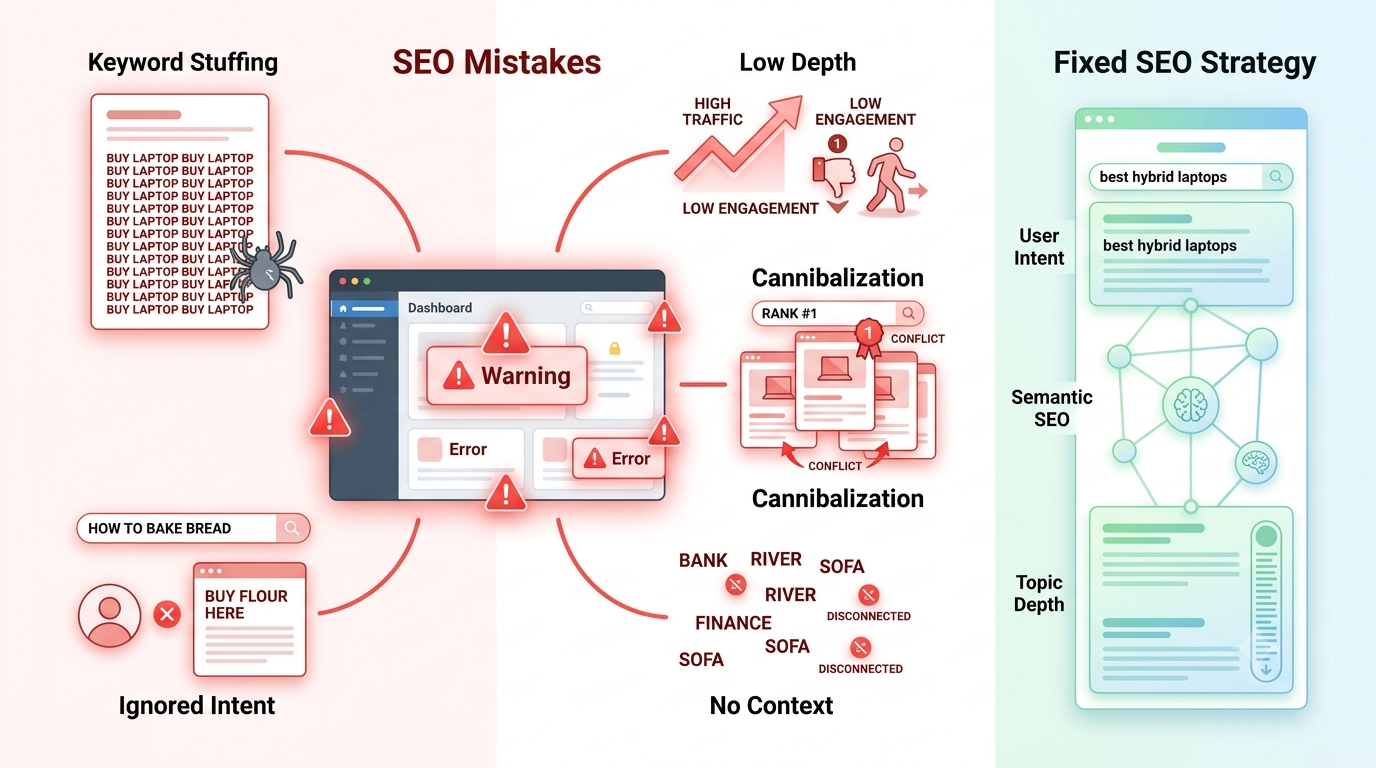
Many websites fail because they misunderstand how semantic search vs keyword search works.
One common mistake is keyword stuffing. Repeating the same keyword multiple times no longer improves rankings and can even harm your SEO.
Another mistake is ignoring search intent. Even if your content contains the right keywords it won’t rank if it doesn’t match user intent.
Some websites focus only on high volume keywords without building topic depth. This results in weak content that cannot compete with authoritative pages.
Another major mistake is creating multiple pages for similar keywords leading to keyword cannibalization.
Finally many people ignore semantic SEO completely. They don’t use related terms, entities or context which makes their content less relevant in modern search.
Avoiding these mistakes is essential if you want to compete in today’s SEO landscape.
Conclusion
Understanding semantic search vs keyword search is essential for modern SEO success. Keyword search helps you target specific queries while semantic search helps you understand user intent and build meaningful content.
Search engines are no longer just matching words. They are interpreting meaning, context and relationships.
To succeed you need to move beyond traditional keyword strategies and adopt a hybrid approach that combines both methods.
When you create content that is optimized for keywords and enriched with semantic context you improve rankings, increase traffic and build long term authority.
FAQs
What is the main difference between semantic search vs keyword search?
Semantic search focuses on meaning and intent while keyword search focuses on exact word matching.
Is semantic search better than keyword search?
Semantic search is more advanced but both are important. The best results come from using both together.
Does Google use semantic search?
Yes Google uses semantic search through technologies like BERT and knowledge graphs to understand queries better.
Should I stop using keywords in SEO?
No keywords are still important. You should combine keyword optimization with semantic SEO.
How do I optimize for semantic search?
Focus on user intent, use related terms and entities and create in depth content that fully answers user queries.