Secondary Keyword: Why Top Pages Rank for More Than One Term
By RankTree Team · 2026-07-15 · Updated 2026-10-07
Part of the 15 Types of Keywords in SEO Everyone Must Know guide →
Here's a number that changes how most people think about content: the page sitting at position one for a given search term usually ranks for hundreds of other queries too not because someone targeted all of them but because the page was built with enough depth to earn them naturally.
That's the real value of a secondary keyword, the related complementary term that sits underneath your main topic.
This guide focuses on the practical side most explanations skip: how to actually find these terms with data instead of guesswork, how to tell them apart from concepts they get confused with and how to map them so they strengthen a page instead of diluting it.
A secondary keyword is a related search term that shares the same intent as a page's primary keyword, covering variations of the same topic so one well-built page can satisfy all of them instead of just the exact phrase it was built around. This is why the page ranking first for a given term usually ranks for hundreds of other queries too, not because someone targeted each one individually, but because the page was built with enough topical depth to earn them naturally. Finding these terms reliably means checking what already ranks together for top pages, analyzing a competitor's full keyword list, filtering by match type starting with phrase matches, and using a clustering tool to group queries by intent automatically. A secondary keyword differs from a related concept, which adds context but has different intent and needs its own page, and from a long tail phrase, which is defined by length and volume rather than its relationship to the main topic.
What Counts as a Secondary Keyword?
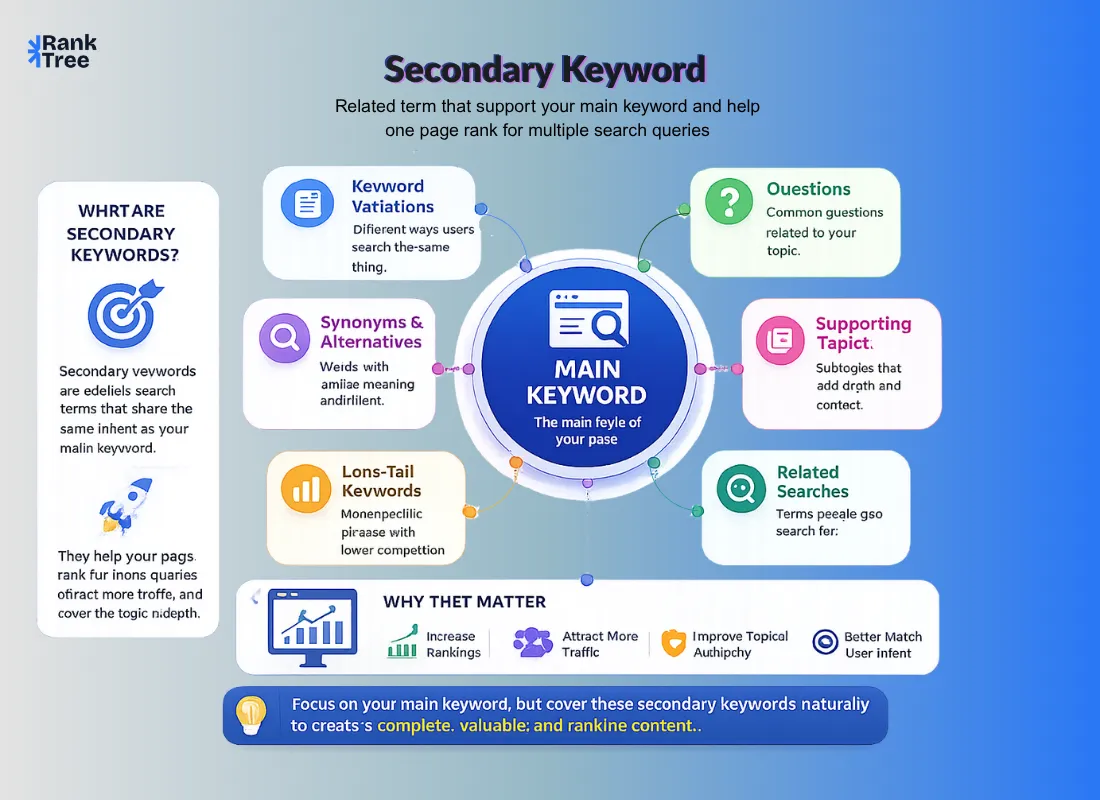
A secondary keyword is a related search term that shares the same intent as your primary keyword. It helps a single page rank for multiple queries by covering variations of the same topic instead of targeting just one phrase.
Someone searching any of these variations is looking for essentially the same answer which is why one well built page can satisfy all of them at once.
The confusion usually isn't about the definition, it's about where the line sits between this kind of term, a related concept and a long tail phrase.
We'll untangle that shortly because getting it wrong leads to either thin pages or wasted effort chasing terms that will never rank together.
Why This Actually Moves Rankings Not Just Traffic?
Search engines don’t just check for exact keywords. They evaluate how well your content covers the full topic including subtopics related terms and follow up questions.
This is where traffic potential matters. Instead of focusing on a single keyword’s volume it reflects the total traffic a page earns from all the queries it ranks for.
A keyword might have 200 monthly searches but the top ranking page can attract thousands of visits by ranking for multiple variations. The difference comes from how deeply the topic is covered.
In simple terms a page focused on one phrase limits growth while a page built with real topic depth multiplies traffic.
Clearing Up the LSI Myth First
“LSI keywords” are often misunderstood. Latent Semantic Indexing is an outdated concept with no confirmed role in modern search rankings. What people usually mean by it is simply related terms.
The takeaway is simple: don’t chase so called LSI keywords. Focus on real supported keywords backed by data and include relevant concepts that naturally strengthen your topic.
Four Ways to Find a Supporting Keyword With Data (Not Guesswork)
1. See what already ranks together
Check which keywords top ranking pages already rank for. If multiple terms drive traffic to the same URLs they likely belong on a single page.
Most SEO tools show this in “also ranks for” or clustering reports these are proven keyword groupings not guesses.
2. Analyze a competitor’s full keyword list
Take a high ranking page and extract all its keywords sorted by volume. This reveals new keyword variations and shows which subtopics are strong enough to rank. It’s especially useful for identifying gaps in your own content.
3. Use match type filtering
Keyword tools return large messy lists. Filter them by match type:
Broad matches → variations with extra modifiers
Phrase matches → close versions of your main keyword
Start with phrase matches to find the most relevant and usable related keywords.
4. Use keyword clustering tools like Ranktree
Instead of manually sorting keywords use a clustering tool like Ranktree to automatically group related queries by intent.
It helps you quickly identify which keywords belong together and which ones should act as supporting keywords saving time and removing guesswork without changing your workflow.
5. Check term frequency across competitors
Analyze which words and phrases appear frequently across top ranking pages but are missing from yours.
This highlights important terms that signal topical depth even if they don’t have standalone search volume.
Secondary Keyword vs. Related Concept Not the Same Thing
This is where most content strategies go wrong. A related concept is an idea connected to your topic but not always a searchable query. For example in an invoicing software guide "accounts receivable" adds context and signals expertise.
However, mentioning it won’t help you rank for that term because the intent is different. If you want to target it it needs its own page.
Supporting keywords are different. They share the same intent as your main topic which means one well structured page can rank for both without creating separate content.
Secondary Keyword vs. Long Tail Phrase Also Not the Same Thing
A long tail phrase is defined purely by length and specificity, usually a longer more specific version of a broader term often with lower individual search volume.
Whether something counts as a supported term has nothing to do with how long the phrase is. It's about its role relative to your main topic.
A short phrase can function as a related keyword. A long highly specific phrase can too. The two classifications answer different questions and can overlap freely.
Checking for Overlap Before You Publish
Before a new page goes live check whether an existing page on your own site already ranks for or is targeting the same cluster of terms.
If two pages are competing for the same handful of related phrases, search engines often struggle to decide which one deserves to rank and both can end up performing worse than a single consolidated page would.
This check matters just as much when updating old content as it does when publishing new pages. A quick way to catch it: search your own site for the exact term you're about to target and see what already surfaces — see our guide on how primary and secondary keywords work together for the bigger picture.
Where the Real Mistakes Happen ?
Treating keyword tools like a checklist. Not every term needs to be added word for word. These tools highlight important topics, not mandatory phrases.
Forcing keywords into sentences. If a phrase doesn’t fit naturally, rewrite it or remove it. Readability always matters more than adding extra variations.
Confusing depth with density. A page that covers multiple subtopics naturally will outperform one that repeats the same keywords. Depth is the real signal not repetition.
Skipping updates. Search behavior changes over time. Review your top pages regularly to identify new supporting keywords and fill any content gaps.
Placing a Secondary Keyword Without Diluting the Page
Knowing where a term should go matters as much as finding it in the first place.
Subheadings the most natural spot when a term represents a genuine distinct sub angle of the topic worth its own section.
Opening lines of a section introduce the sub angle a heading promises using the term that section is built around.
Image alt text only when the image is genuinely tied to that term's subject; forcing it onto an unrelated image helps no one.
Meta description space is tight here so reserve it for one or two of the strongest related terms rather than trying to fit them all.
Body copy uses each term where it fits a sentence naturally. If it doesn't fit either rework the sentence or leave the term out of that section entirely.
Keep your main keyword reserved for the highest value spots the title the H1 and the opening paragraph and let each supporting keyword do its work further down the page.
Mixing the two roles is what usually leads to titles that try to serve two purposes and end up ranking for neither well.
A Short Workflow You Can Repeat for Every Page
Pick the main topic the page is meant to own.
Pull the "also ranks for" style report for that topic and note which terms already cluster together.
Cross check a strong competitor's full ranking list for phrasings you missed.
Filter by match type to separate close variations from loosely related noise.
Sort the surviving list into a mapping table one row per page with no overlapping terms between rows.
Search your own site before publishing to confirm no existing page already targets the same cluster.
Write naturally placing terms only where they fit a real sentence or a real subheading.
Revisit the page every few months and check whether new related terms have emerged in the data that your current draft doesn't cover yet.
This isn't a one time setup. Search behavior around any topic shifts gradually and pages that get revisited on this kind of schedule tend to hold their rankings longer than pages published once and left untouched.
Want to simplify this process? Try Ranktree to automatically cluster your keywords and find the right secondary keywords in seconds.
FAQs
Does a secondary keyword need to appear in headings?
Not always but it's the most natural placement when a term represents a genuine subtopic worth its own section. Forcing every related term into a heading just to check a box usually hurts readability.
How many secondary keywords should one page target?
There's no fixed number. Look at how many related terms the current top ranking pages for your topic cover and aim to match that level of depth rather than hitting an arbitrary count.
Can a related concept ever become a secondary keyword later?
Yes if search behavior shifts and a term that once had no independent volume starts showing meaningful demand on its own it may be worth giving it dedicated coverage or even its own page.
Is keyword density still worth tracking for a secondary keyword?
Not really. Focus on whether the topic is genuinely covered in depth. A naturally comprehensive page will include related terms at a sensible frequency without anyone counting them.
Related reads
- Primary Keyword Strategy: How to Find the Right Keyword Using Search Intent & Parent Topic
- Primary vs Secondary Keywords: How to Use Both to Rank Faster
RankTree Team — The RankTree team writes about SEO strategy, keyword clustering, and topical authority to help you build content that ranks.