Long Tail Search Terms: The Complete Guide With a Real Example
By RankTree Team · 2026-07-20 · Updated 2026-10-21
Part of the 15 Types of Keywords in SEO Everyone Must Know guide →
Most guides on long tail search terms give you a definition, a few tips and a tool pitch. A smaller number get into the real nuance that long tail isn't really about word count and that AI search has fundamentally changed what "the tail" even looks like.
This guide covers that nuance then goes further: a prioritization framework, a content decision template and one complete worked example from research to published page.
Long tail search terms are queries with relatively low individual search volume compared to broad head terms in the same topic, and the defining trait is volume, not word count. A single word can be long tail if few people search it, while a five-word phrase can be a head term if it is searched constantly. These terms fall into three types: supporting long tail, which are just less common phrasings of a bigger query and should be folded into an existing page; topical long tail, a genuinely distinct need that deserves its own dedicated page; and conversational long tail, the full-sentence questions people ask AI assistants, which cannot be targeted individually but require covering the entire cluster of related sub-questions. Long tail terms matter because competition is lower, they are easier to satisfy thoroughly, and they compound: no single term drives much traffic alone, but hundreds addressed across a site add up to durable, substantial traffic.
What Are Long Tail Search Terms?
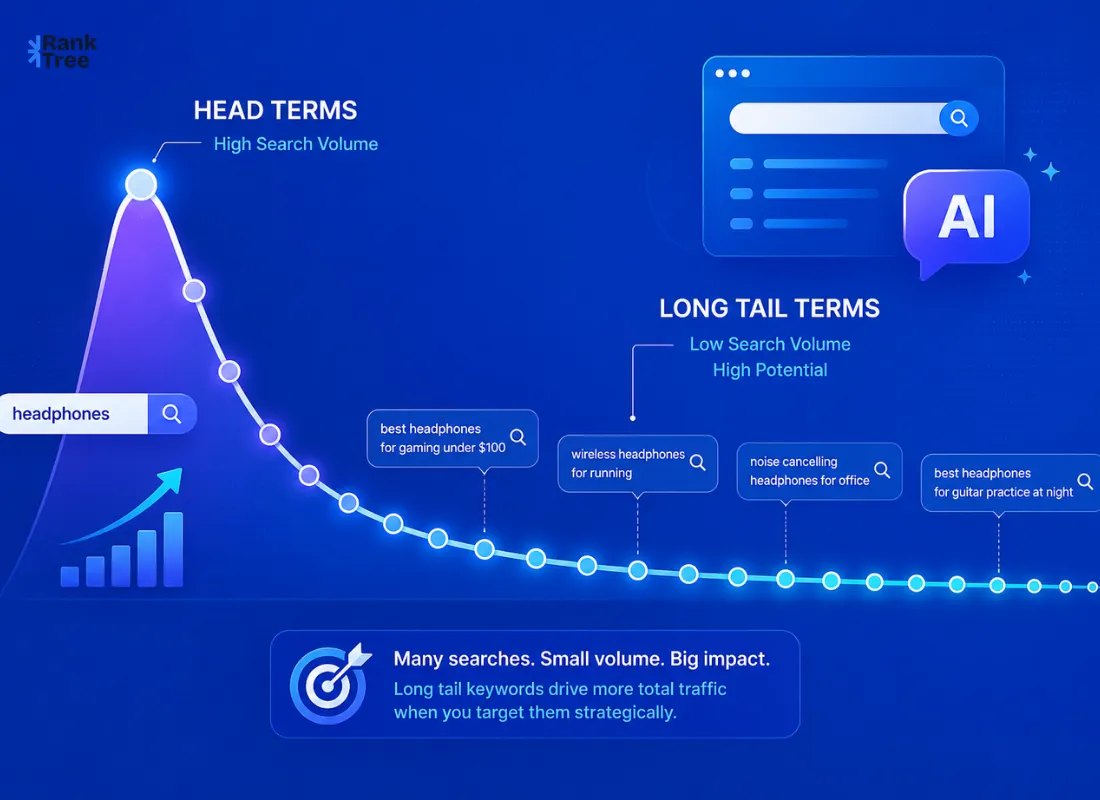
Long tail search terms are queries with relatively low individual search volume compared to broad "head" terms in the same topic. "Headphones" is a head term with massive volume; "best headphones for guitar amp practice at night" is long tail.
Here's the correction most casual guides get wrong: length in words doesn't define long tail search volume does.
A single word can be long tail if few people search it and a five word phrase can be a head term if it's searched constantly.
Judge a keyword by where it sits on the search volume curve for your niche, not by counting words.
Why They're Called "Long Tail"?
Plot every search query by volume highest to lowest and you get a curve with a short tall "head" (a small number of massively popular terms) and a long flat "tail" stretching out with billions of low volume queries.
Most searches in aggregate come from that tail not the head. That shape is where the name comes from.
Why Long Tail Terms Matter?
Lower competition. Fewer sites specifically target them and less marketing budget chases them so ranking is realistically achievable even for newer sites.
Easier to satisfy thoroughly. A specific question usually needs a shorter, more direct answer than a broad one; you don't need 3000 words to answer something narrow.
They compound. No single long tail term drives much traffic alone but addressing hundreds of them across a site adds up to substantial durable traffic.
They're increasingly how people talk to AI. Conversational queries to AI assistants are inherently long and specific which pushes even more search volume into the tail than traditional search ever did.
The Three Types of Long Tail Keywords
Not every long tail term should be treated the same way the type determines whether it needs its own page, deserves to be folded into an existing one or is only reachable through AI native research methods.
Type 1: Supporting Long Tail
These are simply less common ways of phrasing a bigger, more popular query. "Best healthy treats for dogs" (100 searches/month) and "healthiest dog treats" (2500 searches/month) mean the same thing. Google already ranks the same pages for both.
Action: Don't build a separate page. Target the broader parent term and the supporting variations follow automatically.
Type 2: Topical Long Tail
These represent a genuinely distinct specific need, the most popular way to search for that particular thing even though the volume is low. "Fly bites on dogs ears" isn't a variation of anything broader; it's its own topic.
Action: This deserves a dedicated page since ranking for it won't happen as a byproduct of a broader page.
Type 3: Conversational Long Tail (The AI Era Tail)
These are full-sentence, highly specific questions people ask AI assistants, such as “what’s the best type of meditation for someone who struggles to sit still and only has ten minutes in the morning.”
Most don’t appear in traditional keyword tools because users phrase them differently. AI systems also break one query into multiple sub questions (query fan-out), meaning your content can surface even if the exact query was never searched.
Action: You can’t target these individually. Instead, cover the full cluster of related sub questions so your content can answer any fragment AI generates.
How to Decide: New Page Merge or Skip?
Use this simple decision path for any long tail term you uncover:
Does an existing page on your site already rank for a close variation? → It supports a long tail. Don't build anything new; strengthen the existing page instead.
Is this genuinely a distinct need with no page currently addressing it well? → Its topical long tail. Build a dedicated page.
Is this a full sentence conversational question unlikely to repeat verbatim? → It's a conversational long tail. Don't chase it directly make sure your broader topic cluster covers the sub questions it's likely built from.
Does it not actually match anything you sell or offer? → Skip it regardless of volume or difficulty. Fit matters more than either.
How to Find Long Tail Search Terms?
Keyword research tools (Ahrefs, Semrush or similar) filter by low search volume, low difficulty and the "Questions" filter for naturally long tail phrasing.
Google's own features autocomplete "People also ask" and "People also search for" surface real long tail phrasing directly from search behavior.
Your Search Console data filter existing queries with regex for question words (how, why, what which can is) to surface conversational terms you already rank for but haven't optimized around.
Competitor organic keywords filter a competitor's ranking keywords by low volume and low difficulty to find gaps they've already validated as worth targeting.
AI platforms directly ask an AI assistant for long tail variations on your topic or feed it a batch of real questions from forums and ask it to identify recurring underlying sub questions. AI generated ideas still need validation against real search data before you commit to them.
Forums and communities (Reddit Quora) people phrase questions in their own words here often surfacing genuinely unique long tail terms invisible to keyword databases.
Prioritize Before You Build Anything
Score each candidate keyword across four factors before committing content resources:
Factor | What to Check |
Search volume | Enough demand to be worth the effort even if modest |
Difficulty | Realistic to rank given your site's current authority |
Business fit | Actually connects to something you offer |
Type (Supporting / Topical / Conversational) | Determines whether it needs a new page at all |
Skip anything that fails business fit regardless of how attractive the volume or difficulty numbers look fit failures are the most common reason long tail traffic doesn't convert.
Ranking for Long Tail Terms: What Actually Works?
Cluster supporting terms onto one page instead of building duplicate content across near identical queries.
Match content depth to the question's scope: a narrow topical query often needs a shorter, more direct page than a broad one; don't pad it to hit an arbitrary word count.
Use the term naturally in the title one heading and the opening paragraph prioritize readability over exact match repetition.
Cover the full sub question cluster not just the literal phrase since this is what positions you for conversational and AI query fans.
Add FAQ sections addressing closely related questions useful for both readers and featured snippets.
Internally link long tail pages from related higher traffic pages so both users and search engines can discover them.
A Complete Worked Example
Here's the full process applied to a real scenario: a site selling ergonomic office chairs.
Research: Search Console regex filter surfaces "best office chair for lower back pain" low volume ranking position 6 on an existing generic product page.
Classify: Checked for a broader parent term ("best ergonomic office chair" high volume) the top ranking pages differ meaningfully since "lower back pain" searchers want pain specific guidance not general ergonomics. Classified as topical long tail not supporting.
Decision: Fails the "merge" test and builds a dedicated page.
Content built: A focused guide addressing lumbar support features specifically with a self contained answer near the top: "The best office chairs for lower back pain combine adjustable lumbar support, a slight recline and seat depth that matches your leg length without needing to be the most expensive option."
Cluster coverage: Added an FAQ section covering related sub questions ("how to sit with lower back pain" "is a kneeling chair better for back pain") to position for conversational/AI fan out queries around the same underlying need.
Internal linking: Linked from the broader "ergonomic office chair" pillar page and from a related blog post on remote work posture.
Tracking: Checked Search Console again after four weeks new page overtook the old generic product page for the target term and picked up rankings for six related long tail variations without additional content.
Self Audit Checklist
[ ] Classified the keyword as supporting topical or conversational before deciding on a page
[ ] Checked for an existing page that could be strengthened instead of duplicated
[ ] Confirmed genuine business fit not just favorable volume/difficulty numbers
[ ] Matched content depth to the question's actual scope
[ ] Covered the surrounding sub question cluster not just the literal phrase
[ ] Added internal links from related higher traffic pages
[ ] Set a follow up check in date to review rankings
Build the Habit Not Just the List
A long tail keyword list is only useful once every term on it has been classified, prioritized and mapped to a real content decision.
Run your next batch of long tail research through the decision path and checklist above before you build anything. It's the difference between traffic that compounds and pages that never quite pay off.
FAQs
Do long tail keywords have to be three or more words?
No, that’s a myth. Long tail is defined by low search volume relative to a niche not word count. Even one word queries can be long tail while longer phrases can still be high volume.
Should every long tail keyword get its own page?
No. Supporting variations should be included within a broader parent page. Creating separate pages for each can lead to duplication and weaker rankings.
How does AI search change long tail strategy?
AI generates detailed unique queries and breaks them into smaller sub questions. Instead of targeting individual phrases the focus shifts to covering the full cluster of related questions.
Are long tail keywords cheaper in paid search?
Usually yes since competition is lower. However they also bring less volume so they work best alongside broader campaigns rather than replacing them.
Related reads
RankTree Team — The RankTree team writes about SEO strategy, keyword clustering, and topical authority to help you build content that ranks.