Domain Clustering SEO: What It Is and How to Use It
By RankTree Team · 2026-06-27 · Updated 2026-10-20
Part of the Keyword Clustering: The Complete Guide for SEO Success guide →
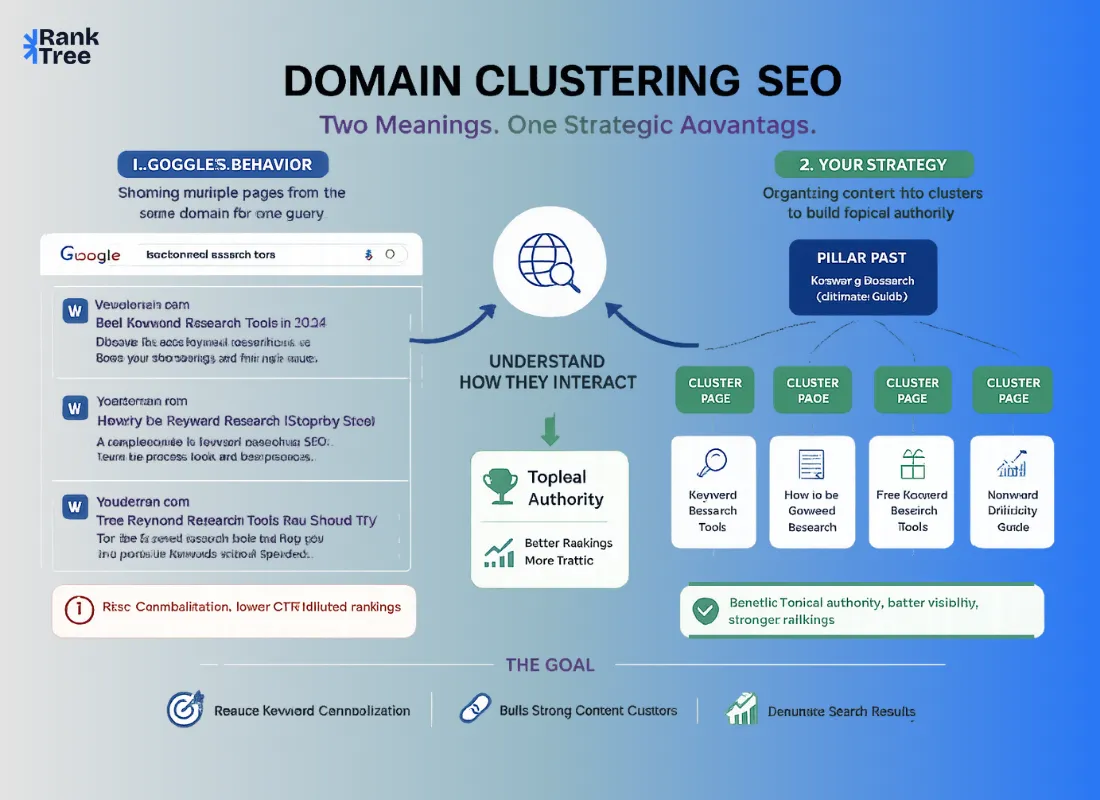
"Domain clustering" appears in two separate SEO conversations and most articles cover only one of them.
The first meaning: Google's behavior of surfacing two or more pages from the same website for a single search query. The second meaning: organizing your site's content into structured clusters to build topical authority.
Both are connected and understanding how they interact is what separates an SEO strategy that compounds over time from one that plateaus early.
This guide covers both what Google's domain clustering behavior means for your rankings, why it happens, what risks it carries and how a deliberate content cluster strategy turns it from a liability into a competitive advantage.
Domain clustering refers to Google displaying two or more organic results from the same website for a single search query, appearing indented on desktop and as standard listings on mobile. Despite Google's 2019 diversification update meant to limit this, it still happens in 2026 whenever relevance overrides that logic — typically for dual-meaning queries, uncertain search intent, or a site having multiple pages that each serve the query from a different angle. It cannot be engineered by targeting the same keyword on multiple pages; doing so causes keyword cannibalization instead, where competing pages split authority and both rank worse. Domain clustering is instead an outcome of genuine topical authority, built through a pillar-and-cluster content architecture: a pillar page giving a broad overview, cluster pages covering subtopics with distinct intent, and internal links connecting every page. Built this way, clustering appears as a byproduct of authority rather than a target pursued directly.
What Is Domain Clustering in SEO?
Domain clustering refers to Google displaying multiple organic results from the same domain for a single search query. On the desktop the second result appears indented beneath the first. On mobile both appear as standard listings without indentation.
Despite Google's 2019 diversification update to limit this behavior, domain clustering still occurs regularly in 2026. When Google determines that one site genuinely offers the two most relevant results for a query relevance overrides diversification logic.
When Does Google Trigger Domain Clustering?
Based on observable SERP behavior clustering occurs in three scenarios:
Dual meaning queries
When a search term has two distinct meanings Google may surface two pages from the same authoritative site to address both.
A query like "framing" could refer to photography or construction Google clusters two results from a high authority source covering each.
Uncertain search intent
When Google is unsure whether intent is informational or commercial it may cluster one page of each type from the same domain.
A query for "tile paint" could mean buying paint or applying it if one domain has both a strong product page and a how to guide both may surface.
Multiple highly relevant URLs
When a site has several pages satisfying a query from different angles such as "wall floating shelves" and "wood floating shelves" Google may cluster two to serve the searcher more completely.
The common thread: Google clusters when one domain's multiple pages serve the searcher better than spreading results across different sites. Your content structure either enables or prevents that conclusion.
The Risk: Domain Clustering and Keyword Cannibalization
Here is where most SEO advice on domain clustering goes wrong. Seeing clustered results tempts practitioners to deliberately optimize multiple pages for overlapping keywords reasoning that two competing pages could earn two listings.
This is flawed and damaging.
Targeting the same keyword across multiple pages creates keyword cannibalization: two pages competing against each other for the same query. Google cannot determine a clear winner and typically ranks neither well. Authority that should concentrate on one strong page gets split across two weaker ones.
Domain clustering that earns two organic listings happens because Google assessed genuine relevance not because two pages targeted the same keyword. The distinction matters entirely.
Understanding keyword clustering is the foundation of doing this correctly. Properly clustered keywords prevent cannibalization at the source before content is written rather than after rankings stall.
Content Clusters as the Path to Earned Domain Clustering
The strategy that most reliably produces clustered domain results is the same one that builds topical authority: the pillar and cluster content architecture.
A content cluster is a group of interconnected pages organized around one core topic consisting of a pillar page providing a broad overview cluster pages covering specific subtopics in depth and internal links connecting every page bidirectionally.
When built correctly each page targeting distinct intent with clear keyword differentiation and consistent internal linking Google reads your site as a comprehensive authoritative resource.
That topical authority is the underlying condition that makes domain clustering possible. Without it even well written individual pages compete against each other and suppress each other's rankings.
How to Build a Content Cluster That Earns Topical Authority?
Step 1: Choose a Focused Core Topic
Your core topic must be broad enough to support multiple pages but focused enough to compete. A new SaaS site targeting "keyword clustering" is realistic.
Targeting "SEO" broadly is not because competition is too wide and authority too narrow. Start focused, build authority in one area first, expand to adjacent topics second.
Step 2: Map Sub Topics by Intent Not Just Subject
Organizing sub topics by theme rather than intent is the most common cluster planning mistake.
Two pages on the same subject serve completely different purposes depending on intent and publishing both without differentiation creates cannibalization.
Classify every sub topic page before writing begins: informational intent for guides and explanatory content commercial intent for comparisons and reviews transactional intent for landing and product pages.
Understanding the different types of keywords for each intent type makes this classification faster and more accurate.
Step 3: Build the Pillar Page First
Publishing cluster articles before the pillar page exists is a common sequencing error. Without an anchor pillar, cluster articles have no hierarchy to link to and no authority structure to draw from.
Build the pillar page first publish it with internal link placeholders for planned cluster pages then build cluster articles that each link back to the pillar. For the full execution process see how to do keyword clustering.
Step 4: Differentiate Each Page with Unique Keyword Clusters
Every page in your cluster needs its own keyword cluster, a group of related terms sharing the same intent targeted simultaneously on one page. No two pages should share the same primary keyword cluster.
Run a cannibalization check before finalizing any page. Search Google for each target keyword and check whether existing pages on your site already rank for it.
If they do update the existing page rather than creating a competing second one.Keyword clustering tools automate this cross reference and flag risks across your full keyword set before content is written.
Step 5: Build Internal Links Deliberately
Internal linking transforms related pages into a cluster that signals topical authority. Every cluster article links up to its sub pillar page. Every sub pillar links up to the pillar and down to its cluster articles.
The pillar links to all sub pillar pages. Use descriptive keyword rich anchor text not generic phrases so Google understands the semantic relationship between pages.
Intent Optimization: The Safe Path to Multiple SERP Listings
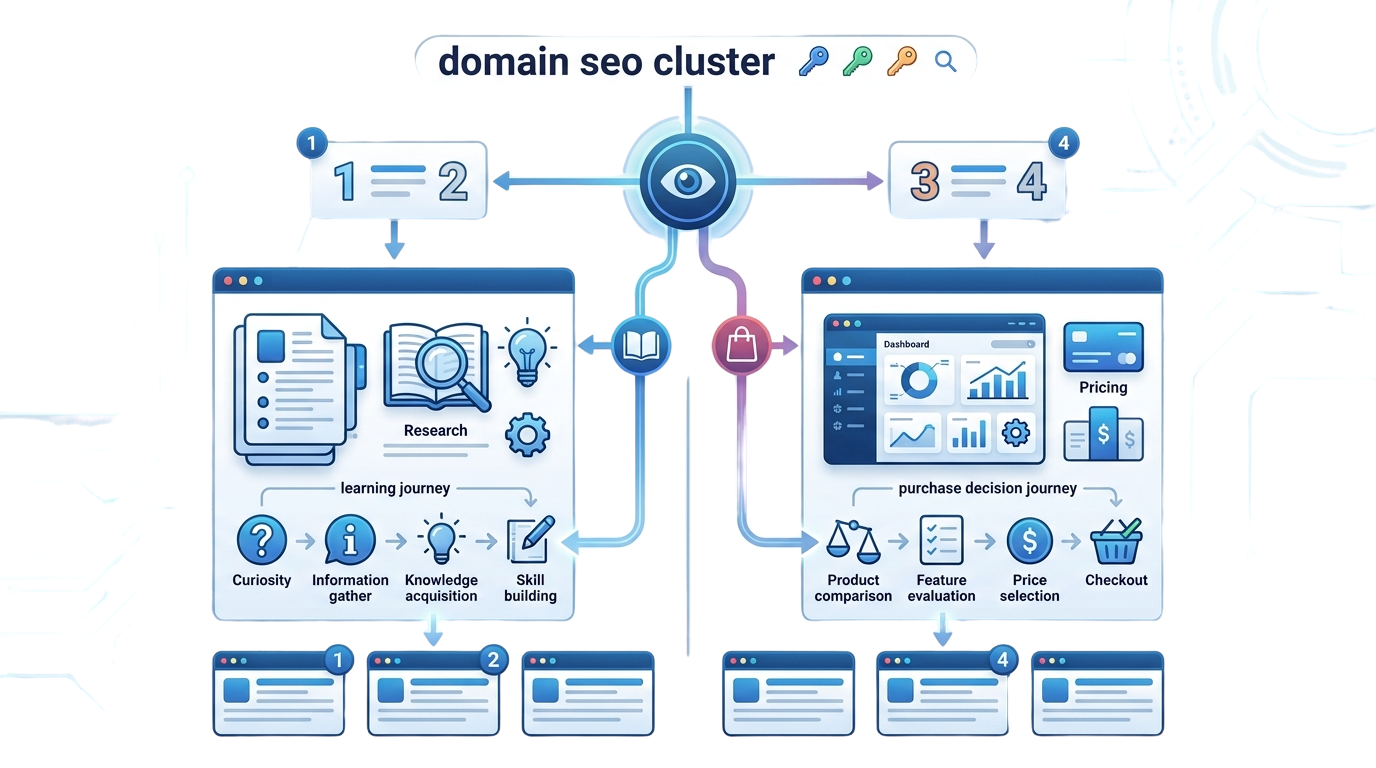
If earning two organic listings for a single query is a goal the only safe path is intent optimization creating two genuinely distinct pages that each serve a different searcher goal within the same topic.
A product page and an informational guide covering the same topic can both rank because they serve different intents. The product page satisfies commercial intent; the guide satisfies informational intent.
Google may cluster both when the query has mixed intent. Both pages should link to each other the guide referencing the product page for readers ready to evaluate the product page referencing the guide for readers still learning.
The key is deliberate keyword differentiation from the start. If both pages target "keyword clustering software" Google sees two competing pages.
If the guide targets "how keyword clustering works" and the product page targets "best keyword clustering software" Google sees two pages answering different questions about the same topic.
Common Mistakes to Avoid
Optimizing for clustering directly. Domain clustering cannot be engineered by targeting the same keywords on multiple pages. Attempting it creates cannibalization and suppresses both pages.
Publishing cluster articles without a pillar page. Without an anchor pillar, cluster articles have no hierarchy and no authority structure. Always build the pillar first.
Ignoring existing content during cluster expansion. New cluster articles regularly create unintended keyword overlap with older published pages. Cross reference every new page against your existing URL structure before publishing.
Treating all domain clustering as beneficial. Clustered results rarely appear in position one. A single strong page ranking first typically outperforms two clustered pages at positions three and five. One authoritative page per intent cluster is more valuable than two mediocre listings.
Final Thoughts
Domain clustering is an outcome not a strategy. It appears when Google determines your site genuinely offers the two most relevant results for a query, a determination built entirely on topical authority from a well structured content cluster strategy.
Build comprehensive pillar pages. Differentiate sub topics by intent. Link everything together deliberately. Eliminate cannibalization before it develops.
Do those things consistently and domain clustering appears as a byproduct alongside the rankings authority and organic traffic that come with it.
FAQs
What is the difference between domain clustering and keyword cannibalization?
Domain clustering occurs when Google shows two pages from the same site for one query often signaling topical authority. Keyword cannibalization happens when pages compete for the same keyword splitting authority and hurting rankings. One is a positive outcome; the other is a structural problem.
Can I deliberately optimize for domain clustering?
Not directly. Forcing it can create cannibalization. Domain clustering occurs when Google finds two of your pages highly relevant. The best approach is creating content for different search intents.
How many pages should a content cluster contain?
There is no fixed number. Clusters of 5–10 well differentiated pages often outperform larger clusters with overlapping content. Quality matters more than volume.
How long does building topical authority take?
New sites typically need 6–12 months of consistent publishing. Established sites may see results in 8–16 weeks with pillar pages often benefiting the most as cluster content grows.
What is the relationship between domain clustering and topical authority?
Topical authority reflects comprehensive subject coverage. Domain clustering is a visible result appearing when Google views your site as the best source for multiple aspects of a query. Content clusters help build that authority.
Related reads
Topic Clusters vs Keywords: Which SEO Strategy Actually Wins
Semantic Search vs Keyword Search: The Complete Decision Framework
SERP-Based vs Semantic Clustering: Which Method Actually Builds Your Content Architecture?
RankTree Team — The RankTree team writes about SEO strategy, keyword clustering, and topical authority to help you build content that ranks.