SEO Content Writing Guide: How to Create Content That Ranks
By RankTree Team · 2026-08-19 · Updated 2026-10-07
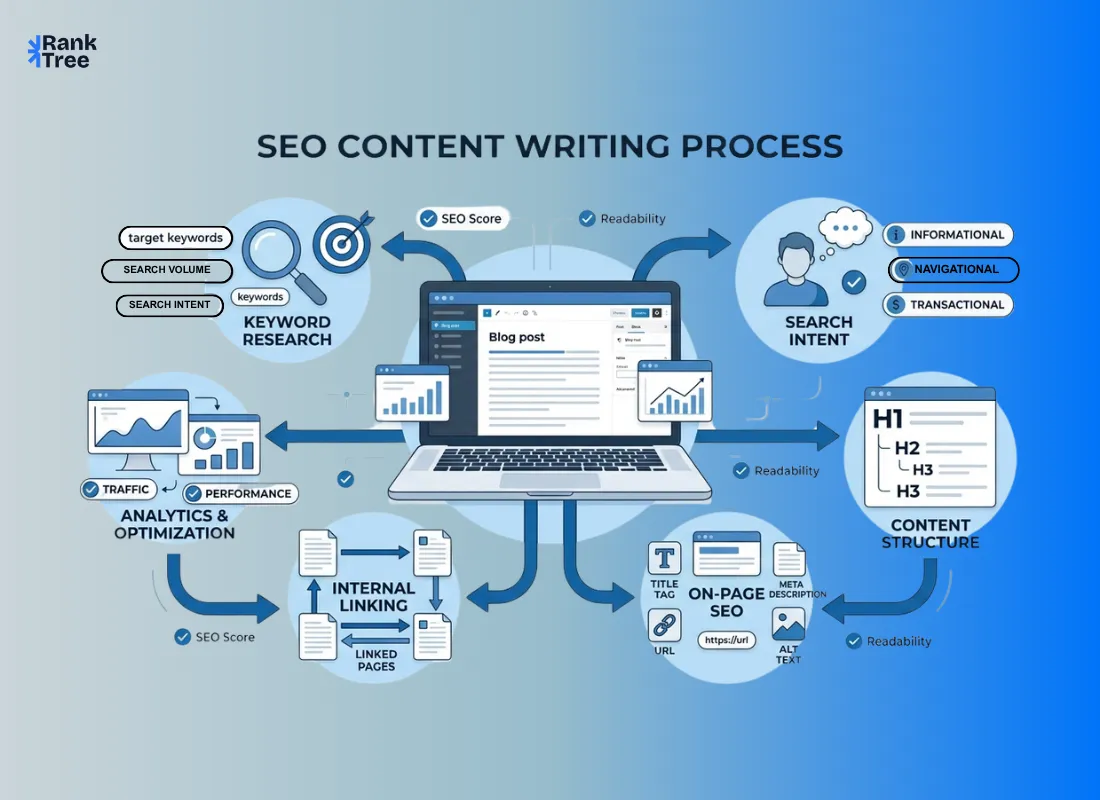
If your content is stuck on page 4 of Google, the problem isn’t your writing, it's your SEO system. Most blog posts fail not because they’re poorly written, but because they’re not structured for how search engines and users actually behave today.
SEO content writing is no longer about inserting keywords into paragraphs. It’s about building content that matches search intent, covers topics deeply and is structured in a way Google can understand and extract.
This guide breaks down exactly how to do it, the research structure, the technical layer most guides skip and a repeatable process you can use for every article on your site.
SEO content writing is the process of creating content that is optimized for search engines while providing real value to users. It combines keyword research, search intent alignment, structured formatting, and on-page optimization to help content rank on Google and attract organic traffic. The process follows a repeatable system: research primary, secondary, and LSI keywords along with the entities Google's NLP models recognize; map search intent, informational, commercial, transactional, or navigational, to the right content format; and structure the article with a direct 40 to 60 word snippet-ready definition, clear H2/H3 hierarchy, and short paragraphs so both readers and AI systems can extract answers. It also requires on-page fundamentals like optimized title tags, meta descriptions, and internal links, plus E-E-A-T signals such as author credentials and original data. Technical elements like schema markup, page speed, and mobile formatting round out the system. Done consistently, this turns individual articles into a compounding source of rankings rather than one-off, unstructured content.
What is SEO Content Writing?
SEO content writing is the process of creating content that is optimized for search engines while providing real value to users. It involves keyword research, search intent alignment, content structure and optimization techniques that help content rank higher on Google and attract organic traffic.
Why SEO Content Writing Matters?
SEO content writing matters because it helps your content get discovered, understood and ranked by search engines while also engaging real users. Without proper structure, even high-quality content can struggle to generate traffic.
Search has evolved. Google now uses AI and language understanding to interpret queries, entities and relationships. With AI Overviews answering queries directly in SERPs, content must be structured to be extractable, not just readable.
For SaaS businesses in competitive niches, this makes SEO content critical:
Organic traffic is a scalable, long-term growth channel
Well-structured content attracts high-quality backlinks
Intent-focused content improves engagement and conversions
AI Overview visibility builds brand exposure before clicks
Step 1: Build the Content Foundation (Keyword & Entity Research)
Before writing a single sentence you need three layers of research; most writers only do the first one.
Primary and secondary keywords
Identify your main target keyword (what you want to rank for) and 5–10 secondary keywords related phrases people search for around the same topic. Tools like Ahrefs, SEMrush or Google Keyword Planner work here.
LSI keywords and semantic terms
LSI (Latent Semantic Indexing) keywords are conceptually related terms that help search engines confirm what your page is actually about. If your keyword is "content writing" LSI terms might include copywriting blog strategy, editorial calendar content marketing keyword density and readability score. Pull these from:
Google's "People also search for" and "related searches"
Tools like Clearscope Surfer SEO or Frase (built specifically for semantic content briefs)
Competitor content gap analysis (what terms do top ranking pages use that yours doesn't?)
Entities and NLP optimization
This layer is often overlooked. Google's NLP models identify entities, people, brands, tools, concepts, places and their relationships. Run your draft or a competitor's top-ranking page through Google's Natural Language API demo or a tool like InLinks to identify recognized entities, then naturally reference relevant ones such as Google Search Console, E-E-A-T, featured snippets and topic clusters.
Step 2: Map Search Intent Before You Write
Every keyword has an intent behind it: informational, navigational, commercial or transactional. Writing the wrong content type for the intent is one of the fastest ways to lose rankings.
Intent Type | Signal Words | Content Format That Wins |
"what is" "how to" "guide" | Blog post guide explainer | |
"best" "vs" "review" | Comparison post listicle | |
"buy" "pricing" "sign up" | Landing page product page | |
Brand names | Homepage about page |
To check intent, search your target keyword and look at what's already ranking. If the top 10 results are all listicles don't publish a single long form narrative essay that match the format Google has already validated then out execute it on depth and quality.
Step 3: Structure the Article for Humans and Algorithms
This is where most content including both competitors we analyzed for this piece either goes too casual (style over substance) or too dense (a wall of unstructured advice). The winning structure does both.
Open with a direct snippet ready definition (40–60 words) that answers the core query immediately this is what gets pulled into AI Overviews and featured snippets
Use a clear H2/H3 hierarchy that mirrors how someone would naturally break the topic into sub questions
Keep paragraphs short (2–4 sentences) online readers skim they don't read linearly
Answer "People Also Ask" style questions in dedicated subsections this both improves topical coverage and targets long tail traffic
SEO Content Writing Example (Before vs After)
To understand how SEO content writing works in practice, let’s compare a basic paragraph with an optimized version.
Before (Not Optimized):
Writing good content is important for websites. You should write clearly and make sure people understand your message.
After (SEO Optimized):
SEO content writing focuses on creating clear, structured, and keyword-optimized content that matches search intent. By using proper headings, relevant keywords and readable formatting, you can improve rankings and user engagement.
The difference is clarity, keyword relevance, and intent alignment which are critical for ranking on Google.
Step 4: Apply On Page SEO (The Non Negotiables)
Title tag: primary keyword near the front under 60 characters
Meta description: 150–160 characters includes the keyword written to earn the click (not just describe the page)
URL slug: short keyword included no stop words (e.g. /seo content writing guide)
Header tags: keyword and related entities distributed naturally across H2s never forced
Internal linking: link to related pages on your site using descriptive anchor text this is one of the most under used levers in both competitor articles we reviewed
Image optimization: descriptive file names compressed file size and alt text that describes the image and includes context not just the keyword
Step 5: Build in E-E-A-T Signals
Google's quality guidelines weigh Experience Expertise Authoritativeness and Trustworthiness heavily especially for topics where accuracy matters.
Include a real author byline with credentials or experience relevant to the topic
Reference original data screenshots or first hand examples rather than generic claims
Link out to credible authoritative sources when citing statistics
Keep the content accurate and update it when facts tools or best practices change
Step 6: Don't Skip the Technical Layer
Both competitor articles we analyzed touched on page SEO but barely mentioned this layer and it matters:
Schema markup: Add Article FAQ and Author schema so search engines (and AI systems) can parse your content structure precisely
Page speed and Core Web Vitals: content that loads slowly gets a worse ranking chance regardless of quality
Mobile first formatting: short paragraphs and clear headers aren't just readability choices they directly affect mobile usability signals
Step 7: Promote and Build Authority (Off Page)
Publishing isn't the finish line. Share the content where your audience already is, look for guest posting or digital PR opportunities relevant to your niche and prioritize a small number of high authority backlinks over a large number of low quality ones link quality has mattered more than link volume for years now.
Step 8: Audit and Update Regularly
Search rankings decay over time as competitors publish newer, more complete content. Every 3–6 months revisit your top performing and near ranking pages:
Update statistics screenshots and examples
Add newly relevant subtopics or FAQs based on current "People also ask" results
Refresh the publish date once the update is substantial
Add new internal links from newer content back to this page
SEO Content Writing Checklist
Before publishing any SEO content, make sure it follows these essential optimization steps. This checklist helps ensure your content is structured, optimized, and ready to rank on Google.
Element | What to Check | Why It Matters |
Primary Keyword | One clear keyword per page | Helps Google understand topic |
Search Intent | Matches user query type | Improves ranking relevance |
Title Tag | Keyword included naturally | Boosts visibility in SERP |
Headings (H2/H3) | Structured with keywords | Improves readability + SEO |
Content Structure | Short paragraphs, clear flow | Better user engagement |
LSI Keywords | Related terms included | Strengthens topical relevance |
Internal Links | Links to relevant pages | Improves site authority |
Images | Optimized with alt text | Helps in image SEO |
Meta Description | Clear and compelling | Increases click-through rate |
CTA | Clear next step for user | Improves conversions |
Key Takeaway
SEO content writing isn't keyword stuffing and it isn't just "write well and hope." It's a repeatable system: research keywords and entities understand intent structure for both readers and algorithms, build trust signals and keep improving what you publish. Do this consistently and rankings compound which is exactly what a growing SaaS site needs.
FAQs
How long should an SEO article be?
There's no fixed number length that should match what's needed to fully satisfy search intent and match (or slightly exceed) the depth of top ranking competitors without adding filler.
Is SEO content writing different from regular content writing?
Yes. Regular content writing focuses on communicating information while SEO writing also considers search intent keywords SERPs structure internal links and organic visibility.
Does SEO content need keywords?
Yes but keyword repetition is unnecessary. Natural language search intent topical relevance and useful coverage matter more than forcing exact match keywords.
Can AI write SEO content?
AI can assist with research outlining drafting and editing but high quality SEO content still needs human expertise fact checking original insights examples and editorial judgment.
How can I improve existing SEO content?
Review rankings impressions, clicks queries and search intent. Then improve missing topics outdated information weak sections internal links metadata and areas where competitors provide better answers.
In this guide
- How to Write a Blog Post: The Complete Step by Step Process
- Content Writing vs. Copywriting: The Real Difference
RankTree Team — The RankTree team writes about SEO strategy, keyword clustering, and topical authority to help you build content that ranks.