How to Find Your Competitors' Keywords?
By RankTree Team · 2026-08-12 · Updated 2026-10-07
Part of the Backlink Gap Analysis: Find and Close Your Link Gaps guide →
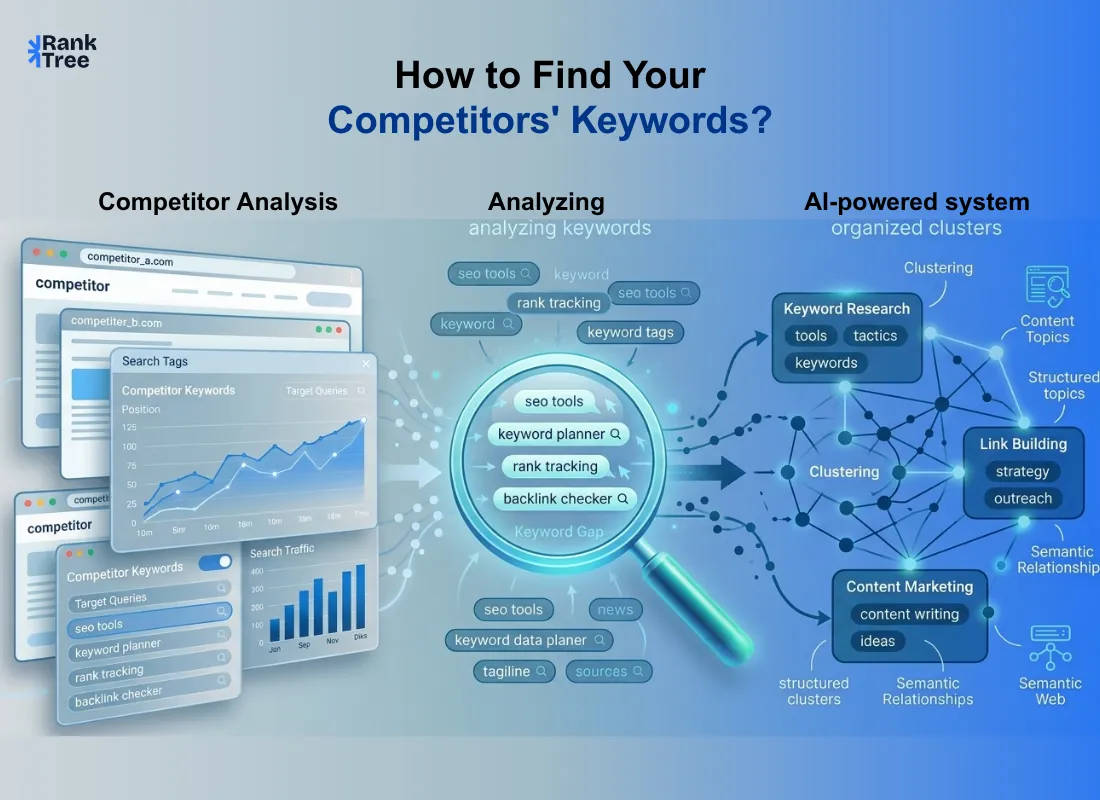
To find your competitors' keywords enter their domain into a keyword research tool (like Semrush Ahrefs or a free alternative like Ubersuggest) and run a keyword gap report to see terms they rank for that you don't.
But in 2026 keyword rankings are only one piece of the puzzle. You also need to check where competitors show up in AI answers (ChatGPT Google AI Overviews Perplexity) and in conversations on Reddit, YouTube and social media.
This guide walks through all three using both paid tools and free methods plus how to turn what you find into content that actually outranks them.
How do you find your competitors' keywords? Enter a competitor domain into a keyword research tool such as Ahrefs, Semrush, or a free alternative like Ubersuggest, and run a keyword gap report to surface terms they rank for that you do not. Start by separating SEO competitors, sites that rank for your target terms regardless of what they sell, from business competitors you compete with for customers, since these two groups often overlap only partially. A manual review of a competitor's navigation, page titles, headings, and URL slugs surfaces seed keywords before you open any tool. Beyond traditional search, competitor keyword analysis in 2026 also means checking AI search visibility in ChatGPT, Perplexity, and Google AI Overviews, plus tracking conversations on Reddit and YouTube, since these sources reveal keyword opportunities and positioning gaps that standard keyword tools miss entirely.
What Is Competitor Keyword Analysis?
Competitor keyword analysis is the process of identifying the specific search terms your competitors rank for so you can find gaps in your own targeting and close them with new or improved content.
It's one of the fastest ways to build a keyword list grounded in real demand instead of guesswork because if a competitor is already getting traffic from a term that term has proven itself.
Step 1: Separate SEO Competitors From Business Competitors
Before pulling any keyword list know who you're actually analyzing:
Type | Definition | Example |
SEO competitors | Sites that rank for the same keywords regardless of what they sell | A blog outranking your product page for a how to term |
Business competitors | Companies selling similar products/services | A direct rival brand you compete with for customers |
These two lists often overlap only partially. A media site or forum can be an SEO competitor without selling anything while your biggest business rival might not even rank for your target terms.
For the most useful analysis pulling keywords from both groups 3 to 5 domains total is a manageable starting point.
Step 2: Manual Review (Free 15 Minutes)
Before opening any tool visit your competitors' sites directly:
Homepage & navigation the terms in their main menu usually reflect their priority keywords
Page titles and headings (H1/H2) view the page source or just read the visible headings
Blog category names and recent post titles
URL slugs often contain the exact keyword they're targeting
This won't give you search volume but it gives you seed keywords fast and tells you how a competitor positions itself in useful context before you touch any software.
Step 3: Run a Keyword Gap Analysis (Paid & Free Tools)
This is the core of the process. You have options at every budget.
Paid tools:
Semrush's Keyword Gap tool enter your domain plus up to 4 competitors then filter by "Missing" (keywords all competitors rank for that you don't) or "Weak" (keywords you rank for but far below them)
Ahrefs' Content Gap / Organic Keywords report same concept; enter a competitor domain to see their full ranking keyword list with volume KD and traffic
Free or low-cost alternatives:
Google Search Console (for your own site) combined with a manual site:competitor.com search to spot their indexed pages
Ubersuggest offers a limited free competitor keyword lookup
AnswerThePublic or Google's "People also ask" free ways to find question-based keywords a competitor may already be answering
Google Keyword Planner free with a Google Ads account useful for checking volume on keywords you find manually
Whichever tool you use filter what you find through three lenses before adding anything to your target list:
Search volume: is there real demand?
Search intent informational, commercial or transactional? Match this to your business goal
Keyword difficulty relative to your site's authority newer sites should target lower-difficulty longer-tail terms first
Step 4: Mine Keyword Candidates From AI Search Visibility
Traditional keyword tools only capture what people type into search engines, but a growing share of research now happens inside AI tools like ChatGPT, Perplexity and Google’s AI Mode. The phrasing used there often reveals keyword ideas that standard tools miss.
Run prompts around your core topics and note the exact wording in responses and follow-up questions these often become strong long-tail keywords. A few starting formats:
"best [product type] for [use case]"
"[competitor] vs [alternative]"
"how do I [solve the problem your product addresses]"
For scaling, tools like Semrush’s AI visibility reports show which prompts competitors are being cited for, and each can be treated as a keyword opportunity.
This step focuses on extracting keyword ideas from AI platforms. For a full audit of where your content is missing in AI-generated answers, refer to Content Gap Analysis.
Step 5: Track Conversations on Reddit YouTube and Social Media
Buying decisions increasingly happen in places keyword tools don't measure and these conversations are frequently the exact sources AI tools cite.
Reddit and forums: Use Google site search operators:
site:reddit.com "competitor name"
site:reddit.com "best [category] tool"
Repeat with category terms not just brand names since people rarely search Reddit by brand. Note which competitors get recommended repeatedly for a specific use case that's a positioning gap worth targeting.
YouTube and TikTok: Search [competitor] review [competitor] vs [alternative] and best [product] for [use case]. High view videos signal genuine audience interest and often map directly to keyword or content opportunities.
X and LinkedIn: Search the competitor's name and note recurring themes people associate with them. Sometimes a single viral post reveals a keyword opportunity (e.g. a feature or use case) that hasn't shown up in any keyword tool yet.
Step 6: Don't Forget Local Competitor Keywords
If you serve a specific city or region also check:
Google Business Profile competitors appearing in the local map pack for your target terms
"Near me" and city modified keywords your local competitors rank for
Google's local pack results for your core service terms noting which competitors appear and what services they highlight in their listings
This layer is easy to miss but critical for service businesses and neither major keyword tool surfaces it automatically you largely have to check manually.
Step 7: Turn Keywords Into Topic Clusters (Not Just a List)
A keyword list alone isn’t a strategy. After collecting keywords, group them into topic clusters based on shared intent and related entities like synonyms and subtopics. Tools like RankTree can automate clustering using search intent and SERP similarity saving time.
For example terms like “competitor keyword tool” “keyword gap analysis” and “SEO competitor research” belong in one cluster while “AI Overview visibility” and “ChatGPT brand mentions” form another.
This step converts scattered keywords into a structured content plan one pillar page per cluster supported by interlinked articles. It also expands your coverage of related terms and entities improving both search rankings and AI visibility.
Step 8: Build a Simple Tracking System
Keyword gaps change constantly as competitors publish new content. Set up a lightweight system to revisit this regularly:
A shared spreadsheet with columns for: keyword/prompt competitor(s) who own it search volume priority status (not started / in progress / published)
Monthly checks on your top 3–5 competitors' new blog posts or pages
Quarterly re runs of your AI prompt tests since AI answers shift often
Ongoing site:reddit.com and YouTube searches for new conversations
Common Mistakes to Avoid
Chasing every keyword a competitor ranks for even ones irrelevant to your business filter for relevance and feasibility first
Ignoring AI search entirely a growing share of research now happens outside Google
Creating new content when an existing page just needs improvement always check your own site first
Only checking Google and missing the fact that many product decisions are influenced by Reddit and YouTube
Treating this as a one time project instead of an ongoing process
Key Takeaway
Competitor keywords are a starting point not the finish line. Combine traditional keyword gap analysis with AI search checks and social/forum conversation tracking to see the full picture of where your competitors reach your audience then prioritize the gaps that are realistic for your team to close and revisit the process regularly as the landscape shifts.
FAQ
How do I find competitor keywords for free?
Use manual site review site: search operators for Reddit Google's "People also ask" boxes and free tier tools like Ubersuggest or Google Keyword Planner. You won't get the depth of a paid tool but you can build a solid starting list at no cost.
What's the difference between competitor keywords and competitor visibility?
Competitor keywords are specific terms they rank for in search. Competitor visibility is broader; it includes their presence in AI answers and conversations across Reddit, YouTube and social platforms giving a fuller picture of where they reach your shared audience.
How often should I redo competitor keyword research?
Quarterly is a reasonable baseline for most businesses with a lighter monthly check on your top few competitors' new published content.
Can a competitor rank in AI answers without ranking well in Google?
Yes. AI tools often cite forum discussions, comparison articles and well structured pages that don't necessarily hold top Google positions which is why checking AI visibility separately matters.
RankTree Team — The RankTree team writes about SEO strategy, keyword clustering, and topical authority to help you build content that ranks.