Content Writing vs. Copywriting: The Real Difference
By RankTree Team · 2026-08-18 · Updated 2026-10-07
Part of the SEO Content Writing Guide: How to Create Content That Ranks guide →
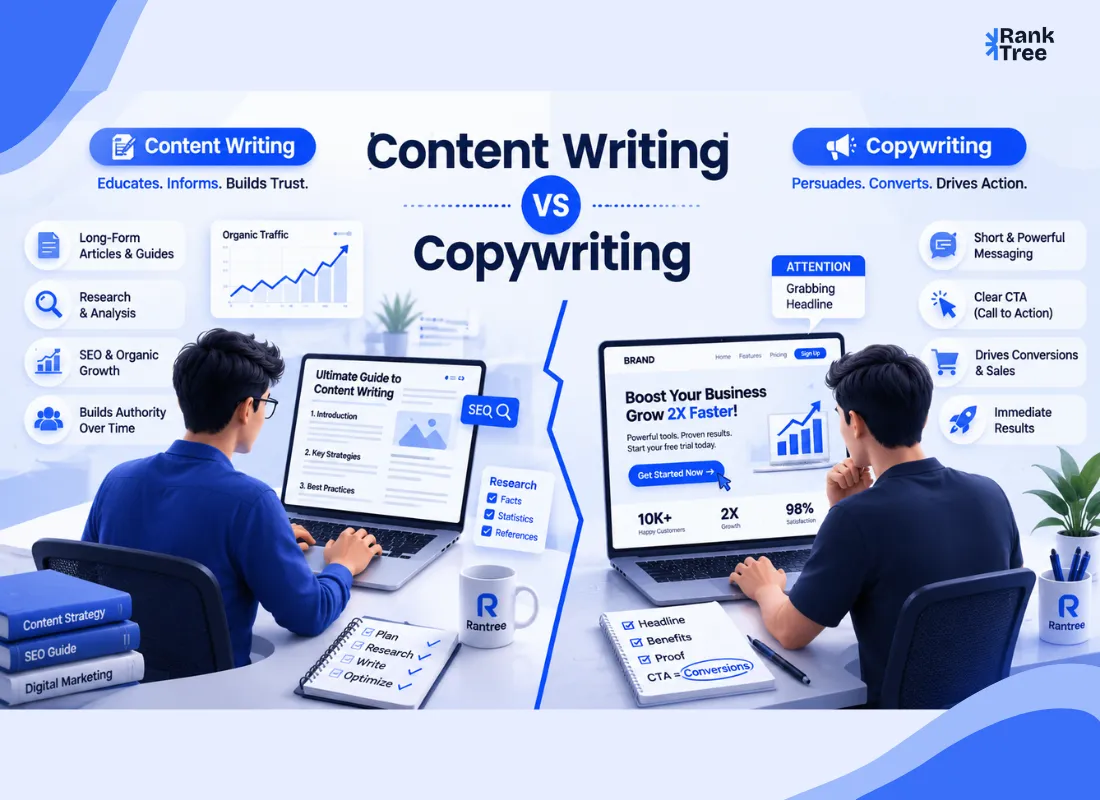
Most people assume content writing and copywriting are the same thing but that assumption quietly kills growth.
If you’re only creating blogs without thinking about conversion or writing sales copy without building trust first you’re missing how modern digital marketing actually works. The reality is simple but powerful: content writing brings people in while copywriting turns them into customers.
In today’s AI driven search environment where Google understands intent more than just keywords knowing how to use both together is no longer optional. It is the difference between getting traffic and getting results.
Content writing focuses on educating and building trust, while copywriting is designed to persuade and drive immediate action.
Content writing and copywriting are two different disciplines inside content marketing, not interchangeable terms: content writing educates and builds trust over time, while copywriting persuades and drives immediate action. Content writing runs from a few hundred to several thousand words, ranks for informational and research-stage keywords, and is measured by time on page and organic rankings — think blog posts, guides, and case studies. Copywriting runs from a sentence to a few hundred words, targets buyer-intent keywords on conversion pages, and is measured by click-through and conversion rate — think ads, landing pages, and product copy. Its impact is immediate rather than compounding. In a typical customer journey both work in sequence: a blog post brings in a reader still researching, and a landing page converts that same reader once ready to act. Content without copy struggles to convert; copy without content struggles to earn the trust needed to work at all.
What is Content Writing?
Content writing is built around educating, informing and engaging an audience over time. It focuses on delivering value rather than pushing for immediate action.
When someone reads a blog post, a guide or a detailed article the goal is not to sell instantly but to build trust and authority.
A strong piece of content answers questions solves problems and keeps the reader engaged long enough to see the brand as reliable.
This is why content writing plays a crucial role in long term SEO growth. It attracts users at the early stage of their journey when they are still exploring and learning rather than buying.
What is Copywriting?
Copywriting on the other hand is designed to drive action. It is focused, intentional and persuasive. Every word is written with a purpose whether that purpose is to get a click, a sign up or a purchase.
Unlike content writing, copywriting does not aim to explore a topic in depth. Instead it highlights benefits, triggers emotions and guides the reader toward a decision.
This is why copywriting is often shorter but more impactful. It works best when the audience already has some level of awareness and just needs a final push to act.
Content Writing vs Copywriting Quick Comparison
Copywriting | Content Writing | |
Primary goal | Drive a specific action now | Build trust and knowledge over time |
Typical length | A sentence to a few hundred words | A few hundred to several thousand words |
Timeline of impact | Immediate | Compounding |
SEO role | Optimizing conversion page copy for buyer intent keywords | Ranking for informational and research stage keywords |
Success metric | Click through rate conversion rate | Time on page return visits organic rankings |
Common formats | Ads landing pages product copy emails | Blog posts guides case studies newsletters |
Content Writing vs Copywriting Examples (Side-by-Side)
Here's what almost no other guide on this topic shows directly: the same product written first as copy then as content.
Copywriting (a product page):
"Cold coffee in 4 minutes not 24 hours. No ice dilution. No overnight wait. Just press pour and go. Order now ships free today."
Content writing (a blog post opening on the same product):
"Cold brew's biggest flaw has always been that most methods need 12 to 24 hours of steeping before you get a smooth low acid cup. This guide breaks down why steep time matters, what actually happens chemically during extraction and how newer rapid brew methods manage to shortcut that process without sacrificing flavor."
Notice what changed: the copy leads with the outcome and a CTA in a handful of words built to trigger a decision. The content leads with context and a promise of depth written to be read start to finish. Same product, two entirely different jobs.
SEO Matters for Both Not Just Content
Most explanations of this topic only connect SEO to content writing but copy carries SEO weight too. Product and landing pages need to rank for commercial and transactional keywords ("buy" "best" "near me") and that requires the same title tag heading and on page discipline as a blog post just compressed into far fewer words with every sentence still doing conversion work at the same time.
Content Marketing: The Umbrella Both Sit Under!
Content writing and copywriting aren't competing disciplines; they're two tools inside a broader content marketing strategy.
A typical customer journey uses both in sequence: a blog post (content writing) brings in a reader researching a problem; a landing page (copywriting) converts that reader once they're ready to act.
Neither works as well without the other content without copy struggles to convert; copy without content struggles to earn the trust needed to work in the first place.
Which is Better: Content Writing or Copywriting?
If you're building a team or briefing a project use this quick framework instead of guessing:
Need to move someone toward a purchase decision this week? → Copywriting (landing page sales email ad).
Need to attract organic traffic and build topical authority over months? → Content writing (blog guide resource hub).
Need to explain a complex product in a way that also builds trust? → Often both a content piece that educates linking into a copy driven page that converts.
Hiring one person for a small team? → Look for a writer with demonstrated range in both since most early stage marketing teams need to switch between the two constantly.
How AI is Changing Content and Copywriting?
AI has shifted the focus from keywords to intent and context. Search engines are no longer matching exact phrases; they are understanding meaning. This has made shallow content ineffective and generic copy easy to ignore.
Content writing now needs to cover topics more comprehensively answering multiple related questions within a single piece. Copywriting meanwhile must be clearer and more benefit driven to stand out in a crowded digital space.
This shift has also made originality and human insight more valuable than ever. AI can generate text but it cannot replace strategic thinking, emotional connection and real understanding of an audience.
Common Mistakes
Hiring a content writer for a conversion critical landing page the writing style skews too educational and the page underperforms on the metric that actually matters there.
Hiring a copywriter for a long form SEO guide the writing skews too punchy and short leaving genuine topic depth uncovered.
Treating SEO as content writing only concerns missing conversion page optimization entirely.
Assuming a writer skilled in one automatically transfers to the other without adjustment the underlying skills overlap but the execution habits don't transfer automatically.
Choose Based on the Job Not the Label
The real question was never "which is better" it's which job needs doing right now. Use the side by side example above as your gut check: if what you're writing is meant to be read once and acted on immediately you're writing a copy.
If it's meant to be read, trusted and returned to your writing content. Most marketing needs both working together, not one instead of the other.
FAQs
Is copywriting harder than content writing or vice versa?
Neither is inherently harder; they require different disciplines. Copywriting demands precision under tight word constraints; content writing demands sustained depth and structure across much longer pieces.
Can one person do both well?
Yes and it's increasingly common especially on small marketing teams but most writers naturally lean toward one and the best output usually comes from someone who's deliberately practiced both rather than assuming the skills transfer automatically.
Does content writing or copywriting pay more?
It varies by market and experience level rather than following a fixed rule copy is often priced per project with a clearer more immediate ROI to point to while content writing rates vary more by niche expertise and client type. Check current freelance marketplaces or salary sites for numbers relevant to your region since these shift year to year.
Is content marketing the same thing as content writing?
No content marketing is the broader strategy (what to publish when and why) while content writing is one of the execution skills used inside that strategy alongside copywriting design and distribution.
RankTree Team — The RankTree team writes about SEO strategy, keyword clustering, and topical authority to help you build content that ranks.