Keyword Cannibalization in SEO: How to Find and Fix It
By RankTree Team · 2026-10-19 · Updated 2026-10-19
Part of the SEO Content Brief: Template, Example and Scoring System guide →
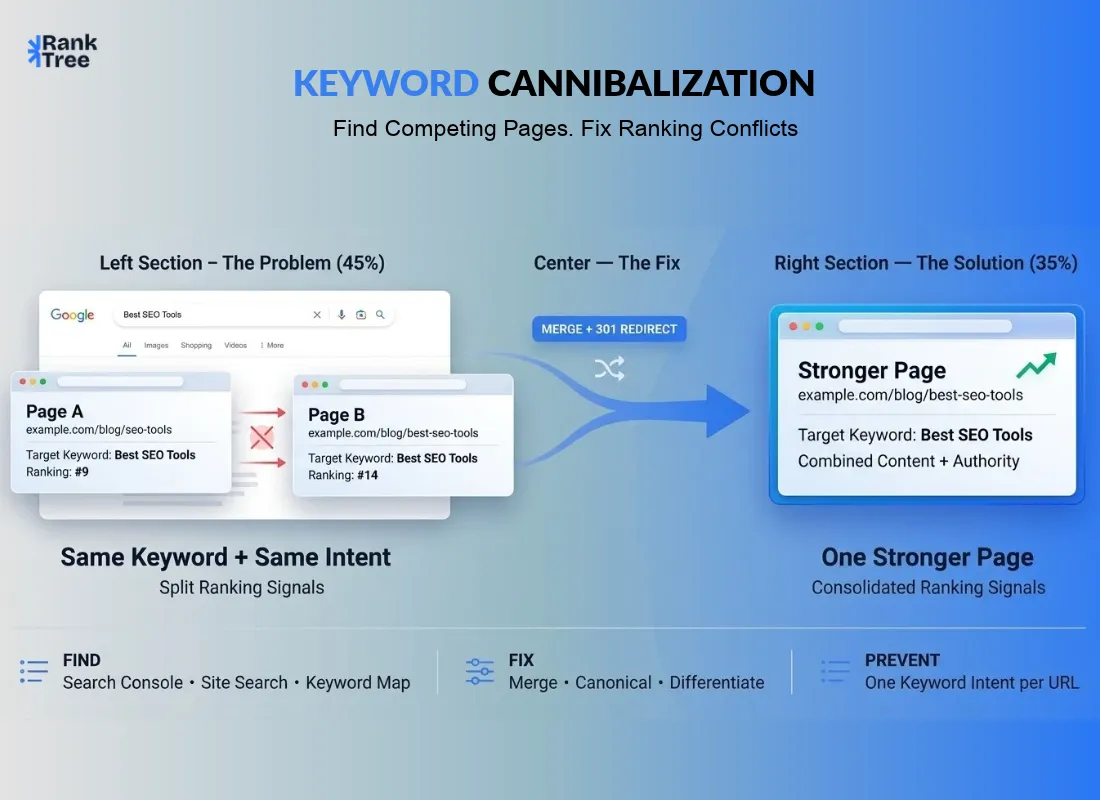
You published two solid articles. Both target the same keyword. And somehow neither one ranks as well as a single weaker page from a competitor.
That's not bad luck. Your pages are fighting each other for the same spot in Google and Google confused about which one deserves it rewards neither.
This guide covers what keyword cannibalization actually is three ways to find it on your site and exactly which fix to apply in each situation with a real example from a consolidation we ran on this very blog.
What Is Keyword Cannibalization?
Keyword cannibalization happens when two or more pages on the same website target the same keyword and search intent, forcing them to compete against each other in Google's results.
Instead of one strong page collecting all the ranking signals the signals split and both pages usually rank lower than one of them would alone.
Notice the two conditions: same keyword and same intent. A pricing page and a tutorial that both mention "keyword clustering" aren't competing; they serve different searchers. Cannibalization starts when both pages try to answer the same question.
Why It Hurts Your Rankings?
Your authority splits. Backlinks and internal links divide between two URLs instead of compounding on one. Neither page looks like the definitive answer.
Your rankings wobble. Google keeps swapping which page it shows #9 one week #14 the next. That instability is the classic symptom.
Your click through rate drops. When the wrong page surfaces, searchers skip it and weaker CTR feeds back into weaker performance.
Nothing breaks and no penalty lands. Your pages just quietly underperform and most owners blame the content instead of the overlap.
How to Find Keyword Cannibalization: 3 Methods?
Method | Cost | Speed | Catches |
Search Console query → Pages | Free | 15 minutes | Active competition (what Google actually does) |
site: operator | Free | 10 seconds | Obvious overlaps |
Keyword map audit | Free (your time) | A few hours | Future risks not just current ones |
Method 1: Google Search Console (most reliable)
Open Performance → Search results click a specific query then switch to the Pages tab. If two or more of your URLs earned impressions for the same query they're competing for it. That is cannibalization caught red handed straight from Google's own data.
Method 2: The site: operator (fastest spot check)
Type site:yourdomain.com "your target keyword" into Google. If two or more of your pages show up targeting the same term with the same intent you've got a suspect. Ten seconds surprisingly effective for obvious cases.
Method 3: Keyword map audit (most thorough)
List every page with its primary keyword and intent in a spreadsheet then sort by keyword. Duplicates jump out immediately including pages that would compete once they start ranking.
This is keyword mapping in action and it's the habit that prevents most cannibalization before it starts.
A Real Example: 12 Articles One Surgery
Theory is cheap so here's one from this blog. During a content audit we found 12 articles with heavy topic overlap buyer intent and commercial intent pieces circling the same keywords splitting signals across near identical intents.
The fix: we consolidated the 12 into 11 stronger pages. Overlapping content merged into the survivors every retired URL got a proper 301 to its survivor and nothing was deleted blindly the best sections of each retired article lived on inside the page that absorbed it.
Two lessons from doing it for real:
Merging beats deleting. Survivors inherited the strongest sections, examples and FAQs of the pages they absorbed. One comprehensive page outranks two thin competitors even when both competitors are yours.
The redirect map is the whole job. Mapping every retired URL to the right survivor verifying each 301 fires updating internal links that's where consolidations succeed or silently fail. Skip verification and you trade cannibalization for broken link equity.
How to Fix It: The Decision Framework
Situation | Fix | Watch out for |
Two articles same topic and intent | Merge + 301 redirect | Verify every 301 fires; update internal links to the survivor |
Both pages must stay live (e.g. variants) | Canonical tag | Canonicals are hints not orders Google can ignore them |
Overlap but slightly different angles | Differentiate re aim one at a distinct long tail | Half measures fail; commit to a genuinely different angle |
Page is outdated thin purposeless | Delete + 301 redirect | Only if the survivor is topically relevant; otherwise let it 404 |
Pick the stronger page (more traffic more backlinks) fold the weaker page's best content into it then redirect.
And finish the job in your internal links: if half your site still links to the retired URL especially with the target keyword as anchor text you're still voting for the wrong page.
When It's NOT Cannibalization?
Not every overlap needs surgery. Multiple pages ranking for your own brand name is normal. A tool page and a tutorial sharing a keyword serve different intents that's coverage not competition.
And your page ranking organically while your video wins a SERP feature is more of your property on the page not a problem. If "fixing" means deleting something genuinely useful to a distinct audience leave it alone.
How to Prevent Cannibalization?
One habit: one primary keyword and one intent per URL written down before you publish. Check the map before writing if the keyword belongs to a URL already improve that page or pick a different angle.
And when you group keywords into clusters by shared intent first each cluster maps to exactly one page which makes cannibalization structurally impossible.
New to the method? Start with the complete guide to keyword clustering. Run a check twice a year anyway sites drift as content grows.
Where RankTree fits in
Most cannibalization starts at the planning stage keywords never get grouped by intent so two pages accidentally chase the same one.
Keyword clustering solves exactly that: it groups your keyword list by shared intent before you write a word so each cluster maps to one page and overlaps never get created.
FAQs
What is keyword cannibalization in simple terms?
It's when two or more pages on your own website compete for the same keyword in Google. Your pages split the ranking signals between them so both rank lower than one consolidated page would.
How do I find keyword cannibalization in Google Search Console?
Open Performance → Search results click a specific query then switch to the Pages tab. If multiple URLs show impressions for that one query those pages are competing with each other.
What is the best way to fix keyword cannibalization?
Merge the competing pages into one comprehensive page and 301 redirect the weaker URL to the survivor. When both pages must stay live use a canonical tag instead.
Can two pages target the same keyword without cannibalizing?
Yes if they serve different search intents. A product page and a tutorial mentioning the same keyword answer different questions for different searchers. Cannibalization needs same keyword plus same intent.
How often should I check for keyword cannibalization?
Audit twice a year and right after any big content push. Prevention matters more: maintain a keyword map assigning one primary keyword and intent per URL before anything gets published.