Keyword Gaps: Why Checking Only One Direction Misses Half the Picture
By RankTree Team · 2026-08-13 · Updated 2026-10-07
Part of the Content Gap Analysis: How to Find & Fix Missing Content guide →
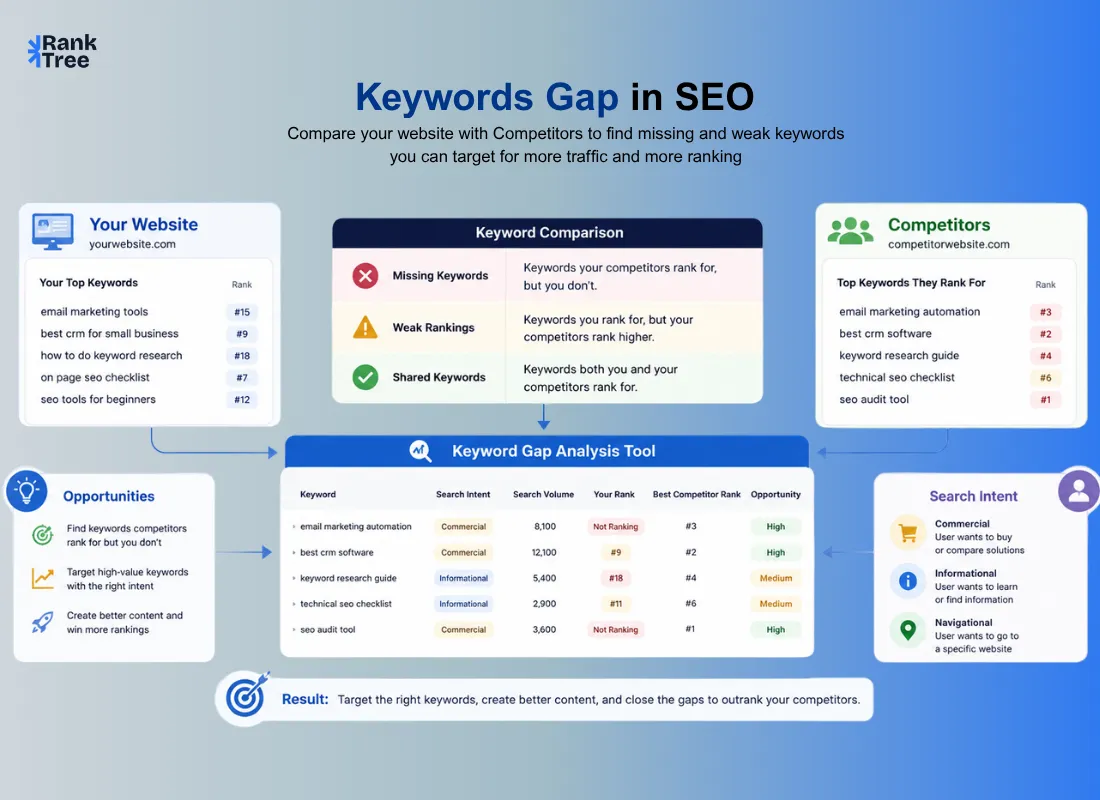
Most keyword gap guides show you only half the data. They tell you what your competitors rank for but ignore what you already own. That missing half is where your real advantage hides.
This guide covers the standard one directional process quickly then spends most of its time on the two things almost no explanation of keyword gaps includes: running the comparison in reverse and scoring what you find with an actual formula instead of eyeballing volume and difficulty side by side.
Keyword gaps are search terms your competitors rank for but your site does not, identified by comparing your domain against competitors in a keyword gap tool, which is distinct from a content gap that looks at entire missing topics and formats rather than individual ranking terms. The standard process only answers where competitors are ahead, so it should always be paired with a reverse comparison, flipping the domains to reveal what you rank for that competitors don't, your differentiation, terms worth defending, and emerging content patterns. Before prioritizing by volume and difficulty, filter every candidate term by intent, informational, commercial, or transactional, since a term with great metrics is still a bad target if its intent does not match a page format your business can realistically deliver. Prioritize using the Gap Value Score, search volume multiplied by intent weight divided by keyword difficulty, and choose comparable competitors close to your own authority level so the resulting gap list stays realistic rather than unusably large.
What Are Keyword Gaps?
Keyword gaps are search terms your competitors rank for but your site does not, identified through keyword comparison tools.
That's distinct from a content gap which looks at entire topics and formats rather than individual ranking terms.
Most guides spend thousands of words on this distinction alone; the short version above is all that's needed before moving to the parts that actually change how you use the data.
How to Find Keyword Gaps?
Finding keyword gaps starts by comparing your website with competitors to see which keywords they rank for but you don’t. In simple terms, this shows missed opportunities where your content is not visible in search results.
You can use tools like Ahrefs, SEMrush or Google Search Console to identify missing keywords, weak rankings, and shared terms.
This process gives you a clear starting point to improve existing pages and create new content based on real search demand instead of guesswork.
The Standard Comparison (And Its Blind Spot)
The usual process: enter your domain and competitors into a gap tool, group results (shared gaps, weak rankings, competitor-only terms), then filter by difficulty and volume to build a content plan.
It works but answers only one question: where are competitors ahead? It ignores the reverse view, leaving you unclear on which terms are truly yours.
That gap can lead to abandoning strong content or chasing keywords that don’t fit your strengths.
Gap Type | What It Shows | Action |
Standard Gap | Competitor advantage | Create content |
Reverse Gap | Your strength | Optimize & defend |
Running the Comparison in Reverse
Flip the domains in your usual gap tool to find what you rank for that competitors don’t.
This reveals what standard checks miss:
Your differentiation: unique topics or angles you cover, often a stronger signal of authority than matching competitors term-for-term.
Terms to defend: if a keyword drives traffic and competitors haven’t targeted it, keep investing in that page (updates, links, depth).
Content patterns: recurring themes can highlight an emerging specialty to guide future content.
Practical habit: always run both directions. The standard gap shows where to expand; the reverse shows what to protect and build on.
Filter by Intent Before You Filter by Anything Else
Volume and difficulty get checked first in most workflows. That's backwards. A missing keyword with excellent volume and low difficulty is still a bad target if the intent behind it doesn't match what your page or your business can actually deliver.
Run every candidate term through this quick check before it goes any further:
Informationally the term expects an explanation or answer. Good fit for blog or guide content.
Commercially the term expects a comparison or evaluation before a decision. Good fit for comparison or "best of" style pages.
Transactional the term expects to act immediately. Good fit for product pricing or signup adjacent pages.
If a missing term is transactional but your only realistic content format is an educational blog post that gap isn't worth chasing yet the page you'd build wouldn't match what the searcher expects regardless of how favorable the volume and difficulty numbers look.
Choosing Competitors Who Are Actually Comparable?
A gap comparison against a competitor with dramatically more established authority than your site returns a list so large it's unusable nearly every term will show up as "missing" most of them out of realistic reach for months or years.
A more useful comparison uses competitors close enough in authority to be realistic targets with maybe one slightly stronger site included to show where the ceiling sits.
If every competitor in your comparison set is dramatically ahead of your own domain, narrow the list to sites closer to your current position and revisit the larger competitors again once your site has grown.
Grouping Without Creating New Overlap
Once you have a filtered scored list group related terms into single page clusters rather than treating each one as its own page.
The rule that prevents overlap here is simple: one clear intent, one cluster, one page.
If two terms from your list would require noticeably different page types to satisfy their intent if they don't belong in the same cluster, split them rather than forcing one page to serve both.
Cross Checking Against Paid Search Data
Most organic gap workflows miss an important signal: whether competitors are already bidding on a keyword in paid search.
If a term appears as a strong organic gap and multiple competitors are running ads on it it signals real commercial intent businesses are willing to pay for visibility which often indicates buyer intent even before you see your own conversion data.
On the other hand a term with good organic metrics but no paid competition should be treated cautiously; it may look promising but not actually drive purchases and the lack of ad spend can be an early warning.
This check is simple: quickly review which competitors are advertising on your top gap terms using any ad research or transparency feature in your keyword tool. It adds a practical validation layer to your Gap Value Score before investing in content.
Calculating the Gap Value Score
The Gap Value Score is a simple prioritization formula: Search Volume × Intent Weight ÷ Keyword Difficulty. Intent Weight reflects how close the keyword sits to a conversion — 1 for informational intent, 2 for commercial intent, 3 for transactional intent (see the FAQ below on adjusting these). A higher score means more potential value for less competitive effort, so sort your gap list by this score first.
Building a Simple Tracking Sheet
Keep the output of all this in one place rather than scattered across tool exports. A simple sheet with one row per term and these columns covers everything above without needing anything more elaborate:
Term
Search volume
Intent category
Keyword difficulty
Gap Value Score
Paid competition present (yes/no)
Assigned page/cluster
Direction (standard gap or reverse/defend)
Last reviewed date
The "Direction" column matters more than it looks it's the single field that keeps the reverse analysis from quietly disappearing back into a one directional habit over time.
Every term should be tagged as either something you're chasing or something you're defending and both categories deserve a place on the same sheet rather than being tracked separately or not at all.
Re Auditing on Triggers Not Just a Calendar
A quarterly check is a reasonable default but waiting for the calendar date misses gaps that open up faster than that. Treat these as immediate re audit triggers instead of waiting for the scheduled review:
A known competitor publishes a wave of new content in your topic area
A term you're tracking shows a sudden ranking swing in either direction
Your own new page underperforms its Gap Value Score expectation after a reasonable indexing period
Checking on triggers rather than only on schedule catches shifts while they're still small enough to act on cheaply.
Common Mistakes Specific to This Process
Only running the comparison one way. Skipping the reverse check means missing what you're already doing well, often leading to abandoning strong but overlooked pages.
Chasing every low difficulty term. Easy rankings aren’t valuable if the intent doesn’t align with what your business can deliver.
Comparing against vastly stronger competitors. This inflates the gap with unrealistic targets making the process feel more overwhelming than it should be.
Relying on gut feel instead of a formula. Without consistent scoring priorities shift with each reviewer leading to inconsistent decisions.
Related Reading
If you haven't already paired this with a content gap analysis to understand not just missing keywords but missing topics and formats entirely the two work best used together not as substitutes for each other.
FAQs
How is a reverse keyword gap check different from reviewing my own top pages?
A top page review shows what performs well on your site alone. A reverse gap check compares that performance against competitors confirming whether a term is truly uncontested or just quietly ranking.
Should the intent weights in the Gap Value Score always be 1, 2 and 3?
They’re solid defaults but adjust them to fit your model. Ad driven sites may value informational traffic more while signup focused sites should prioritize transactional intent.
What if a high scoring gap doesn’t fit any existing page type?
That’s a cue to create a new page type. Forcing a mismatch (e.g. transactional intent on a blog page) usually fails both search engines and users.
Is keyword gap analysis useful for a brand new site?
Yes The reverse check will show little initially due to limited data so start with the standard approach to plan content then use reverse checks once rankings develop.
RankTree Team — The RankTree team writes about SEO strategy, keyword clustering, and topical authority to help you build content that ranks.