How to Check Keyword Difficulty (and What the Score Actually Means)
By RankTree Team · 2026-10-27 · Updated 2026-10-27
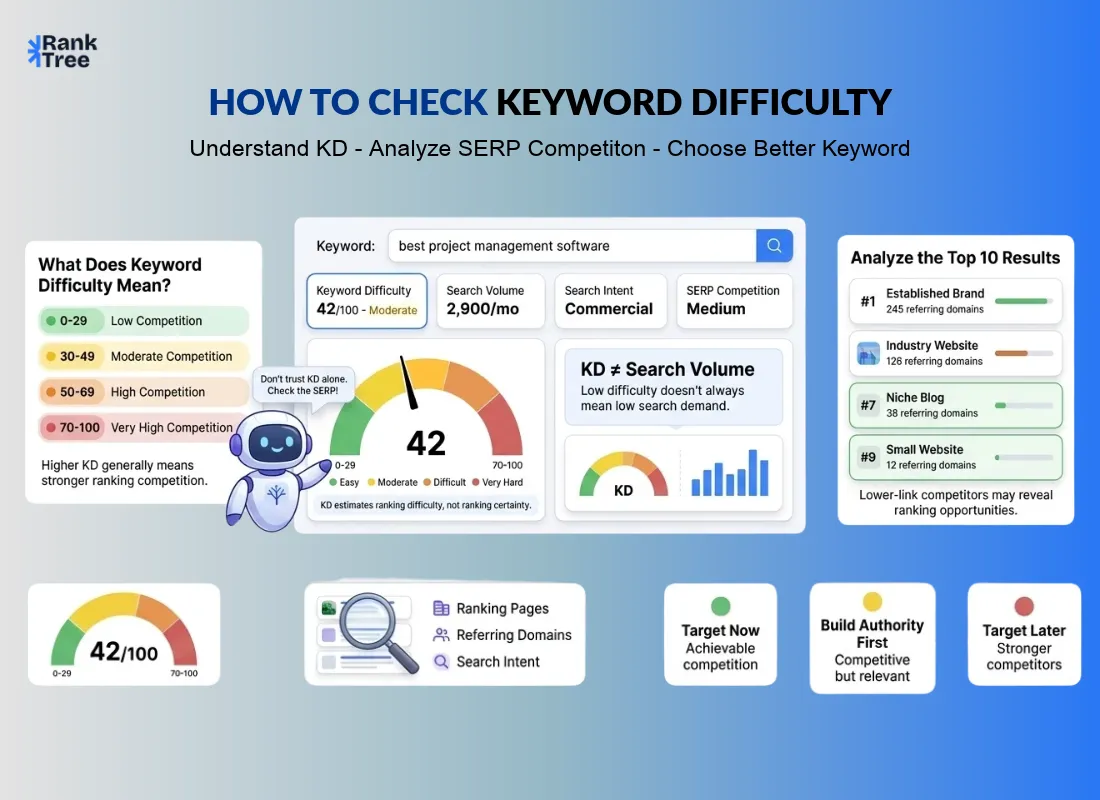
You found a keyword worth targeting. Before you write a word, one question matters: can your site actually rank for it?
Keyword difficulty KD is the shortcut answer. It is a 0–100 score that estimates how hard it will be to reach Google's top 10 for that keyword. Higher means more effort, more links, more time.
This guide shows you how to check it, how to read the number, and how to decide whether the keyword is yours to take including the free ways to check it.
What Is Keyword Difficulty?
Keyword difficulty is a third-party estimate, scored from 0 to 100, of how hard it is to reach Google's top 10 for a keyword. A low score means a new page with a few good links can get there.
A high score means you are up against pages with hundreds of referring domains. Google publishes no organic difficulty score.
One warning before you go further: Keyword Planner's "Competition" column is not difficulty. It measures how many advertisers bid on the keyword.
A keyword can have high ad competition and low organic difficulty or the reverse. Ignore that column for this job.
How the Main Tools Calculate Keyword Difficulty?
Tool | What the score counts | Scale |
Ahrefs | Referring domains pointing at the top 10 pages | 0–100, non-linear |
Semrush | Median referring domains, Authority Score, follow/nofollow mix, SERP traits | 0–100%, six bands |
Moz | Domain and page authority of the top 10 | 0–100 |
Ubersuggest / Mangools | Their own mixes of links and authority | 0–100, own scales |
So why does the same keyword get three different scores? Because each tool measures something different, from a different link index, on a different day, in a different country. Ahrefs counts links.
Semrush blends links, authority, and SERP features. Moz leans on its own authority metrics. None of them is wrong they are answering slightly different questions.
Pick one tool and use it consistently. Comparing an Ahrefs 40 with a Semrush 60 tells you nothing.
What the Score Means: Two Tables That Matter?
Ahrefs publishes a table that turns its KD score into a link target roughly how many referring domains you need to reach the top 10:
Ahrefs KD | Referring domains needed |
0 | 0 |
10 | 10 |
20 | 22 |
30 | 36 |
40 | 56 |
50 | 84 |
60 | 129 |
70 | 202 |
80 | 353 |
90 | 756 |
Notice the curve: the jump from KD 40 to 50 needs 28 more domains. The jump from 80 to 90 needs 400. Difficulty does not grow in a straight line it bends upward, fast.
Semrush groups its 0–100% score into six bands:
Semrush KD% | Band | What it takes |
0–14 | Very easy | A new page can win |
15–29 | Easy | A focused page can win |
30–49 | Possible | Good content plus some links |
50–69 | Difficult | Strong content plus real links |
70–84 | Hard | Authority-site territory |
85–100 | Very hard | Only the strongest pages |
Both tables are the vendors' own published figures, not Google's. Treat them as a map, not a promise.
How to Check Keyword Difficulty for Free?
Ahrefs free checker one keyword at a time, with a SERP overview. If you use Ahrefs, our guide on how to use Ahrefs to find keywords walks through the tool step by step.
Semrush free — 10 searches a day.
Moz — 10 free searches a month.
Ubersuggest — a few free searches a day.
The manual check — search the keyword yourself. Forums, Reddit threads, or new blogs in the top 10 are a good sign: the ranking pages are weak. Long, well-linked guides from big brands are the opposite.
Free tiers use limited data, so treat a free score as a first read, not a final verdict. Confirm it with the live SERP before you commit to a keyword.
The 5-Step Check: Can You Rank for This Keyword?
Step 1: Find your comfort zone in your own data
Open Google Search Console, look at the last three months, and list the queries you already rank 1–10 for. Look up their KD scores. That range is your comfort zone today the difficulty you can already handle.
Step 2: Read the live SERP
Search the keyword and look at what actually ranks: the intent, the format, the features sitting above the organic results. A page that answers a different question than the searcher asked will not rank, whatever its KD says. Check the search intent first, then trust the score.
Step 3: Look at who ranks, page by page
Big brands, niche experts, forums, fresh pages, stale pages? A top 10 full of thin or outdated pages is an opening. Weak pages in the top 10 are content gaps you can win.
Step 4: Count the links you would need
Check the referring domains of the pages in positions 5–10. That is your real target, not the top 3.
Step 5: Decide now, later or park it
Decision | When |
Target now | KD inside your comfort zone, SERP shows weak pages, intent matches |
Target later, with a cluster | KD above your zone, but the topic is core to your site — build the cluster first |
Park it | KD far above your zone, top 10 full of strong brands, no weak page in sight |
When you target later, score the whole cluster, not one keyword. Group the keywords first with keyword clustering, publish the easiest pages first, link them to the pillar, then return for the head term once the cluster has earned links.
Keyword clustering tools can group the list for you the KD check then runs on the group, not on one keyword at a time.
What Keyword Difficulty Can You Rank For?
New site: Semrush 0–29, Ahrefs KD under about 20. Win the easy ones first.
Growing site: up to 40–45, with strong content and a few good links.
Established site: up to 60–65, with excellent content and real authority.
One more thing the score cannot see: the same KD is easier when you already cover the topic in depth.
A site with ten good pages on a subject can win a KD 45 keyword that a general site cannot touch topical coverage moves your effective difficulty down.
Worked Example: One Keyword, Three Different Scores
GrowthMinded checked the keyword "lose belly fat" in three tools on the same day: Ahrefs said 83, Semrush said 100%, Moz said 72. Same keyword, three different answers — because each tool measures something different.
The decision is the same in all three readings: this is not a keyword a new site targets first. The score is high everywhere, and the top 10 is full of health publishers with serious link profiles.
The right move is a narrower version of the same idea a long-tail keyword with a KD under 30 and a return to the head term later, once the cluster around it exists.
Common Mistakes
Chasing scores near zero. A KD of 0 usually means nobody searches for it.
Comparing scores across tools. An Ahrefs 40 and a Semrush 60 are different measurements.
Reading Keyword Planner Competition as difficulty. It counts advertisers, not organic strength.
Ignoring intent. The wrong format will not rank, whatever the score says.
Never rechecking. KD moves as pages gain and lose links — check again before you commit.
FAQs
How do I check keyword difficulty for free?
Use a free checker such as Ahrefs' free Keyword Difficulty Checker, or a free tier Semrush gives 10 searches a day, Moz gives 10 a month. Enter the keyword and the country, read the 0–100 score, then check who actually ranks.
What is a good keyword difficulty score for a new website?
Semrush 0–29 (very easy or easy), or an Ahrefs KD under about 20. Then confirm with the live SERP before you commit — a low score on a mismatched SERP is still a bad target.
Why do Ahrefs and Semrush show different difficulty for the same keyword?
They measure different things. Ahrefs counts referring domains to the top 10. Semrush blends median referring domains, authority, the follow/nofollow mix, and SERP traits. Compare scores only inside one tool.
Does Google use keyword difficulty?
No. KD is a metric created by SEO tool vendors. Google ranks with its own systems and publishes no organic difficulty score.
How many backlinks do I need to rank for a KD 40 keyword?
Ahrefs' own table suggests about 56 referring domains to reach the top 10. Treat that as a rough guide, not a guarantee — intent, content, and topical coverage move the real number.