SEO Content Strategy: The Complete Framework for 2026 (With Examples)
By RankTree Team · 2026-09-08 · Updated 2026-10-20
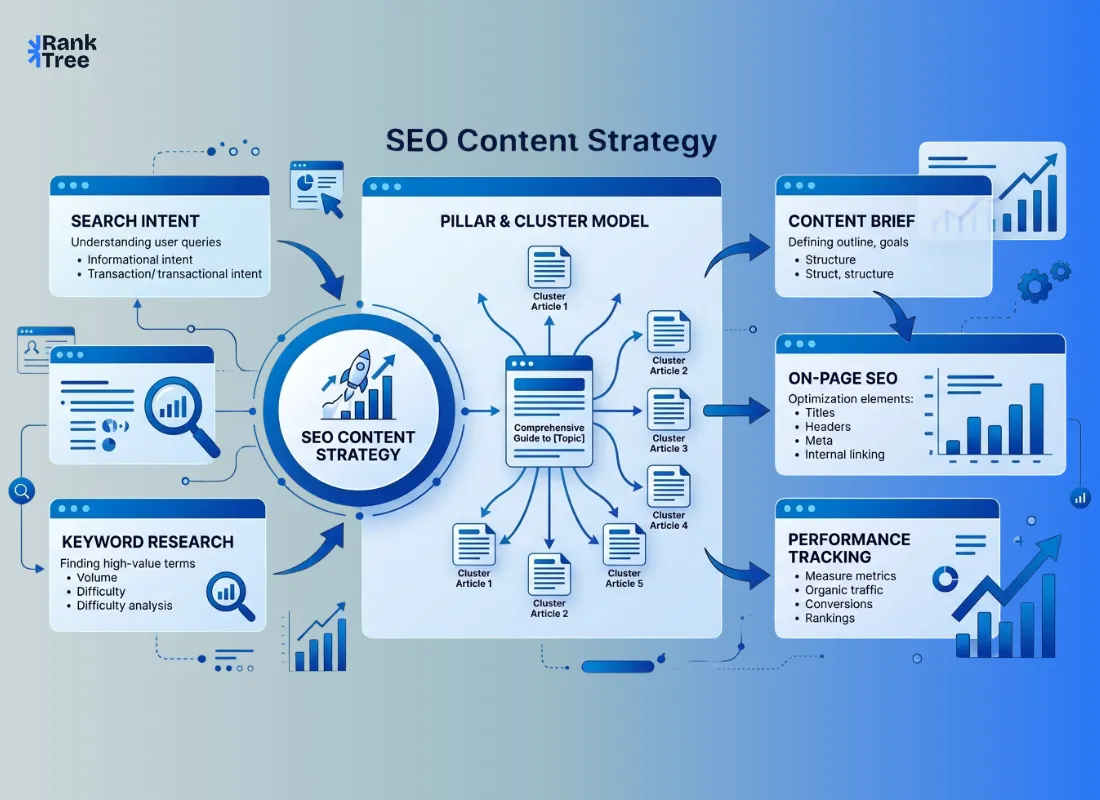
An SEO content strategy is a structured system for planning, organizing and scaling content to drive consistent organic growth.
Instead of publishing isolated articles it focuses on building connected topics, prioritizing high impact pages and creating a clear content roadmap aligned with business goals.
If you’re starting from zero, that’s an advantage you can build it correctly from day one instead of fixing years of scattered content later.
Note: This guide focuses on the planning layer what to build, in what order and why. For execution see our SEO Content Writing Guide.
An SEO content strategy is a structured system for planning, organizing, and scaling content to drive consistent organic growth by building connected topics rather than publishing isolated articles, prioritizing high-impact pages and creating a roadmap aligned with business goals.
It rests on four pillars: audience research into real problems and language customers use, keyword research organized into topic clusters rather than a flat list, pillar pages paired with supporting cluster articles that link back to reinforce depth and content funnel mapping so each page serves a defined role in attracting, evaluating or converting users.
Building it means defining the business goal first, grouping researched topics into themes, mapping several supporting articles under each pillar before writing begins, briefing every piece, setting a publishing cadence matched to that goal and tracking performance after three to six months to decide what gets refreshed.
Without this structure, content strategies fail through topic overlap, cannibalization and pages that never earn the authority a coordinated cluster would.
What Is an SEO Content Strategy?
An SEO content strategy is a plan for deciding:
what topics to cover?
how those topics are structured?
which pages to prioritize?
and how everything connects into a scalable system
It turns a list of keywords into a structured content roadmap instead of isolated blog posts.
It’s also separate from execution tasks like writing articles or optimizing pages those belong to SEO content writing not strategy.
Why SEO Content Strategy Matters for Growth?
It builds topical authority not isolated rankings
Search engines evaluate how well your content covers an entire topic not just individual pages.
When multiple related pages are connected and structured properly they reinforce each other and signal depth rather than randomness.
It creates a scalable system
Instead of random publishing each page supports others through internal linking and structure.
This allows you to expand into new topics without losing clarity or creating confusion across your content.
It improves content efficiency
A clear plan reduces wasted effort on low impact topics and prevents overlapping content.
It ensures that every piece you create has a defined role and contributes to overall growth instead of sitting unused.
It supports long term growth
As your content structure strengthens new pages rank faster and require less effort to gain visibility.
Over time this creates a compounding effect where existing content helps future content perform better.
It reduces content overlap and confusion
Without a structured strategy multiple pages can end up targeting similar topics which weakens performance.
A clear system ensures that each page has a distinct purpose and supports the overall structure.
It strengthens internal linking and navigation
A well planned structure makes it easier to connect related pages naturally. This improves both search engine understanding and user navigation across your content.
The 4 Pillars of an Effective SEO Content Strategy
1. Audience research
Before using any keyword tool, start with the real problems your audience is trying to solve, the questions they ask before buying, and the language they naturally use.
This becomes the foundation for every other step; skipping it leads to targeting the wrong topics, even if execution is technically strong.
Talk to sales and support teams, review support tickets, and analyze customer feedback to capture real phrasing, not internal assumptions.
Audience research focuses on understanding problems questions and real world use cases your content should address.
2. Keyword research and topic mapping
Keyword research is not about volume, but about realistic opportunities based on your site’s current authority. For new SaaS sites, this means prioritizing long-tail, low-competition terms to gain traction early.
Group related keywords into themes to form topic clusters, and run competitor gap analysis to identify keywords others rank for that you don’t yet target. The goal is not just collecting keywords but organizing them into structured topics.
3. Topic clusters and pillar pages
A pillar page provides broad coverage of a core topic, while cluster articles dive into specific subtopics and link back to the pillar.
This interconnected structure signals depth and authority to search engines far more effectively than isolated content.
4. Content funnel mapping
Each piece of content should serve a role in your growth system:
some pages attract new users
some help users evaluate solutions
some support conversions
The goal is to create a balanced structure not just publish informational content.
Step by Step: How to Build Your SEO Content Strategy
Step 1 Define the business goal first
Decide whether your focus is traffic demo requests, free trial signups or category authority. Your goal determines which keywords are worth pursuing and how success will be measured.
Step 2 Research topics and group them into themes
Use Google Search Console Ahrefs or Semrush to surface what your audience is searching for around your product category.
Group findings into topic themes rather than a flat keyword list for a new site favor themes built on long tail low competition terms you can realistically win over broad terms you can't yet compete for.
Step 3 Build your topic clusters
Choose 2–3 core pillar topics aligned with your SaaS product. Map 5–8 supporting articles under each before writing a single word this avoids keyword overlap and orphaned pages later.
Step 4 Write a brief for every piece
Outline how each topic will be covered and how pages will connect to each other before moving into writing.
Step 5 Set a cadence that matches your goal not a generic schedule
Cadence isn't one size fits all it should follow directly from Step 1:
Goal = demo requests → prioritize fewer deeper BOFU/MOFU pieces over raw volume
Goal = topical authority → prioritize consistent output across a full cluster before moving to the next
Goal = quick traffic validation → start with 2–3 long tail TOFU pieces to test before committing resources to a full cluster
One well researched well optimized article per week aligned to the right goal consistently outperforms four rushed undirected ones.
Step 6 Track then decide what gets refreshed
After 3–6 months identify pages ranking on page 2 (positions 11–20) and pages with declining traffic.
Prioritize refreshes on pages closest to page 1 and pages tied to commercial intent these carry the highest return per hour of rework. (For how to actually execute a refresh see our SEO Content Writing Guide.)
A Real Topic Cluster Example (SaaS) With a 3 Month Roadmap
If your product is say a customer support helpdesk tool a cluster might look like this:
Pillar: "Customer Support Software: The Complete Guide"
Cluster: "Help Desk vs. Ticketing System: What's the Difference?"
Cluster: "How to Reduce First Response Time in Customer Support"
Cluster: "Best Customer Support Software for Small Teams"
Cluster: "Customer Support KPIs Every Team Should Track"
Cluster: "How [Your Product] Helped [Customer] Cut Resolution Time by X%"
A realistic build order for a new site:
Month | Focus |
Month 1 | Publish the pillar page + 1 supporting comparison article ("Help Desk vs. Ticketing System") these two together validate the topic and start earning early rankings |
Month 2 | Add 2 supporting how to and KPI articles and interlink everything published so far |
Month 3 | Add the "best for small teams" and customer story pieces then revisit Month 1 content for early refresh opportunities |
Each supporting article links back to the pillar and to at least one sibling article. That interlinking is what turns five separate blog posts into one authoritative topic hub and it's exactly what a scored and sequenced roadmap like this is built to produce.
How Keyword Clustering Builds a Strong Content Strategy?
A strong content strategy is built on structure not individual keywords. Grouping related keywords into clusters allows you to:
prevent keyword cannibalization
cover topics completely
build stronger internal linking
scale content without overlap
This transforms a flat keyword list into a structured system:
keywords → clusters → pages → internal links
Without this structure content strategies often fail due to overlapping topics and weak organization.
Common Strategic Mistakes That Kill SEO Content Strategies
Publishing before researching intent technically solid content still fails if it answers the wrong question.
Building isolated pillars with no supporting cluster a pillar page published alone without the subtopic articles that should surround it rarely builds the authority a full cluster does.
Chasing volume over relevance 50 mediocre posts underperform 15 genuinely useful ones.
Treating every page as equally important without a prioritization framework low impact topics quietly consume the same resources as high impact ones.
Never refreshing old content rankings decay as competitors improve and information ages; a refresh calendar isn't optional.
Tools for Planning and Research
Google Search Console free essential for tracking what's already working and finding page 2 opportunities
Ahrefs or Semrush keyword research competitor gap analysis and cluster planning
Notion Airtable or Google Sheets mapping clusters briefs and the editorial calendar
How to Measure Content If It's Working?
Organic sessions your baseline growth indicator
Keyword rankings track movement for target terms not just top 3 vanity terms
Click through rate reveals whether your titles and meta descriptions are actually earning clicks
Engagement (time on page scroll depth bounce rate) shows whether content satisfies intent after the click
Conversions and assisted conversions the metric that actually matters to the business even when a piece isn't the final touchpoint
For a new site don't expect meaningful ranking data before month 3–4. Content strategy is a compounding investment not a paid ads style instant channel.
FAQs
How long does it take for a new SaaS site to rank with SEO content?
Typically 4–6 months for initial movement on long tail terms and 9–12 months for more competitive terms depending on niche competition and publishing consistency.
How many articles should a topic cluster have?
Most effective clusters have one pillar page and 5–10 supporting articles though this scales with how broad the core topic is.
Do I need to hire an SEO consultant to execute this?
Not necessarily the framework above is executable in house with the free tools listed. A consultant becomes more valuable once you're scaling output or troubleshooting a plateau.
In this guide
- SEO Content Brief: Template, Example and Scoring System
- Content Brief Tools and Generators: What They Are and How They Work
RankTree Team — The RankTree team writes about SEO strategy, keyword clustering, and topical authority to help you build content that ranks.