Primary vs Secondary Keywords: How to Use Both to Rank Faster
By RankTree Team · 2026-07-06 · Updated 2026-10-20
Part of the 15 Types of Keywords in SEO Everyone Must Know guide →
Most pages don’t fail because of bad content. They fail because the keyword strategy behind them is wrong.
If you don’t clearly separate your primary keyword from your related keywords, your page either becomes too broad or too shallow and Google struggles to understand what it should rank for.
The difference between primary vs secondary keywords is what allows a single page to rank for dozens of queries instead of just one. Get it wrong, and your content competes with itself.
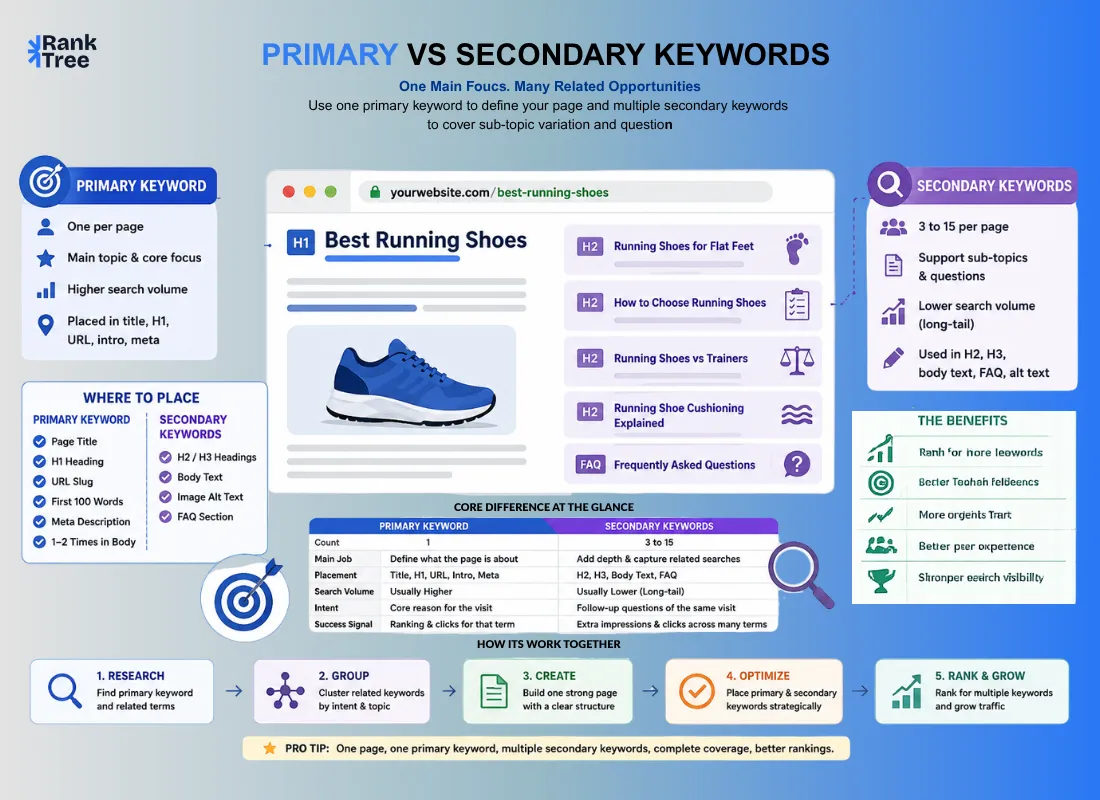
Here’s exactly how to use both the right way. A primary keyword is the main topic a page targets, while secondary keywords support it by covering related subtopics and variations to improve rankings and capture more search queries.
A primary keyword is the single main phrase a page is built around, defining its core topic and shaping its title, H1, and URL, while secondary keywords support it by covering related subtopics, variations, and follow-up questions the same reader is likely to search next. The two are not separate strategies but layers of one keyword cluster: a pillar page targets the broad head term, each supporting page targets one primary keyword from that cluster, and the secondary keywords on that page cover its sub-topics. How many secondary keywords to use scales with content length, roughly three to five for a short page and twelve to fifteen for a long guide, placed one per H2 or H3 rather than crammed into a single section. Getting the split wrong causes keyword cannibalization when the same primary keyword is targeted on multiple pages, or dilution when a secondary keyword with its own distinct intent is forced onto a page instead of earning its own.
Factor | Primary Keyword | Secondary Keyword |
|---|---|---|
Role | The single main phrase a page is built around | Supports the primary by covering related subtopics and variations |
Placement | Title, H1, URL | One per H2 or H3 |
Count per page | 1 | 3–5 for a short page, 12–15 for a long guide |
Risk if misused | Cannibalization — same primary targeted on multiple pages | Dilution — forced onto a page instead of earning its own |
What Is a Primary Keyword?
A primary keyword is the single main phrase a page is built around it defines the page's core topic and shapes its title H1 and URL. For the full breakdown of what makes a strong primary keyword and how to validate one, see Primary Keyword.
What Is a Secondary Keyword?
A secondary keyword supports the primary keyword by covering related subtopics variations and follow up questions the same reader is likely to search next. For the complete method on finding and mapping secondary keywords with data, see Secondary Keyword.
Real SEO Example
Let’s take a real SEO example instead of a generic one.
Primary keyword: “primary vs secondary keywords”
Secondary keywords:
difference between primary and secondary keywords
how to use related keywords
keyword placement SEO
primary keyword vs secondary keyword examples
Instead of creating separate pages, all of these should be covered in one structured page:
H1: Primary vs Secondary Keywords
H2: What Is a Primary Keyword
H2: What Is a Secondary Keyword
H2: Difference Between Primary and Secondary Keywords
H2: Where to Place Keywords in SEO
This allows one page to rank for multiple variations while fully satisfying search intent.
When to Use Primary vs Secondary Keywords?
Use a main search term when defining the main topic of a page. This should represent the core intent of the user and the main reason the page exists.
Use related keywords when expanding that topic into sub questions, variations, and supporting information that the same user is likely to search.
If a keyword has a different intent or requires a different page type, it should not be used as a supporting keyword. It should become its own core topic on a separate page.
How Many of Each Should You Use?
The count scales with the length and depth of your content.
Short pages (300 to 500 words): one primary keyword plus 3 to 5 secondary keywords. There is not enough room to do more without sounding forced.
Long guides (1500 to 2000 words): one primary keyword plus around 12 to 15 supporting keywords. There is more space to explore sub topics naturally.
The mistake most people make is treating keyword count as a target and forcing terms into content.
Modern search engines focus on context and intent, not keyword volume. A well covered topic will always outperform a page stuffed with loosely related phrases.
As a rule of thumb, keep your primary keyword density around 0.5%–1% and let secondary and semantic keywords appear naturally. If a phrase feels forced, remove it, natural language always performs better.
Where to Place Primary and Secondary Keywords?
Placement is where the theory turns into rankings.
Primary keyword placement:
Page title and H1 heading
URL slug
First 100 words of the intro
Meta description
At least one or two times in the body where it reads naturally
Secondary keyword placement:
H2 and H3 subheadings one secondary term per section where possible
Body text inside those sections answering the query directly
Image alt text where it genuinely fits
A short FAQ block at the end for question based variations
The cleanest method is one related keyword per section. Assign each secondary term to its own H2 or H3 then write a focused answer under it.
If two secondaries overlap heavily, merge them into one section and lead with the stronger phrase. This structure also helps people who scan because the answer sits exactly where they look for it.
How to Find Secondary Keywords Without Guessing?
You should not invent related keywords from your head. Pull them from real demand.
Good sources for secondary terms include:
Google Search Console queries that already bring impressions to the page
People Also Ask boxes on the SERP for your primary keyword
Related searches at the bottom of Google
Your own site search logs
A dedicated keyword clustering tool that groups related terms automatically
Doing this by hand is slow once you have more than a handful of pages. A keyword clustering tool speeds it up by taking a large list of keywords and grouping them by search intent and topic.
Each cluster usually maps to one page with the highest volume term becoming your primary keyword and the rest becoming candidate secondary keywords. That single step removes most of the guesswork from deciding what goes where.
How Primary and Secondary Keywords Fit Into a Keyword Cluster?
This is where most guides stop short so it is worth being clear. A primary keyword and its secondary keywords are not a strategy on their own. They are one piece of a larger keyword cluster.
A cluster is a group of closely related keywords organised around a single topic with a pillar page covering the broad subject and supporting pages covering the narrower sub topics.
Here is how the layers connect:
The cluster is the full topic and all its related keywords.
The pillar page targets the broad head term.
Each supporting page targets one primary keyword from the cluster.
The secondary keywords on each supporting page cover that page's sub topics.
So the question of primary vs secondary keywords is really a within page question while clustering is the cross site question of which page targets what.
When you map keywords into clusters, first choosing the primary and secondary keywords for each page becomes almost automatic.
You are no longer guessing; you are reading the cluster. This is also how you avoid the most common mistake in the next section.
Common Mistakes to Avoid
Keyword cannibalisation. Never target the same primary keyword on multiple pages. This creates internal competition and Google may rank neither page well. One core topic should belong to only one page.
Keyword stuffing. Overusing your primary keyword doesn’t help and can trigger quality issues. If exact match usage goes beyond 1% it usually becomes stuffing.
Treating secondaries as primaries. If a secondary keyword has different intent or strong volume give it its own page. Forcing it into the same page weakens both keywords.
Ignoring intent. Always check the top 10 results before finalizing a keyword. If the SERP shows comparison content and you publish a sales page it likely won’t rank.
Skipping measurement. Track performance in Search Console. If a supporting keyword starts getting impressions but lacks depth, expand that section instead of creating a new page.
Final Thoughts
Primary vs secondary keywords is not just about placement. It is about structuring your content so both search engines and AI systems can clearly understand your topic.
A well structured page built around one primary keyword and supported by tightly grouped supporting keywords creates depth, clarity, and stronger ranking signals.
This approach not only improves traditional rankings but also increases the chances of your content being selected in AI generated answers, where structured and topic focused content performs best.
Focus on clarity, not keyword count. The better your structure, the better your rankings.
FAQs
Can a page rank for keywords I didn’t target?
Yes, Well structured content often ranks for many related terms because search engines understand context. Focus on covering the topic, not listing every phrase.
Is keyword density still important in 2026?
It’s a guideline not a rule. Keep your primary keyword around 0.5%–1% and write naturally. Intent and relevance matter more.
What’s the difference between secondary and LSI keywords?
Secondary keywords are real search terms that can form sections. LSI (semantic) terms add context and are usually used naturally within content.
Should the primary keyword always be the highest volume term?
Usually yes because it has the most traffic potential and matches the page theme. The exception is when a slightly lower volume term fits your business goal far better. Conversion potential can outweigh raw volume.
Related reads
Primary Keyword Strategy: How to Find the Right Keyword Using Search Intent & Parent Topic
Secondary Keyword: Why the Top Ranking Page Rarely Ranks for Just One Term
RankTree Team — The RankTree team writes about SEO strategy, keyword clustering, and topical authority to help you build content that ranks.