What Is a Content Keyword? How to Find Winning Keywords
By RankTree Team · 2026-08-27 · Updated 2026-10-07
Part of the 15 Types of Keywords in SEO Everyone Must Know guide →
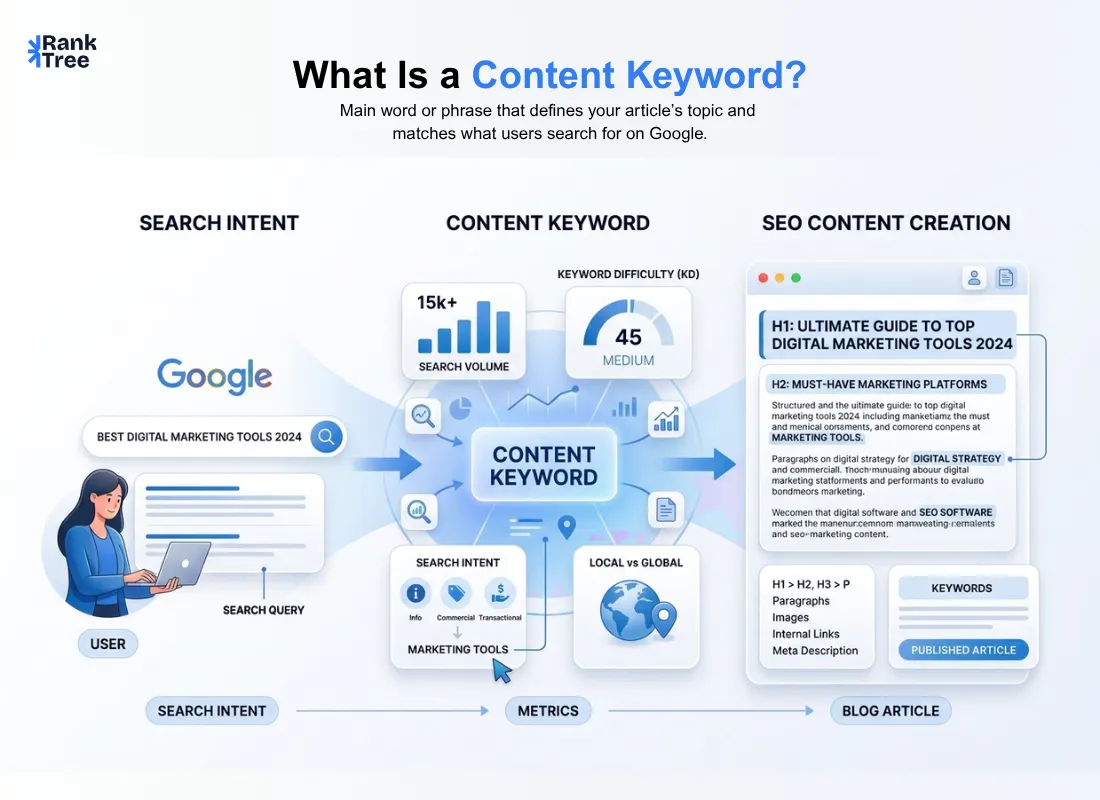
If you're building an SEO strategy for a website everything starts with one thing: the right keyword.
Before you write a single line of content you need to know what a content keyword actually is, how it differs from a search query and most importantly how to find one that's actually worth targeting.
This guide breaks down exactly that with a practical framework you can use for every piece of content you publish.
A content keyword is a word or phrase that defines the core topic of a piece of content and reflects what users actually type into a search engine to find it. It tells search engines what a page is about and tells writers what audience needs that page must satisfy, acting as the bridge between what people search for and what you publish. It differs from a search query, which is the exact, often messy phrase a user types in real time; a content keyword is the deliberate, research-backed term you choose in advance to build content around. A well optimized article targets one primary keyword supported by secondary keywords, long tail keywords, and semantic variations, which together help a single piece rank for multiple related queries instead of just one. A good content keyword balances decent search volume, manageable difficulty, and clear search intent, and matches what your content can genuinely deliver to the person searching for it.
What Is a Content Keyword?
A content keyword is a word or phrase that defines the core topic of a piece of content and reflects what users actually type into a search engine to find it. It tells search engines what a page is about and it tells writers what audience needs that page is meant to satisfy.
In simple terms: it's the bridge between what people are searching for and what you're publishing.
How Keywords Work Inside an Article?
Keywords act as signals for search engines to understand your content. They help Google identify your topic, categorize your page and decide where to rank it.
In a well optimized article keywords are naturally placed in key areas like the title headings URL and content body. But modern SEO is not about stuffing keywords.
It’s about using semantic variations related terms and natural language so your content feels human while still being optimized.
A single article usually targets one primary keyword supported by secondary keywords LSI terms and semantic phrases. This combination helps your content rank for multiple queries instead of just one.
Content Keyword vs. Search Query What's the Difference?
These two terms get used interchangeably but they're not quite the same thing.
A search query is the exact phrase a user types into Google at a specific moment. It's real time and often messy ("best project management tool for small teams 2026").
A content keyword is the target term you choose in advance based on research to build a piece of content around.
In other words search queries are the raw data. Content keywords are the strategic decisions you make after analyzing that data.
Types of Keywords You Should Use in Content (Quick Relevance)
There are different types of keywords used in SEO but since you already have a detailed guide on keyword types here we’ll keep it short and focused for relevance.
It's worth reading our full breakdown of keyword types and how each one fits into a content strategy before moving to the next step.
Every article should include:
A primary keyword (main topic of the page)
Secondary keywords (supporting variations)
Long tail keywords (specific queries with clear intent)
Semantic keywords (related terms that add context)
For example if your primary keyword is “content keyword” your secondary and semantic terms could include “SEO keywords” “keyword research” “search intent” and “content optimization.”
This structure helps you create topical authority and makes internal linking easier with your existing keyword type articles.
How to Find a Winning Content Keyword?
Not every keyword is worth building content around, especially when you're working with a new website that doesn't have authority built up yet. Before you commit to a keyword run it through these checks:
Factor | What to Look For |
Search Volume | How many people search for it monthly? Don't just look at the number check whether the trend is rising flat or declining. |
Global vs. Local Search Volume | A keyword might show a large global number but if your SaaS product only serves the US or UK that global figure can be misleading. Always check the volume filtered by the specific country you're targeting. |
Keyword Difficulty (KD) | For a brand new website prioritize low to medium difficulty keywords first. High KD terms are usually dominated by established competitors with strong domain authority. |
Search Intent | Is the searcher looking for information comparing options or ready to buy? Your content format and CTA should match the intent, not just the keyword itself. |
SERP Features | Check what's already ranking featured snippets "People Also Ask" boxes video carousels. This tells you what format Google expects for that keyword. |
Country/Region Targeting | If your SaaS serves multiple markets, evaluate volume and competition separately for each region rather than relying on a single blended number. |
CPC (Cost Per Click) | A rough signal of commercial value higher CPC generally means higher buyer intent even for organic content decisions. |
For gathering this data, tools like Google Keyword Planner, Ahrefs or Semrush all work well. RankTree is especially useful for newer sites, as it surfaces low-competition opportunities and clusters keywords into structured groups without digging through multiple reports.
The keyword that wins isn't always the one with the highest volume, it's the one where search demands achievable difficulty and clear intent all line up with what your content can realistically deliver.
How Keyword Clustering Improves Content Strategy?
Instead of targeting one keyword per page randomly, modern SEO focuses on keyword clustering.
Keyword clustering means grouping similar keywords based on intent and SERP similarity. This allows you to create one strong article that ranks for multiple related queries.
For example instead of writing separate articles for similar keywords you combine them into one comprehensive piece.
This is where tools like RankTree become useful. They help you automatically group keywords into pillar, sub pillar and cluster levels. This saves time and ensures your content strategy is structured properly.
Where to Place Content Keywords on Your Page?
Once you've chosen your keyword placement matters just as much as selection:
URL short readable includes the keyword
Title tag written for humans first keyword included naturally
Meta description keyword present but written to earn the click
H1 matches the primary keyword or a close variation
Body content used naturally throughout not stuffed
Image alt text descriptive keyword relevant where it makes sense
Common Mistakes to Avoid
Chasing volume over intent a high volume keyword with the wrong intent will rank but won't convert.
Ignoring country level data global numbers can make a keyword look more valuable than it is for your actual market.
Keyword stuffing repeating the keyword unnaturally hurts readability and can flag content as low quality.
Skipping competitor analysis if you don't know what's already ranking you're guessing instead of strategizing.
How to Create SEO Content That Wins with Keywords?
A winning SEO article is not just keyword optimized—it is user focused.
Start with a strong introduction that grabs attention. Then clearly answer the user’s query in the first section. After that provide detailed explanations, examples and insights.
Use simple language, clear structure and proper headings. Make your content easy to read and easy to scan.
Add semantic keywords naturally so your content covers the topic completely. This increases your chances of ranking for multiple queries and even appearing in featured snippets.
Conclusion: Build Your Content Strategy Around Keywords
Content keywords are the foundation of SEO. They guide your content, connect you with your audience and determine your ranking potential.
By understanding keyword intent, analyzing metrics and creating structured content you can turn simple keywords into powerful traffic sources.
The real goal is not just to find keywords but to use them strategically. When you combine keyword research clustering and high quality content you create a system that consistently drives organic growth.
If you focus on the right keywords and build content around them, ranking on Google becomes predictable not random.
FAQs
What makes a good content keyword?
A good content keyword balances decent search volume, manageable difficulty and clear intent and matches what your content can genuinely deliver to the searcher.
Is a content keyword the same as a search query?
Not exactly. A search query is what a user types in real time; a content keyword is the term you deliberately choose to target based on research.
Why does country specific volume matter?
Because global search volume can overstate real demand if your product only serves specific regions always check volume filtered by your target country.
Related reads
- Content Keywords in Search Console: Guide to Finding Analyzing and Ranking in the AI Era
- What Are Meta Keywords in SEO?
RankTree Team — The RankTree team writes about SEO strategy, keyword clustering, and topical authority to help you build content that ranks.