How to Find SERP Feature Opportunities in 2026
By RankTree Team · 2026-10-15 · Updated 2026-10-15
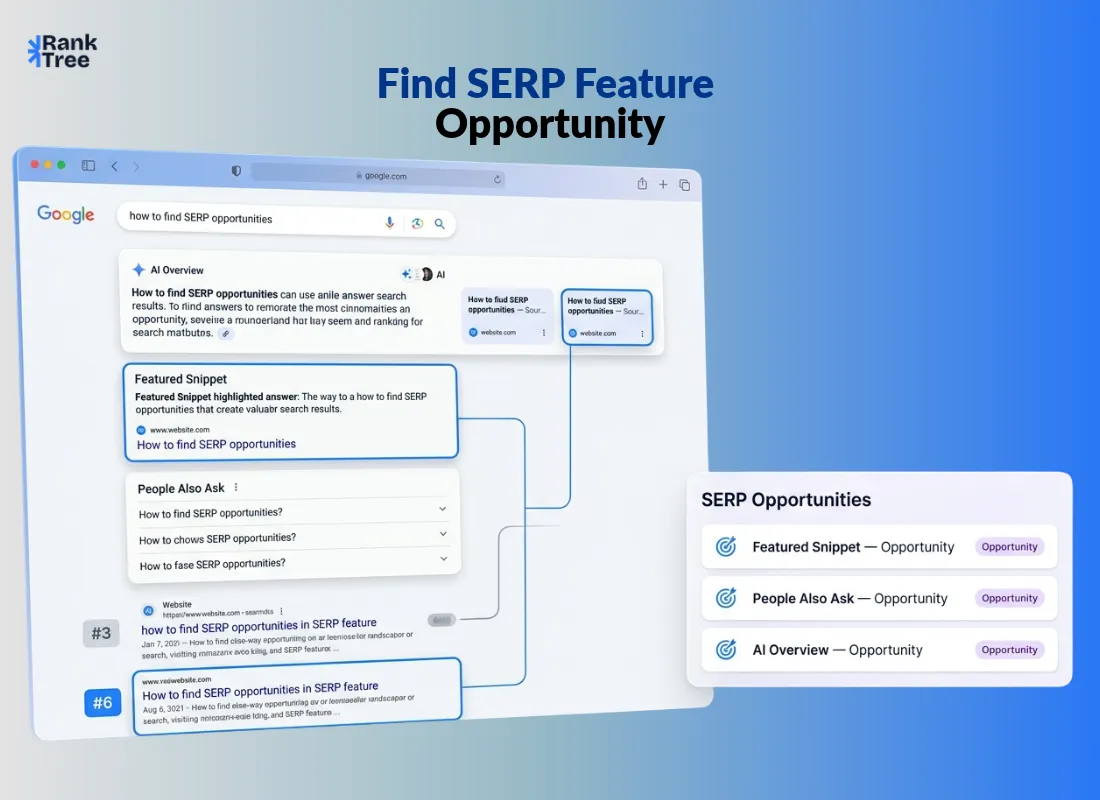
You finally hit position #3 for your money keyword. Traffic should pour in but it doesn't. Meanwhile the site at position #6 gets more clicks than you. What happened?
A featured snippet a People Also Ask box and an AI Overview pushed the organic results halfway down the page and your competitor sits inside every one of those boxes. You outranked them and still lost.
Those boxes are SERP features. And every feature you don't own is traffic you hand to someone else. This guide shows you how to find SERP feature opportunities: which features fire on your keywords where you're invisible and which gaps to close first.
What Is a SERP Feature Opportunity?
A SERP feature opportunity is a keyword where Google shows a SERP feature like a featured snippet a People Also Ask box an image pack or an AI Overview and your site doesn't appear inside it yet.
Finding these opportunities means mapping which features fire on your keywords spotting the ones you miss and fixing your content so you can win them.
Notice the difference: ranking #1 and owning the SERP are two different games now. You can win the first and still lose the second.
Why SERP Features Decide Who Gets the Click?
SERP features sit above the classic blue links. On many queries they answer the question right on the results page which means:
They steal clicks from even the #1 organic result.
They give massive visibility to whoever owns them sometimes more than ranking first.
Google keeps adding new ones. AI Overviews joined the lineup and changed the math again.
Here's the honest part: you can't buy most features and nobody can promise you'll win one. But you can find where the opportunities are and give yourself the best shot. That's what the rest of this guide does.
The 7 SERP Features Worth Chasing First
Not all features matter equally. These seven show up constantly and real sites actually win them:
SERP feature | What triggers it | How hard is it to win? |
Featured snippet (paragraph) | Question queries ("what is" "how to") | Medium |
People Also Ask box | Broad or question queries | Easy best starting point |
AI Overview | Informational complex queries | Medium hard (new still shifting) |
Image pack | Visual queries (design products diagrams) | Easy medium |
Video carousel | How to and tutorial queries | Medium (you need an actual video) |
Local pack | Medium (needs a Google Business Profile) | |
Product/review listings | Commercial queries | Medium |
Start with People Also Ask and image packs. They take the least effort and flip the fastest.
How to Find SERP Feature Opportunities: The 5 Step Workflow?
You don't need an expensive tool for this. A spreadsheet your keyword list and two focused hours work fine. (Tools speed it up SERP analysis tools can automate the mapping but the method below works manually.)c
Step 1: Map which features fire on YOUR keywords
Pull your top 20–30 keywords from Google Search Console the ones that already bring impressions. If you're still building your list start with a proper keyword clustering pass so you're working from real groups not guesses.
Now Google each keyword in an incognito window and log what you see:
Keyword | Features showing | Are you inside any? |
how to find serp features | Featured snippet PAA AI Overview | No |
serp analysis | PAA image pack | No |
One row per keyword. Be-honest "almost there" doesn't count.
Step 2: Find your zero presence gaps
A gap is simple: a feature fires on your keyword AND you're not in it. Highlight those rows. That's your opportunity list.
These zero-presence gaps are just the start our content gap analysis guide walks through the full method for finding every topic your competitors cover that you don't.
Ignore keywords where no feature appears there's nothing to win there yet. And ignore features you already own that's maintenance not opportunity.
Step 3: See who owns the features you're missing
Click into each feature. Whose content sits there? Open their page and study it:
What format did they use? (A 50 word definition? A Q&A list? A table?)
How deep does it go? (Two sentences or a full section?)
How fresh is it? (A 2022 article holding a snippet is vulnerable.)
This tells you the "price of admission" the minimum bar you must clear. You're not copying them. You're learning what Google currently rewards for that feature so you can beat it.
Step 4: Match the fix to the feature
Every feature wants something specific. Give Google exactly that format:
Feature you're chasing | What to add to your page |
Featured snippet (paragraph) | A 40–60 word direct answer right under an H2 that mirrors the search question |
Featured snippet (list) | A clean numbered or bulleted list under a matching H2 |
People Also Ask | One H3 per related question each answered in 2–3 sentences |
Image pack | Original images with descriptive file names and real alt text (not "image1.jpg") |
Video carousel | An actual embedded video text alone can't win this one |
AI Overview | Clear definitions fresh data and expert quotes be the source the AI cites |
Table snippet | A real HTML table comparing or listing the thing |
One page can chase two or three features. Don't chase all seven you'll dilute the page.
Step 5: Prioritize with the easy wins matrix
You can't fix fifty gaps at once. Score each opportunity on two axes:
Traffic value how many clicks does this feature steal each month? (Check the keyword's volume and how dominant the feature looks.)
Your chance to win is the current owner weak outdated or thin? PAA boxes and image packs score high here.
Start where high traffic meets high win chance. For most sites that's People Also Ask boxes on keywords you already rank for on page 1 you're one well structured Q&A section away.
Then re-check monthly. Features change hands constantly; today's gap list won't match next quarter's.
AI Overviews Changed the Game in 2026
AI Overviews now answer informational queries right at the top of results with citations linking to source pages. Nobody can optimize "for" the Overview directly there's no button to press. But citation patterns are emerging:
Clear quotable definitions get cited. Write the definition Google would want to quote.
Fresh specific data gets cited. "Recent" beats "comprehensive but old."
Real expertise signals get cited. Named authors original examples first hand experience.
Treat every definition block and data point in your content as a citation audition. The pages that explain things most clearly win the citations and the traffic that follows them.
How to Track Your SERP Feature Wins?
Winning a feature means nothing if you don't notice. Once a month re-run your sheet from Step 1 and mark what's changed: features gained features lost new features appearing.
For the bigger picture track it alongside your overall keyword visibility feature ownership and visibility move together and watching both tells you whether your content work is actually converting into SERP real estate.
3 Mistakes That Kill Your SERP Feature Chances
Chasing every feature on every page. A page optimized for seven features is optimized for none. Pick two or three per page max.
Copying the current winner's format exactly. Match the format Google rewards then beat the substance. A clearer answer in the same shape wins.
Setting it and forgetting it. Features rotate. A snippet you win in October can belong to someone else by December. The monthly re-check isn't optional it's the whole game.
FAQs
What is a SERP feature?
A SERP feature is any Google search result beyond the classic blue links featured snippets People Also Ask boxes image packs video carousels local packs and AI Overviews. They answer queries directly on the results page.
Can you give some examples of SERP features?
The most common are featured snippets (the answer box at the top) People Also Ask dropdowns image packs video carousels the local 3 pack with map product listings and AI Overviews.
How do I do a SERP analysis?
List your top keywords Google each one and record which SERP features appear and whether you're inside them. That map features vs. your presence is the core of SERP analysis. It shows exactly where your opportunities are.
What does SERP mean in Google search?
SERP stands for Search Engine Results Page the page Google shows after you search. "SERP features" are the special boxes and elements on that page beyond regular organic listings.
How long does it take to win a SERP feature?
Usually weeks to a few months after publishing or updating the page depending on crawl frequency and competition. Nobody can guarantee a timeline or a win. Track monthly and keep improving the pages that get close.