What Are Meta Keywords in SEO?
By RankTree Team · 2026-08-03
Part of the Search Intent: How Google Understands What Users Really Want guide →
If you've ever looked at a webpage's source code you may have stumbled across a line like this:
<meta name="keywords" content="running shoes best sneakers buy sneakers online">
That's a meta keywords tag and for years marketers believed stuffing it with keywords was the secret to ranking #1 on Google. It isn't. Not anymore.
In this guide you'll learn exactly what meta keywords are, the real history of why they stopped working, whether any search engine still uses them in 2026 and most importantly what you should be doing instead to actually improve your rankings.
What Are Meta Keywords?
Meta keywords are a type of HTML meta tag that website owners once used to tell search engines what topics or keywords a webpage was about.
They live inside the <head> section of a page's HTML code meaning they're invisible to regular visitors and only readable in the source code.
The syntax looks like this:
<head>
<meta name="keywords" content="keyword one keyword two keyword three">
</head>
You'll also hear meta keywords referred to as:
Metadata keywords
Meta tag keywords
The keywords meta tag
HTML keywords tag
Unlike your meta title or meta description which can appear directly in search engine results pages (SERPs) the meta keywords tag was purely a backend signal one that search engines have largely stopped listening to.
A Brief History: Why Google Stopped Using Meta Keywords?
Understanding why meta keywords lost their power helps explain why you shouldn't waste time on them today.
In the early days of search engines (1990s–early 2000s) meta keywords were a legitimate ranking factor. Webmasters would list their target keywords and search engines used that metadata to help categorize pages.
The problem? It was incredibly easy to abuse.
Site owners began keyword stuffing cramming meta keyword tags with hundreds of high-volume often irrelevant terms just to rank for popular searches.
A page selling kitchenware might stuff in "cheap flights" or "insurance quotes" simply because those terms got traffic.
This manipulation devalued the signal so badly that in September 2009 Google's then head of webspam Matt Cutts publicly confirmed that Google does not use the meta keywords tag in its web search ranking algorithm at all. Google hasn't reversed that stance since.
Meta Keywords vs. Meta Title vs. Meta Description
These three tags are often confused but they serve very different purposes:
Tag | Visible in SERPs? | Used as a Google Ranking Factor? | Purpose |
Meta Title | Yes | Yes | Appears as the clickable headline in search results |
Meta Description | Yes (as the snippet) | Not a direct ranking factor but affects click-through rate | Summarizes page content to entice clicks |
Meta Keywords | No | No | Historically listed target topics; now ignored by Google |
If you're going to spend time optimizing meta tags, prioritize your title tag and meta description not meta keywords.
Do Any Search Engines Still Use Meta Keywords in 2026?
Google may have dropped meta keywords in 2009 but what about other engines? Here's an updated breakdown:
Search Engine | Meta Keywords Stance |
Confirmed: not used as a ranking signal | |
Bing | Not used for ranking; excessive/stuffed tags may be flagged as a spam signal |
Yahoo | Powered by Bing's index; same treatment |
DuckDuckGo | Uses Bing's index; doesn't rely on meta keywords |
Yandex | Historically treated as a very weak signal; minimal impact today |
Baidu | Not confirmed to use meta keywords for ranking |
Naver | No official guidance suggesting meta keywords affect ranking |
Bottom line: Across every major search engine that matters for most websites meta keywords have little to no impact on rankings and in some cases overusing them can actively hurt you.
Why Should You Avoid Meta Keywords?
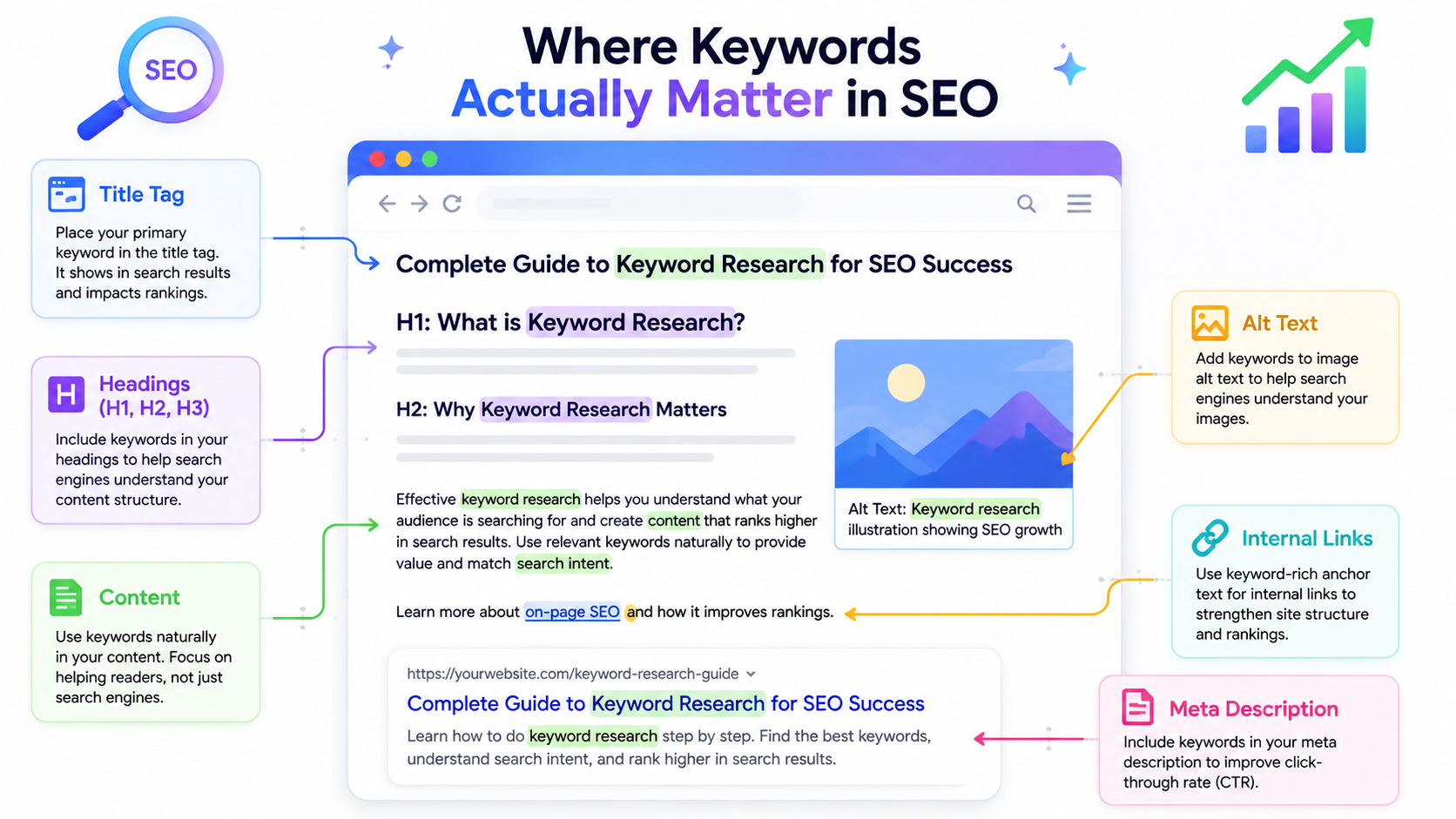
Beyond simply "not helping" there are real reasons to skip meta keywords altogether:
Zero ranking benefit on Google the search engine that drives the majority of organic traffic globally
Potential spam signal Bing may flag keyword-stuffed meta tags as a manipulation attempt
Competitor intelligence risk anyone can view your page source and see exactly which keywords you're targeting
Wasted time and resources time spent maintaining meta keywords is better spent on content internal linking or technical SEO
Outdated best practice recommending meta keywords (or tactics like stuffing misspellings into them) reflects SEO advice from over a decade ago not current standards
How to Add or Remove the Meta Keywords Tag?
If you're auditing an older site here's how to check for or remove meta keywords on common platforms:
WordPress (with Yoast SEO or Rank Math)
Go to the page/post editor
Scroll to the SEO plugin section
Modern versions of Yoast and Rank Math no longer include a meta keywords field by default this is intentional since it's a deprecated practice
If an old theme or plugin injects one remove it via Appearance → Theme Editor or disable the plugin responsible
Shopify
Shopify does not include a native meta keywords field in its theme editor reflecting current SEO standards. If you need to check your HTML go to Online Store → Themes → Edit Code and search for name="keywords".
Wix
Wix's SEO settings (under Marketing & SEO → SEO Tools) focus on title tags and meta descriptions; only meta keywords are not part of the standard interface.
Raw HTML
Simply locate the <head> section of your file and delete any line containing:
<meta name="keywords" content="...">
What to Do Instead: SEO Keyword Optimization That Actually Works?
Rather than relying on an invisible ignored tag place your target keywords where they genuinely influence rankings:
Title Tag: Include your primary keyword naturally near the beginning
Meta Description: Use your keyword to improve click-through rate (not rankings directly but still valuable)
Heading Tags (H1 H2 H3): Structure content around your primary and secondary keywords.
Body Content: Write naturally for readers first; include semantic and related terms (LSI keywords) not just exact match repetition
Alt Text: Describe images accurately using relevant keywords for both SEO and accessibility
Anchor Text: Use descriptive keyword relevant text for internal and external links
Schema Markup / Structured Data: Help search engines understand entities and context on your page beyond just keywords
Semantic & Entity-Based SEO: Modern search engines (especially Google post-BERT and post-MUM) understand topics, entities and intent not just literal keyword matches. Focus on comprehensively covering a topic rather than keyword density.
Tools like keyword research platforms and on-page SEO checkers can help you verify keyword placement and identify content gaps but the meta keywords tag itself isn't part of that equation anymore.
Do Meta Keywords Have Any Use Outside of SEO?
Yes in limited contexts:
Internal site search: Some website search functions use meta keywords to improve internal result matching.
Ad networks: A small number of legacy ad systems may use meta keyword data to serve contextually related ads.
Even here though most modern platforms have moved to more sophisticated content analysis methods making meta keywords largely redundant even for these secondary use cases.
Key Takeaways
Meta keywords are an HTML tag once used to signal page topics to search engines
Google has ignored meta keywords for ranking purposes since 2009
No major search engine today treats meta keywords as a meaningful ranking factor
Overusing or stuffing meta keywords can be flagged as spam and reveals your strategy to competitors
Focus your SEO efforts on title tags meta descriptions headings body content alt text anchor text and semantic/entity based optimization instead
FAQs
Does Google use meta keywords for ranking in 2026?
No. Google confirmed in 2009 that it does not use the meta keywords tag as a ranking factor and this has not changed since.
Are meta keywords the same as meta description?
No. Meta keywords are an invisible backend tag with no SERP impact while the meta description is a visible snippet shown under your page title in search results and can influence click-through rate.
Will adding meta keywords hurt my SEO?
Simply having the tag won't directly harm you but keyword-stuffed or irrelevant meta keywords can be flagged as a spam signal by engines like Bing and they expose your keyword strategy to competitors.
Should I remove meta keywords from my existing website?
It's not urgent but removing them is good housekeeping. Since they provide no SEO benefit, cleaning them up simplifies your codebase without any ranking risk.
What should I focus on instead of meta keywords?
Prioritize your title tag meta description header structure high-quality body content alt text internal linking and semantic/entity based content coverage.