Generative AI Intent: Understanding AI-Driven Intent in SEO
By RankTree Team · 2026-07-24 · Updated 2026-10-22
Part of the Search Intent: How Google Understands What Users Really Want guide →
Most people think AI generated content fails because of poor writing. That’s not true. The real problem is deeper.
AI can generate words, sentences, even full articles in seconds. But without understanding why the content is being created the output may look correct yet lacks direction, purpose and impact.
That missing layer is called Generative AI intent. If your content does not align with intent whether human or AI driven it will not rank, convert or deliver real value.
In today’s search landscape with systems like large language models (LLMs) Google AI Overviews and conversational search understanding generative AI intent is no longer optional. It has become the foundation of modern SEO and content strategy.
This guide explains what generative AI intent is, how it works, how it differs from traditional search intent and how you can optimize your content to align with AI driven systems.
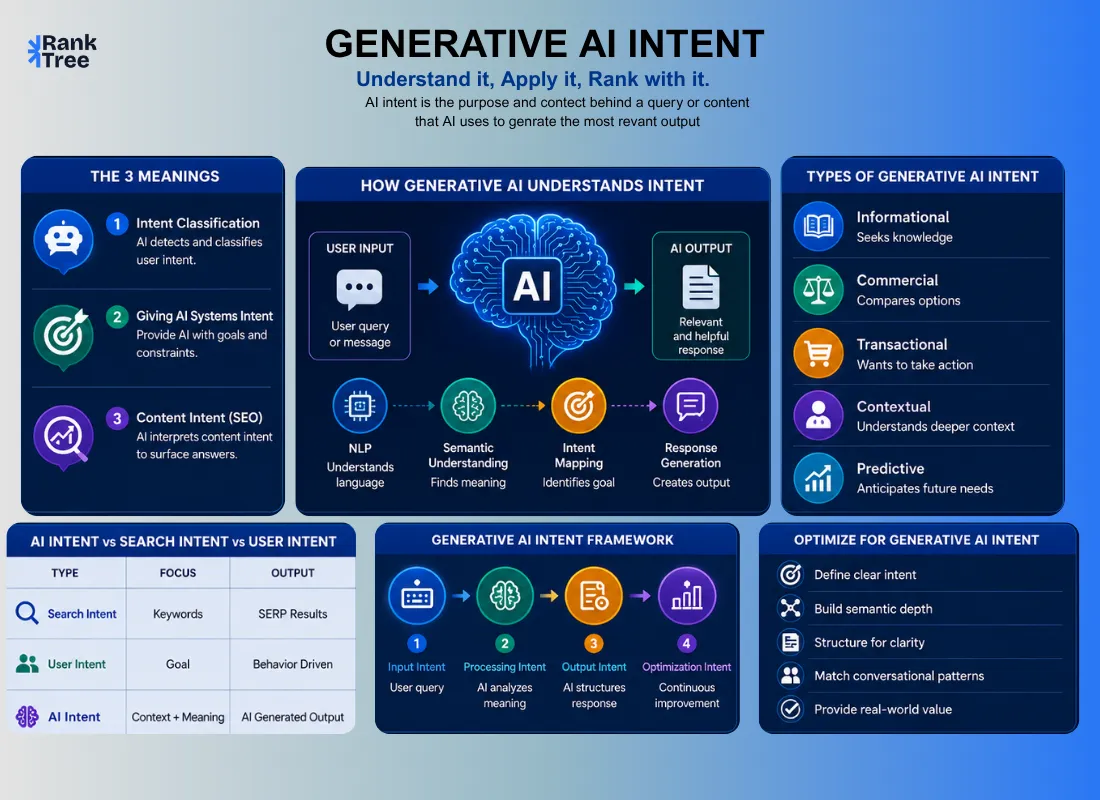
Generative AI intent refers to the underlying purpose, goal, and contextual direction an AI system uses to generate meaningful output from a user's input — not just what it generates, but why. Unlike keyword matching, generative AI relies on natural language processing, semantic understanding, and contextual reasoning to interpret the deeper meaning behind a query, weighing linguistic meaning, user expectations, domain context, and learned patterns together. The term covers three related meanings: intent classification (identifying what a user wants from a message), giving AI systems intent (defining goals and constraints so multi-step agentic workflows stay coherent), and how AI interprets content intent for SEO (evaluating whether content actually satisfies the meaning behind a query, not just its keywords). This third meaning matters most for search visibility: content that matches keywords but lacks intent clarity may still be indexed, yet it will not be selected for AI-generated answers.
What Is Generative AI Intent?
Generative AI intent refers to the underlying purpose, goal and contextual direction that an AI system uses to generate meaningful output based on user input. In simple terms it defines not just what AI generates but why it generates it.
Unlike traditional systems that rely on keyword matching, generative AI uses natural language processing, semantic understanding and contextual reasoning to interpret deeper meaning behind a query.
When a user enters a prompt AI does not just retrieve information. It processes multiple layers including linguistic meaning, user expectations, domain context and probability patterns from training data.
For example a query like “best CRM for startups” is not treated as just informational. AI interprets it as a commercial query where the user expects comparisons, recommendations and decision support.
The Three Meanings of Generative AI Intent
Generative AI intent is often misunderstood because it is used in three different but related ways.
1. Intent Classification Using Generative AI
This is the most practical and widely used meaning.
Intent classification is the process of identifying what a user wants from a query or message so the system can respond correctly.
Traditional models required large labeled datasets and complex training. Generative AI models now perform this task using few examples or structured prompts reducing setup time from weeks to hours.
This is commonly used in:
Customer support automation
Search query understanding
SaaS product workflows
2. Giving AI Systems Intent (Agentic AI)
As AI systems move from single prompts to multi step workflows they need clear direction to stay consistent.
Without defined intent AI workflows drift. Each step may look correct individually but fail to achieve the overall goal.
In practice giving AI intent means:
Defining clear goals
Setting constraints and guardrails
Maintaining context across steps
Evaluating outputs against the original objective
This is critical for advanced AI systems and automation workflows.
3. How AI Interprets Content Intent (SEO Context)
This is where generative AI intent directly connects to SEO.
Search engines are no longer just indexing content. They are generating answers by extracting and combining information from multiple sources.
AI systems evaluate whether your content actually satisfies the underlying intent behind a query.
If your content matches keywords but lacks intent clarity it may still be indexed but will not be selected for AI generated answers.
Generative AI Intent vs Search Intent vs User Intent
Generative AI intent is not the same as search intent or user intent although all three are connected.
Search intent focuses on what the user types into a search engine.
User intent refers to the real goal behind that search.
Generative AI intent goes a step further; it determines how AI interprets and responds to that intent.
Comparison Table
Type | Definition | Focus | Output Behavior |
What user searches | Keywords | SERP results | |
User Intent | Why user searches | Goal | Behavior driven |
Generative AI Intent | How AI interprets and responds | Context + meaning | Generated output |
This distinction is critical for SEO. Traditional SEO optimized for search intent. Modern SEO must optimize for AI interpretation of intent.
If your content matches keywords but not intent, AI systems will ignore or misinterpret it.
Generative Intent: The Fifth Search Intent
For years, SEOs sorted every query into four boxes: informational, navigational, commercial, transactional. That framework still works for classic search. It just doesn't cover what people now type into ChatGPT, Gemini, or AI Mode.
Those prompts don't ask for a link. They ask for a finished thing — a draft, a plan, a comparison, a fix. That is generative intent, and SEOs have started treating it as a fifth search intent. The classic four still live in our search intent guide this article won't repeat them.
Generative prompts split into six sub-types:
Content creation a ready draft or asset. Example: "Write a product description for noise-cancelling headphones"
Problem-solving a diagnosis and a fix. Example: "My traffic dropped after a redesign what broke?"
Data processing numbers crunched or compared. Example: "Compare these 5 tools in a table with prices"
Personalized advice a plan made for their situation. Example: "Build a 90-day SEO plan for a small dental clinic"
Creative output original material in a style. Example: "Draft a case study in a friendly tone"
Code & technical a script or config that works. Example: "Write a Python script to cluster these keywords"
Why should an SEO care? Because each type demands a different page. Content that only answers "what is" questions wins the first type and misses the other five.
Pages that include a worked example, a comparison table, or a ready template give AI systems something to cite for the rest.
Why Generative AI Intent Matters in SEO?
Generative AI intent matters because search engines are no longer just indexing content they are generating answers.
With the rise of AI powered search experiences including Google’s AI Overviews and conversational assistants, content is now evaluated based on how well it satisfies intent at a deeper level.
This shift changes everything.
Previously ranking depended on:
keyword optimization
backlinks
technical SEO
Now ranking increasingly depends on:
contextual relevance
semantic depth
intent alignment
structured information
Generative AI systems extract, summarize and recombine content. If your content lacks clear intent signals it becomes unusable for AI systems.
This leads to three major consequences:
First your content may not be selected for AI generated answers.
Second, even if indexed, it may not appear in top positions because it does not match intent properly.
Third, it may fail to convert because it does not guide the user journey.
In short, generative AI intent directly impacts visibility rankings and conversions.
How Generative AI Understands Intent (NLP and LLM Processing)
Generative AI understands intent through a combination of NLP machine learning models and contextual reasoning.
At its core generative AI relies on large language models trained on massive datasets. These models identify patterns in language meaning and relationships between words.
The process works in multiple stages.
First the system analyzes the input using natural language processing. It identifies entities context and structure of the sentence.
Second, it interprets semantic meaning. Instead of focusing on exact keywords it understands relationships between concepts.
Third it maps the input to probable intent categories based on learned patterns.
Fourth it generates output aligned with that interpreted intent.
For example when a user asks:
“how to improve SaaS onboarding”
the AI identifies:
domain: SaaS
topic: onboarding
intent: informational with strategic value
expected output: actionable steps
This allows the system to generate a structured and relevant response.
This entire process is driven by:
semantic understanding
contextual embeddings
token prediction models
probabilistic reasoning
This is why generative AI can handle complex conversational and ambiguous queries better than traditional systems.
How to Optimize Content for Generative AI Intent?
Optimizing for generative AI intent requires aligning content with how AI systems interpret and generate responses.
First focus on clarity of intent. Each piece of content should answer a specific question or solve a defined problem.
Second, use semantic depth. Instead of repeating keywords include related concepts, entities and context.
Third, structure content properly. Use clear headings, logical flow and direct answers.
Fourth, include real world examples. AI systems prioritize practical actionable content.
Fifth match conversational patterns. AI models favor natural language over keyword stuffed content. Finally ensure consistency. Your content should maintain alignment between topic intent and execution.
Get cited, not just ranked
Ranking gets you into the list. AI answers work differently: one prompt fans out into several hidden sub-questions, and the AI builds its reply from pages that answer those pieces clearly. Google's own guidance says there is no separate trick here — visibility in AI features still rests on solid SEO. What changes is the writing:
Answer sub-questions, not just the main one. A page that covers the follow-ups gets quoted more.
Keep key answers in short, standalone blocks an AI can lift without surgery.
Use your own numbers and examples. AI systems cite pages that add something, not pages that repeat the consensus.
Think of it as a second reader. Your first reader is a human scanning the page. The second is a model deciding whether your paragraph is safe to quote.
A Practical Framework for Applying Generative AI Intent
Use this decision path to identify which problem you're actually solving:
Are you trying to understand what a user wants from a single message? → Meaning 1 (intent classification). Start with structured output prompting before reaching for a custom model.
Are you building a multi step AI workflow that needs to stay coherent across steps? → Meaning 2 (intent as direction). Start by writing an explicit goal and constraint specification before building the workflow.
Are you trying to get your content surfaced accurately in AI Overviews or AI generated answers? → Meaning 3 (content intent alignment). Start by auditing whether your content answers the real underlying question, not just the literal keyword.
Is per request cost or latency a hard constraint at scale? → Consider a fine tuned or smaller purpose built model over a general purpose API call.
Common Mistakes
Defaulting to custom model training when a handful of few shot examples with structured output would solve the problem faster and cheaper.
Treating "AI intent" as a purely abstract concept without translating it into concrete goal specifications and constraints for actual workflows.
Optimizing content for keywords alone missing the deeper intent alignment that AI Overviews and conversational search now weigh heavily.
Ignoring edge cases and ambiguous inputs during classification setup only discovering gaps after deployment.
Building multi step agentic workflows without persistent intent context leading to output that drifts from the original goal by the final step.
Start With the Simplest Approach That Solves Your Problem
Whether you're classifying support tickets or designing a multi step AI workflow the same principle applies: start with an explicit concrete specification of what you're trying to accomplish before reaching for the most complex technical solution available. Most real world intent problems are solved faster with a clear few shot prompt and structured output than with a custom trained model save the heavier infrastructure for the cases that genuinely need it.
FAQs
What is generative AI intent?
Generative AI intent is the purpose and context AI systems use to generate meaningful responses based on user input.
How is generative AI intent different from search intent?
Search intent focuses on queries while generative AI intent focuses on how AI interprets and responds to those queries.
Do I need to train a custom model for intent classification in 2026?
Usually not as a starting point. Structured output prompting with a general purpose LLM handles most classification tasks well; custom training becomes worthwhile mainly at high volume strict latency requirements or data residency constraints.
What does it mean to give an AI system "intent"?
In practice it means explicitly specifying the goal constraints and success criteria for a task or workflow rather than relying on the AI to infer purpose from a single prompt which becomes especially important in multi step agentic systems.
Is generative intent a fifth type of search intent?
Many SEOs now treat it that way. The classic four intents describe what a searcher wants from a results page. Generative intent describes what a user wants an AI to produce — a draft, a plan, a comparison, a fix. The two systems overlap, but the output the user expects is different, so the content that wins is different too.
RankTree Team — The RankTree team writes about SEO strategy, keyword clustering, and topical authority to help you build content that ranks.