How Many Keywords Per Page: SEO Guide to Keyword Usage & Strategy
By RankTree Team · 2026-08-22 · Updated 2026-10-07
Part of the 15 Types of Keywords in SEO Everyone Must Know guide →
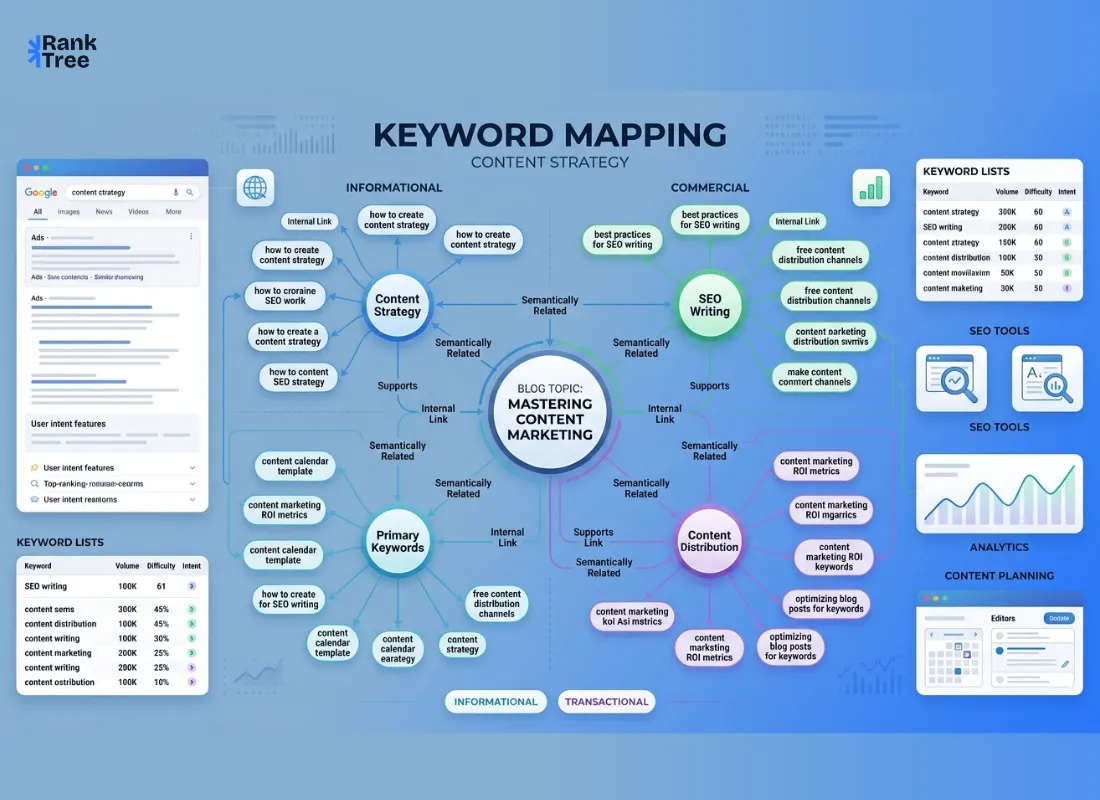
The old rule was "one keyword per page." The real answer for modern SEO is different: 1 primary keyword, 3–8 secondary keywords, and as many natural semantic variations as the topic genuinely calls for — not because that's a magic count, but because Google ranks a single page for dozens or even hundreds of related queries at once, not just the one you optimized for.
This guide covers how that works, how search intent changes keyword usage, and how keyword clustering lets one page rank for many keywords instead of splitting them across separate pages.
How many keywords should a page target? A page should focus on one primary keyword, 3 to 8 secondary keywords, and as many natural semantic variations as the topic genuinely requires, rather than chasing a fixed count. Google now uses context, meaning, and entity relationships to understand what a page covers as a whole, not just which phrase gets repeated, so it ranks a single page for dozens or even hundreds of related queries at once. The right number scales with content length: 500-800 words typically supports 1 primary plus 2-4 secondary keywords, 1000-1500 words supports 1 primary plus 4-6 secondary keywords, and 2000-3000+ words can carry 1 primary plus 6-10 secondary keywords with wider topical coverage. Keyword density is not a strict ranking factor; keyword clustering, grouping related keywords under one focused page by shared search intent, is the more effective strategy than splitting them across separate pages.
Why "One Keyword Per Page" No Longer Works
That advice comes from an era when search engines matched content to queries by exact keyword text. Google now uses context, meaning, and entity relationships — via Natural Language Processing — to understand what a page covers as a whole, not just which phrase you repeated.
Practically, this means: if your page targets "how many keywords per page," Google also expects to see related terms like keyword density, SEO optimization, and keyword strategy show up naturally. Your primary keyword acts as the main signal; secondary and long-tail keywords extend that coverage. Counting keywords is the wrong exercise — covering the topic completely is the right one.
Each page should have:
Keyword Type | Example | Purpose |
Primary Keyword | how many keywords per page | Main ranking focus |
Secondary Keywords | keywords per page SEO | Variation targeting |
Long tail Keywords | how many keywords should a blog post have | Specific intent capture |
Semantic Keywords | keyword usage search queries SEO content | Context building |
This structure lets your page rank for multiple queries while staying focused on a single topic.
Types of Keywords You Should Use on a Single Page
A well optimized page includes different types of keywords working together.
Primary keywords define the main topic of the page and should appear in key areas like the title headings and introduction.
Secondary keywords support the main keyword and help capture variations that users search for. These are often used in subheadings and body content.
Long tail keywords target specific user questions and usually appear in FAQs or detailed sections.
Semantic keywords add depth to your content and help Google understand the overall context without repeating the same phrase.
How Keyword Usage Changes by Search Intent
Keyword usage depends on search intent and is a key factor in modern SEO.
Informational Intent Keyword Usage
For informational content, keyword usage should be broad, educational and semantically rich.
The primary keyword appears naturally in the introduction while secondary keywords are used in headings and long-tail keywords in FAQs or detailed sections.
The focus is on providing value, answering questions and covering the topic in depth, which helps the page rank for more keyword variations.
Commercial Intent Keyword Usage
In commercial content keywords are comparison based and decision focused. They often include terms like best, top, review or comparison, used in headings, tables and product comparisons.
The goal is to build trust and guide users toward a decision with structured keyword placement.
Transactional Intent Keyword Usage
Transactional content uses action-oriented keywords focused on conversions. Terms like buy, get, use or tool names are placed near CTAs, product sections or landing pages.
This content is shorter, more direct and designed to drive action rather than explain concepts.
Keyword Clustering vs Single Keyword Targeting
Keyword clustering is a more effective strategy than targeting a single keyword.
Instead of creating separate pages for each keyword, clustering groups related keywords with the same intent and targets them on one page.
This improves content depth, avoids duplication and increases ranking potential across multiple queries — exactly what search engines prioritize.
How to Use Keyword Clusters on One Page? (Step by Step)
To use keyword clusters effectively, map your keywords based on search intent before creating content
Group related keywords that share the same meaning or user goal
Assign those keywords to a single page if their intent matches
Use clustering tools like RankTree to analyze relationships between queries and align them under one focused topic
Separate keywords with different intent into different pages to avoid confusion and keyword cannibalization
Ensure each page stays focused on one topic while targeting multiple relevant keywords
Keyword Density vs Keyword Usage
Factor | Keyword Density | Keyword Usage |
Definition | Percentage of how often a keyword appears in content | Natural and contextual use of keywords in content |
SEO Importance | Not a strict ranking factor | Highly important for modern SEO |
Approach | Fixed % (e.g., 1% guideline) | Flexible and natural placement |
Focus | Keyword repetition | Topic coverage and relevance |
Risk | Can lead to keyword stuffing and over-optimization | Keeps content readable and user-friendly |
Google Preference | Less important | Preferred by Google |
Best Practice | Use as a loose guideline only | Focus on clarity, variation, and intent |
Does Word Count Affect Keyword Usage?
Yes, keyword usage naturally changes with content length, but it should always remain natural and intent-focused.
Content Length | Keyword Usage Strategy |
500–800 words | 1 primary + 2–4 secondary keywords, limited variations |
1000–1500 words | 1 primary + 4–6 secondary + more semantic keywords |
2000–3000+ words | 1 primary + 6–10 secondary + wide topical coverage |
Common Keyword Mistakes That Hurt Rankings
One of the biggest mistakes is keyword stuffing where the same keyword is repeated excessively without adding value.
Another common issue is keyword cannibalization where multiple pages target the same keyword and compete against each other.
Using irrelevant keywords that do not match user intent can also reduce your rankings, because Google prioritizes relevance over keyword presence.
Avoiding these mistakes is essential for building strong SEO performance.
Bottom Line
Focus on one primary keyword supported by multiple related keywords that match the same search intent — not on hitting a specific count. When a page is built around a clear topic, uses natural variations, and matches intent, it ranks for multiple keywords without forced optimization.
FAQs
How many keywords should a blog post have?
A blog post should focus on one primary keyword and include multiple related keywords naturally throughout the content.
Can one page rank for multiple keywords?
Yes, a single page can rank for many keywords if they belong to the same topic and search intent.
Is keyword density still important in SEO?
Keyword density is not a major ranking factor, but maintaining natural usage helps avoid over-optimization.
Should every page target different keywords?
Yes, each page should target a unique keyword cluster to avoid cannibalization and improve clarity.
What is keyword stuffing in SEO?
Keyword stuffing is the excessive use of keywords in content, which negatively affects readability and rankings.
RankTree Team — The RankTree team writes about SEO strategy, keyword clustering, and topical authority to help you build content that ranks.