Semantic Keyword Gaps in SEO: Fix the Missing Piece
By RankTree Team · 2026-08-29 · Updated 2026-10-07
Part of the Content Gap Analysis: How to Find & Fix Missing Content guide →
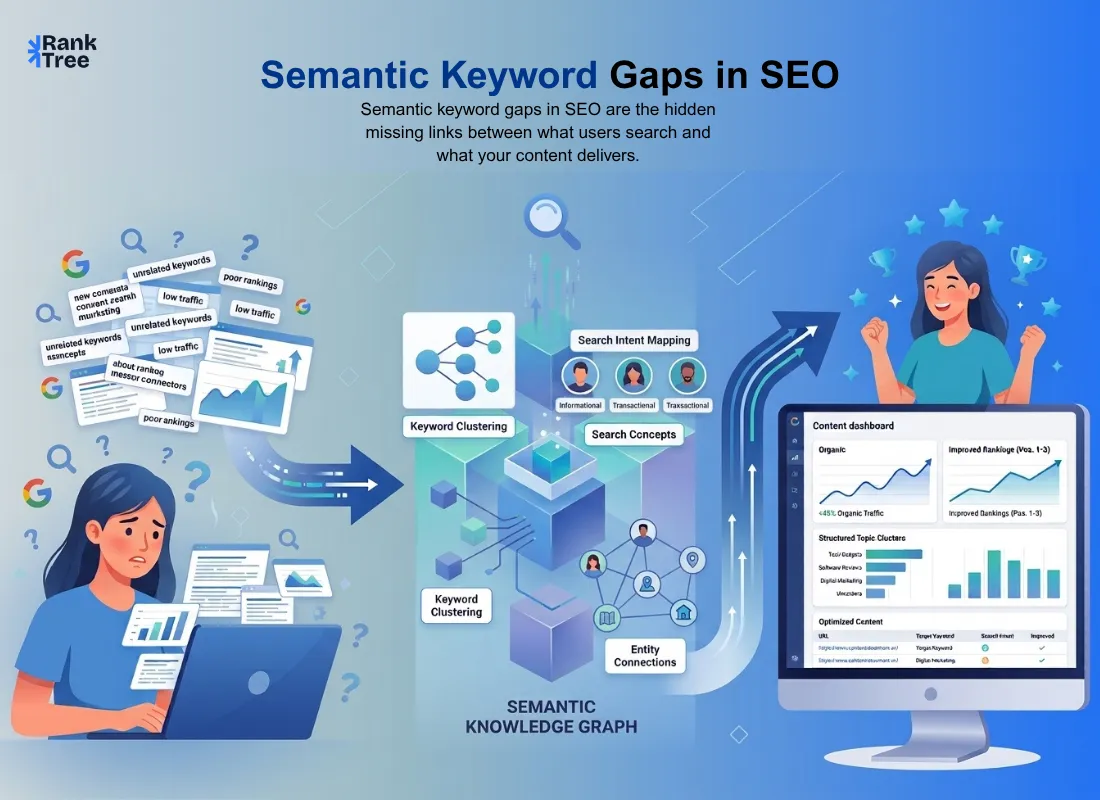
You publish content, optimize keywords and still your page refuses to rank. It feels like everything is “right” yet something invisible is holding your rankings back.
Today's ranking depends on how completely your content covers the meaning behind a query and the distance between what you cover and what top ranking pages cover is called a semantic keyword gap.
If your page "should" rank but doesn't, a semantic keyword gap is one of the most common and most fixable reasons why.
This guide breaks down exactly what semantic keyword gaps are the different types you'll run into, how to find them with real tools and a step by step process to close them before your competitors do.
A semantic keyword gap in SEO is the missing context, related terms, and intent-driven concepts a page fails to cover within a topic, meaning it may target the right main keyword but still miss the broader meaning and expectations search engines expect around it. This differs from a content gap, an entire missing subtopic or page, an entity gap, missing named things like tools or standards the topic implies, and an intent gap, a mismatch between content format and what the searcher actually wants. Because modern search engines build a statistical picture of what complete coverage of a topic looks like, missing that expected vocabulary lowers topical relevance, weakens long tail visibility, and reduces eligibility for AI-generated summaries. Fixing it means analyzing search intent first, extracting semantic terms from People Also Ask and competitor content, clustering keywords by topic similarity, expanding content to cover related questions and use cases, and explaining relevant entities rather than just inserting them.
What Are Semantic Keyword Gaps?
Semantic keyword gaps in SEO are the missing context related terms and intent driven concepts that your content fails to cover within a topic.
In content gap analysis this means your page may target the main keyword but does not fully address the broader meaning and expectations behind it.
Search engines today rely on semantic search, natural language processing and entity relationships to understand content.
If your page lacks important supporting terms related queries or key concepts it creates a semantic gap. This gap reduces your relevance and limits your ability to rank for multiple variations of a query.
Semantic Keyword Gap vs Related Gap Types
These terms get used loosely and interchangeably which causes confusion. Here's how they actually differ:
Gap Type | What's Missing | Example |
Semantic keyword gap | The vocabulary phrasing and related terms search engines expect around a topic | Writing about "email marketing" without ever mentioning "deliverability" "segmentation" or "open rate" |
Content gap | An entire subtopic or page you haven't published at all | Competitors have a "pricing comparison" page and you don't |
Entity gap | Specific named things (people brands standards tools) the topic implies | Writing about "semantic SEO" without mentioning "Knowledge Graph" or "schema markup" |
Intent gap | Matching the searcher's underlying goal format or stage of decision making | Publishing a definition post when the SERP wants a comparison |
A semantic keyword gap focuses specifically on missing context related terms and topic depth within a page.
Unlike broader content gaps, this type of gap exists even when a page already targets the right keyword but lacks complete topical coverage.
Why Semantic Keyword Gaps Hurt Rankings?
Modern search engines build a statistical picture of what a "complete" page on a topic looks like based on the language used across top ranking results. When your content is missing that expected vocabulary a few things happen:
Lower topical relevance scores the page reads as adjacent to the topic rather than authoritative on it.
Weaker long tail visibility you rank for your target phrase but miss the dozens of related queries that a semantically rich page would naturally pick up.
Poor eligibility for AI generated summaries and snippets systems that synthesize answers favor pages with clear well labeled coverage of the concepts they're pulling from.
Higher bounce and pogo sticking readers sense the page is thinner than expected even if they can't articulate why.
In short keyword gaps don't just cost you your target keyword, they cost you the entire cluster of queries around it.
How to Identify Semantic Keyword Gaps in SEO?
When semantic keyword gaps exist your content:
fails to match full search intent
ranks only for limited queries
loses visibility for long tail keywords
appears less authoritative
Modern algorithms like BERT and NLP models evaluate meaning, not just keywords. If your content lacks semantic depth it cannot compete with pages that fully cover the topic.
What Is Keyword Gap in SEO vs Semantic Gap?
A keyword gap in SEO refers to missing keywords your competitors rank for but you don’t.
A semantic gap goes deeper. It focuses on missing meaning, context, and related concepts within your content.
While keyword gaps are data-driven, semantic gaps are context-driven and directly impact how search engines understand your content.
How to Fix Semantic Keyword Gaps in SEO Step by Step?
Fixing semantic gaps in SEO requires a structured approach that focuses on intent context and topic completeness.
1. Analyze Search Intent First
Before adding keywords, understand what users actually want.
Ask:
Are they looking for a guide?
A comparison?
A solution?
Matching intent is the foundation of semantic SEO.
2. Extract Semantic Keywords
Find related terms using:
People Also Ask
Google suggestions
competitor content
Focus on meaning, not just synonyms.
3. Use Keyword Clustering
intent
topic similarity
search behavior
Tools like RankTree can automate this process and show:
pillar keywords
sub pillars
cluster keywords
4. Expand Content Coverage
Add missing sections that answer:
related questions
use cases
comparisons
This improves topical depth and reduces semantic gaps.
5. Optimize with Entities
Include important entities such as:
concepts
tools
frameworks
Explain their relationships clearly to improve context.
Tools That Make Semantic Gap Analysis Faster
You can do this manually but these tools speed it up significantly:
Google Search Console → find related queries
Ahrefs / SEMrush → competitor gap analysis
RankTree is especially useful for new websites because it simplifies identifying missing keyword clusters without complex analysis.
None of these tools replace judgment; a term showing up in a report still needs to earn its place with real explanation not just insertion.
Real Example of Semantic Keyword Gaps in SEO
Semantic keyword gaps in SEO can be clearly understood through a simple example.
If your topic is content gap analysis but your article only explains its definition you are missing the semantic layer.
A complete article should also include semantic SEO keyword clustering search intent competitor analysis and content optimization strategies.
When all these related concepts are included your content becomes comprehensive and aligns better with search engine expectations. This is what helps top ranking pages dominate search results.
Common Mistakes to Avoid
Keyword stuffing disguised as "semantic optimization." Cramming every related term into a paragraph reads worse to both users and algorithms than leaving it out.
Copying competitor terms without adding context. A term that isn't explained doesn't close a gap, it just checks a box.
Treating gap analysis as a one time task. SERPs shift as competitors update content; revisit high value pages every few months.
Ignoring intent while chasing vocabulary. The right words in the wrong format (or aimed at the wrong stage of the buyer journey) still won't close the real gap.
Only using automated tools. AI driven term extraction is a starting point not a final list always sanity check against actual SERP intent.
How to Measure Improvement After Fixing Gaps?
After fixing semantic keyword gaps in SEO you should track performance using measurable SEO signals.
An increase in impressions for related queries shows improved semantic coverage. Ranking for long tail keywords indicates better alignment with search intent. Higher engagement metrics such as time on page and lower bounce rate reflect improved user satisfaction.
Over time these improvements contribute to stronger topical authority and higher rankings across multiple keywords.
Final Thoughts on Semantic Keyword Gaps in SEO
Semantic keyword gaps in SEO are one of the most critical yet overlooked factors in modern content strategy.
Ranking is no longer about targeting a single keyword. It is about covering the full meaning, intent and relationships within a topic.
When you combine content gap analysis with semantic SEO keyword clustering and entity optimization your content becomes more complete, more relevant and more competitive.
This is the exact approach that separates average content from content that consistently ranks on the first page.
FAQs
What's the difference between a semantic keyword gap and a content gap?
A content gap usually means an entire missing page or subtopic. A semantic keyword gap means the page exists but is missing the vocabulary and related terms needed to be seen as complete.
How many missing terms count as a "gap"?
There's no fixed number to prioritize terms that show up across the majority of top ranking pages and directly match user intent rather than chasing every term a tool surfaces.
Do semantic keywords need to be exact matches?
No. They can be synonyms related concepts or natural phrasing variations; the goal is contextual completeness not literal repetition.
Can I close a semantic keyword gap without new tools?
Yes. Manually reviewing top ranking pages People Also Ask boxes and related searches will surface most of the same gaps that paid tools do. It just takes longer.
How often should I re-run a semantic gap analysis?
For competitive keywords every 3–6 months or any time you notice a ranking plateau despite no technical or backlink issues.
RankTree Team — The RankTree team writes about SEO strategy, keyword clustering, and topical authority to help you build content that ranks.