Keyword Visibility in SEO: What It Is & How to Track It (2026)
By RankTree Team · 2026-10-13 · Updated 2026-10-19
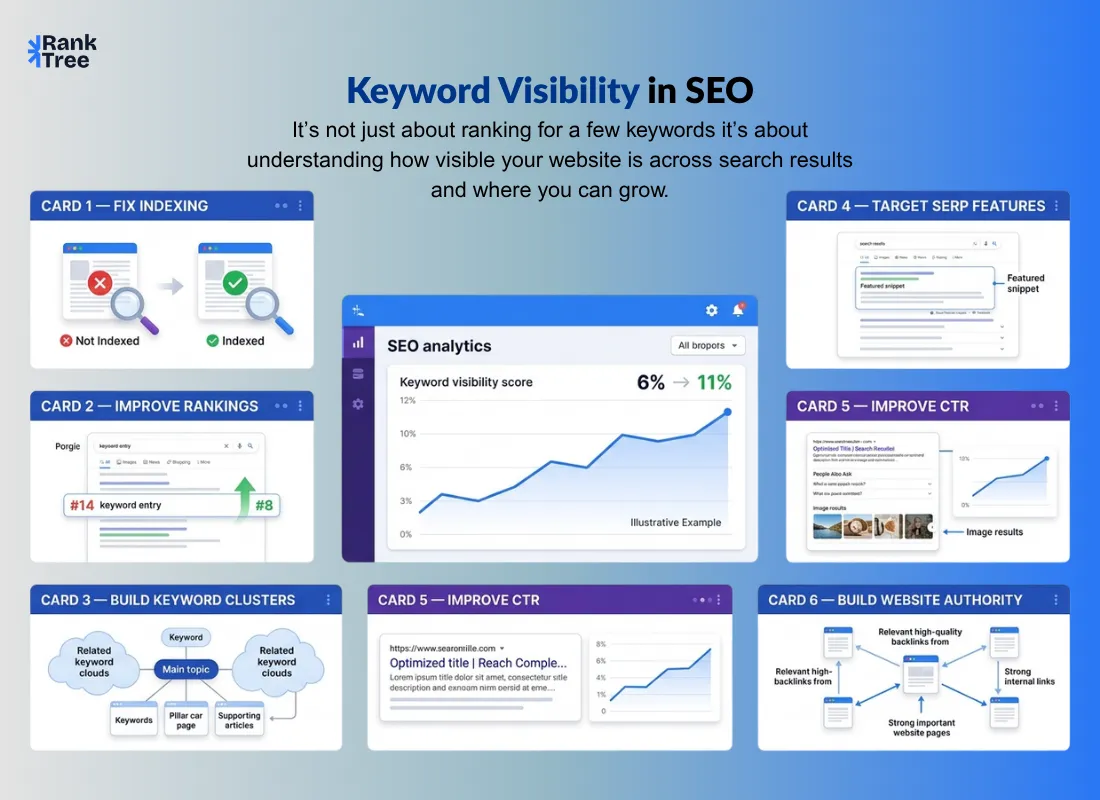
Here's a scenario. You rank #1 for three keywords. Feels great until you notice a competitor sitting on page one for five hundred keywords and quietly owning the entire SERP.
Rankings tell you where you stand for one keyword. Keyword visibility tells you how much of the search landscape you actually own. That's the number that shows the full picture.
This guide covers what keyword visibility is (also called search visibility) how the visibility score actually gets calculated how it differs from rankings and share of voice how to track it without paying for a tool and six practical ways to push it higher.
What Is Keyword Visibility?
Keyword visibility also called search visibility is a metric that estimates how often and how prominently a website appears in search results for a defined set of tracked keywords.
Most tools express it as a percentage: the higher you rank across more keywords the higher your visibility score.
A quick example: a site ranking #8 for 500 relevant keywords almost always has higher keyword visibility than a site ranking #1 for five. One number whole footprint. That's the entire point of the metric.
Two things worth knowing about that number:
It only covers your tracked keywords. Your tool calculates visibility from the keyword set you gave it. Track 50 keywords and the score describes those 50 nothing more. So choose the set carefully. A lazy keyword list makes the whole metric meaningless.
Every tool does the math differently. Semrush Ahrefs Moz each has its own formula. Never compare your Semrush score against someone else's Ahrefs score. Pick one tool and watch your trend line. That's the only comparison that counts.
How Is Keyword Visibility Calculated?
Strip away the branding and every visibility formula does the same thing: it estimates the clicks your rankings should earn then shows that as a share of all available clicks.
Visibility score = (Σ estimated CTR at your rank × keyword search volume) ÷ total potential clicks × 100
For each tracked keyword the logic runs like this:
Note your ranking position.
Take the estimated click through rate for that position position 2 pulls far more clicks than position 9.
Multiply that CTR by the keyword's monthly search volume. That's your estimated clicks for the keyword.
Add up every keyword's estimated clicks divide by the total clicks up for grabs multiply by 100.
Let's make it concrete with four keywords:
Keyword | Monthly volume | Your position | Illustrative CTR at position | Est. monthly clicks |
keyword A | 10000 | 2 | ~15% | ~1500 |
keyword B | 5000 | 5 | ~6% | ~300 |
keyword C | 2000 | 12 | ~1.5% | ~30 |
keyword D | 1000 | not ranking | 0% | 0 |
Total | 18000 | ~1830 |
So: 1830 ÷ 18000 × 100 ≈ 10.2%. This site grabs roughly a tenth of the available clicks for its tracked set. And here's the fun part move keyword C from position 12 to position 6 and the score jumps without publishing a single new page. That's why SEOs love this metric: it turns boring rank movements into a story you can actually report.
One honest caveat: those CTR numbers are illustrative not gospel. Real click through rates shift with SERP layouts snippets ads and AI Overviews and every tool models them differently. That's exactly why your score changes between platforms. Compare a tool against itself over time. Nothing else.
Keyword Visibility vs Keyword Rankings: What's the Difference?
Keyword rankings | Keyword visibility | |
Measures | Position for one specific keyword | Aggregate presence across a keyword set |
Answers | "Where do we rank for X?" | "How much of our market do we own in search?" |
Best for | Diagnosing individual pages | Tracking overall SEO progress month to month |
Blind spot | Misses the big picture | Only as good as the keywords you track |
Think of it this way: rankings are the ingredients visibility is the dish. You need one to cook the other. But telling a stakeholder "we rank #4 for one keyword" says almost nothing while "our visibility went from 6% to 11% this quarter" says everything.
Keyword Visibility vs Share of Voice: What's the Difference?
Fair warning the industry uses these terms loosely and tools don't agree with each other. Here's the distinction that actually helps in practice:
Keyword (search) visibility tracks your own presence over time. Your trend line no one else's.
Share of voice (SOV) adds competitors to the picture: your estimated clicks divided by everyone's estimated clicks for the same keyword set. Your slice of the pie.
Under the hood plenty of platforms compute the two with nearly identical math sometimes it's just a different label on the dashboard. So when you're comparing tools ask one question: is this score absolute (my trend) or competitive (me vs rivals)? That answer matters more than whatever they decided to name it.
How to Track Keyword Visibility?
Method 1: Google Search Console (free)
No Search Console won't hand you a visibility percentage. But it gives you the raw ingredients free: impressions and average position.
Open Performance → Search results and set the range to the last 3 months.
Write down total impressions and average position. Do it monthly; a plain spreadsheet works fine.
Watch the trend. Impressions climbing while average position drops (lower = better)? Your visibility is growing even if the clicks haven't caught up yet.
The catch: no single score no competitor view and exports cap at 1000 rows. Good enough for a free proxy. Not enough for client reporting.
Method 2: A rank tracking tool
This is what visibility scores were built for. Semrush Ahrefs AccuRanker you define the keyword set they plot your visibility percentage over time usually with competitor lines on the same graph. Choose based on keyword set size update frequency and whether you want that competitive share of voice view.
Method 3: The spreadsheet method (DIY)
Export your Search Console queries assign each position an estimated CTR from a published CTR curve multiply by volume sum it all up. More manual work but you control the keyword set and the math. No black box. Honestly worth doing once just to understand what the paid tools are actually calculating behind the curtain.
Realistic setup for most sites: Search Console for the free trend one rank tracker for the official number. Done.
6 Ways to Improve Keyword Visibility
1. Fix indexing first
Unindexed pages contribute exactly zero visibility. Before creating anything new check Search Console's Pages report "crawled but not indexed" and canonical mix ups are the usual culprits.
2. Attack striking distance keywords
Positions 11–30 are your cheapest wins in all of SEO. Dragging a keyword from #14 to #8 can multiply its estimated clicks several times over. Filter your Search Console queries by position and start there. Most sites completely ignore this.
3. Cover more ground with clusters
Every subtopic you cover adds keywords to your footprint. Build content clusters around a pillar page and you systematically grow the set of keywords you can be visible for. This is genuinely how smaller sites outrank bigger ones breadth beats brute force.
4. Win SERP features not just blue links
Snippets People Also Ask image packs all of it is visibility that a plain position number misses. Match your formatting to what the SERP actually shows: definition blocks for "what is" queries tables for comparisons lists for steps.
5. Earn more clicks from the same positions
Visibility math multiplies by CTR so a page sitting at #5 with a 6% CTR beats the identical page with 3%. Find your highest impression lowest CTR queries in Search Console and rewrite those titles and metas first.
6. Build authority for the stubborn ones
Pages parked on pages 4–8 usually don't have a content problem they have an authority problem. Relevant backlinks plus internal link equity from your strongest pages are what drag those terms into visibility range.
Where RankTree fits in?
See the pattern? Most visibility growth comes from covering more of your keyword landscape with well structured pages.
That's exactly what keyword clustering does it groups your keywords by shared intent so one strong page targets a whole cluster instead of scattering related terms across thin pages. Better clusters → more keywords per page → a wider visibility footprint.
Run your own list through RankTree's clustering and count how many tracked terms collapse into rankable groups. The number usually surprises people.
FAQs
Is search visibility the same as keyword visibility?
Yes same metric different name. "Search visibility" is what Semrush and a few other tools call it; "keyword visibility" is the rank tracking world's term. Don't build two pages for them. Don't even think about it.
What is a good keyword visibility score?
There isn't a universal benchmark and anyone selling you one is guessing. The score depends on how many keywords you track how competitive they are and which tool does the math. Aim for direction not a number: a steadily rising trend in one tool and a widening gap between you and your named competitors.
Why does my visibility score differ between tools?
Different keyword databases different CTR models different ranking depths different update schedules. Two tools can track "the same" keywords and still disagree because their underlying data was never the same to begin with. Pick one as your source of truth and stop cross checking.
Can I track keyword visibility for free?
Sort of. Search Console gives you impressions and average position trends free which is a solid proxy. A true visibility percentage with competitor comparison? That needs a rank tracker.
How often should I check keyword visibility?
Glance weekly a sudden drop usually means something technical broke. Review properly once a month against your baseline. And revisit the keyword set itself every quarter because tracking a stale set makes the score meaningless.
Pair this with a solid SERP analysis tools workflow to see which features fire on your tracked keywords.