Best SERP Analysis Tools (Free & Paid)
By RankTree Team · 2026-10-06 · Updated 2026-10-06
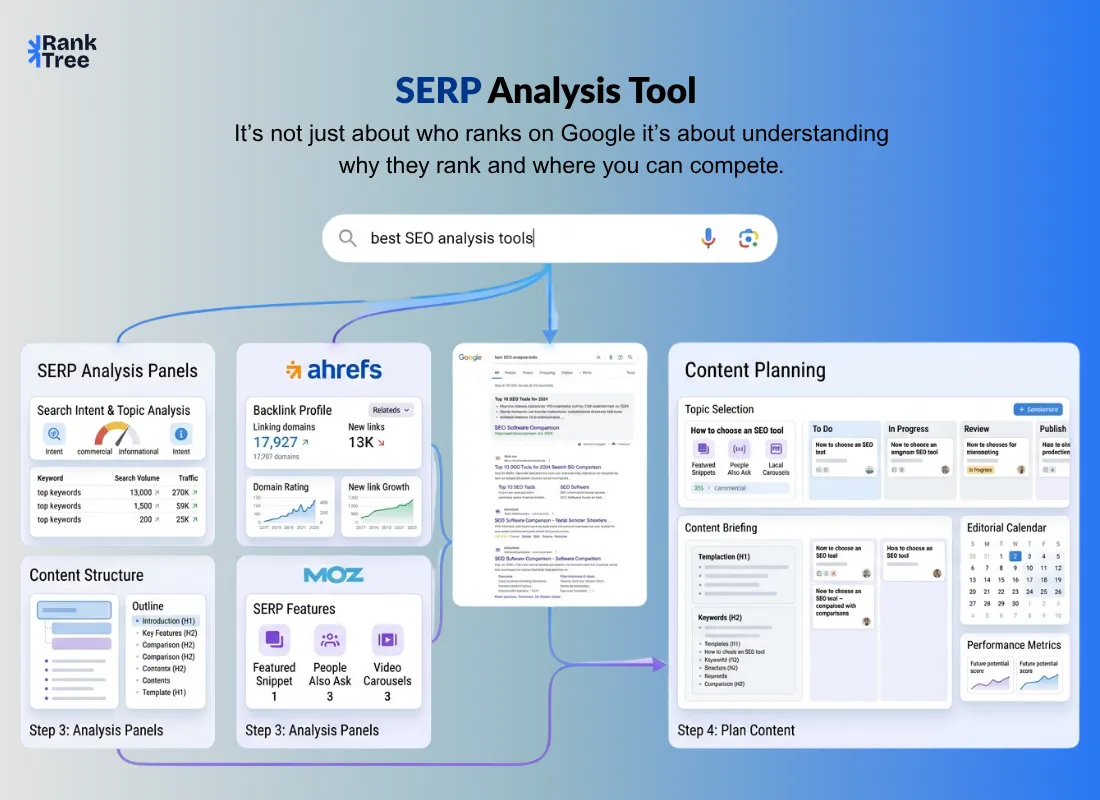
The best SERP analysis tools depend on what you need to learn. Semrush Ahrefs Moz Pro Mangools SERPChecker and thruuu are the strongest paid and freemium options while Google Search Console Ahrefs' free SERP Checker and the SERP Sonar browser extension cover most free needs.
You don't need all of them. You need the one that answers your question and a quick way to tell which that is.
If you want to... | Start with |
Do everything in one platform | Semrush |
See backlink based competition in any location | Ahrefs |
Learn SERP basics with simple metrics | Moz Pro |
Check local SERPs on a budget | Mangools SERPChecker |
Study the content structure of up to 100 results | thruuu |
See how your own pages rank for free | Google Search Console |
What Are SERP Analysis Tools?
SERP analysis tools collect and organize the data on a search engine results page: who ranks what type of pages they are which SERP features appear and how strong the competition looks.
Doing this by hand works for one keyword. It stops working at twenty. A tool pulls the same information in seconds and lets you compare it side by side.
Most tools show some mix of:
The top ranking URLs and their page types
Authority and backlink metrics for each result
SERP features such as People Also Ask featured snippets and videos
Search intent and keyword difficulty
Content details like word count and headings
Types of SERP Tools
"SERP tool" is a loose label. Three kinds of tools sit under it and mixing them up leads to buying the wrong one.
Type | What it does | Example question it answers |
SERP analyzers and checkers | Snapshot of the results for a keyword right now | "Who ranks for this and can I compete?" |
Rank trackers | Track your positions over time | "Did my page move after the update?" |
SERP simulators and APIs | Preview your snippet or pull raw SERP data | "How will my title look?" |
This guide focuses on the first group with trackers mentioned where a tool combines both. A SERP keyword checker a SERP analyzer and a "SERP checker" are all variations of that first group.
How We Compared SERP Tools?
We looked at five things:
What it shows: intent authority SERP features content data
Free access: is there a real free option and what are the limits?
Location accuracy: can you see results for the country you target?
Depth: top 10 only or more?
Honest limitations: what it does not do
This comparison is based on each vendor's public documentation and plan details. Limits change often so check the vendor's page before you commit.
The Best SERP Analysis Tools
1. Semrush: Best All in One Option
Best for: teams that want SERP analysis tracking and content tools in one place.
Semrush splits SERP work across several tools. Keyword Overview shows volume intent and keyword difficulty plus a table of the top ranking pages with authority and backlink data. Position Tracking monitors your rankings daily by location and device.
The SERP Gap Analyzer an add on app points out weaknesses in the pages that currently rank and suggests whether to create new content or update existing pages.
Free option: Semrush has offered a free account with a daily query limit on Keyword Overview plus a free SERP checker. Confirm the current limits on their site.
Watch out for: the SERP Gap Analyzer is sold as a separate paid app and the full toolset can feel heavy if all you need is a quick look at one results page.
2. Ahrefs: Best for Location Based SERPs and Backlink Data
Best for: SEOs who judge competition by backlinks and need to see results from different countries.
Ahrefs' SERP Checker shows the top 10 results for a keyword across hundreds of locations without proxies. Each result comes with SEO metrics and an estimate of the organic traffic that page gets.
It also records SERP position history for the top ranking pages. Inside Keywords Explorer the SERP overview can go deeper up to 100 positions.
Free option: the standalone SERP Checker is free to use and Ahrefs Webmaster Tools gives free data on your own site. Some metrics are limited in the free version.
Watch out for: Ahrefs is generally pricier than budget tools and its strengths lean toward backlink data rather than page level content analysis.
3. Moz Pro: Best for Beginners
Best for: newer SEOs who want simple readable metrics.
Moz's Keyword Explorer includes a SERP Analysis view for any keyword. It shows which SERP features appear the strength of the ranking pages and a Page Score that estimates how well each page is optimized for the keyword.
Keyword Difficulty and an organic click through estimate help you judge whether a SERP is worth chasing.
Free option: full access comes through a free trial rather than a permanent free plan.
Watch out for: you're paying for a whole platform so it's less efficient if SERP analysis is all you do.
4. Mangools SERPChecker: Best for Budget and Local SERPs
Best for: freelancers and small businesses that need clean SERP data without enterprise pricing.
SERPChecker reports 45+ SEO metrics for each result drawing on Mangools Moz and Majestic data and detects SERP features like featured snippets and answer boxes. Its location coverage runs to tens of thousands of places including cities which helps local SEO.
Free option: a limited free account lets you try the tool.
Watch out for: Mangools focuses on keywords and rankings. It has no content editor or technical audit and its data sets are smaller than those of the big suites.
5. thruuu: Best for Content Structure
Best for: content writers who want to see how ranking pages are built.
thruuu analyzes up to 100 Google results in about a minute. For each result it pulls word count headings page type and SERP features and you can export everything to Excel. It also tracks AI Overview citations.
Free option: there's a free plan with a small monthly allowance of SERP analyses. Extra analyses use paid credits.
Watch out for: thruuu leans toward on page content rather than deep backlink data so pair it with a backlink tool if authority matters for your keyword.
What About Enterprise Platforms?
Platforms such as BrightEdge Conductor and seoClarity target large sites tracking thousands of keywords. They bundle SERP analysis with reporting and workflow features.
Pricing is typically quote based so ask vendors directly. For most small sites and blogs the tools above cover everything you need.
The Best Free SERP Tools
You can do real SERP analysis without paying anything. The trade off is limits.
Free tool | What you get | Main limit |
Google Search Console | Queries clicks impressions and average position for your own site | Only your site not competitors |
Ahrefs SERP Checker | Top 10 results for any keyword and location | Some metrics gated |
Semrush free account | Keyword Overview and SERP checker | Daily query cap |
thruuu free plan | Content and structure of ranking pages | Small monthly allowance |
SERP Sonar (Chrome extension) | Data on roughly the first 100 results in your browser | AI features need your own OpenAI API key |
Mangools free account | SERPChecker trial | Few lookups |
A free first workflow that works: use Ahrefs' SERP Checker or SERP Sonar to see who ranks thruuu to study the structure of two or three top pages and Search Console to see how your own pages perform once you publish.
Check the permissions and data policy of any browser extension before installing it.
How to Choose the Right Tool?
Ask what job you're hiring the tool for.
Your job | Best choice |
Quick check before writing one article | Free Ahrefs SERP Checker or SERP Sonar |
Judging if a keyword is winnable | Ahrefs Semrush or Mangools |
Planning an article's structure | thruuu |
Tracking rankings after you publish | Semrush Position Tracking or Search Console |
Learning SEO metrics as a beginner | Moz Pro |
Local SEO | Mangools SERPChecker |
Managing thousands of keywords | An enterprise platform |
If you already pay for a major SEO suite use its SERP features first. Adding another subscription rarely helps until you hit a specific limit.
A 5 Step SERP Analysis Workflow
Whichever tool you use the process is the same.
Set location and device. Results differ by country and by phone versus desktop so match your real audience.
Read the intent first. Look at the page types. If the top 10 are all comparison lists a landing page won't rank.
Check the authority gap. Look for weaker sites in the top 10 such as newer domains with few backlinks. Those show where a new site has a chance.
Note the SERP features. People Also Ask videos and snippets show which formats Google rewards for this query.
Compare the content. Look at headings depth and freshness. Note what's missing and cover it better.
For example if you search "best project management software" and nine of the ten results are comparison lists you need a comparison list. A product page won't compete no matter how well it's written.
Turning SERP Data Into a Page Plan
SERP analysis also tells you which keywords belong on the same page. If two keywords return mostly the same top 10 URLs Google treats them as one topic and one page can target both. If they return different results they need separate pages.
Checking this by hand across hundreds of keywords isn't realistic. SERP based clustering does it automatically by grouping keywords according to how many results they share.
Our keyword clustering tool works this way and our comparison of keyword clustering tools covers the other options. For the theory behind it see SERP based vs semantic clustering. A SERP analysis tool tells you what's ranking.
Clustering tells you which pages to build from it. If you're also checking what your competitors cover that you don't our guide to content gap analysis picks up from there.
Common Mistakes
Trusting a difficulty score without opening the SERP. A score is a summary. The actual results tell you whether the intent matches what you're about to write.
Checking from the wrong location. A SERP checked from the wrong country shows the wrong competitors.
Copying the top result's outline. The goal is to find what the top pages miss not to rebuild them.
Treating AI summaries as SERP data. Chat tools can brainstorm but without live search data they can't tell you what's ranking today.
Paying for three tools that overlap. Pick one main tool add a free one for gaps.
Bottom Line
You don't need the most expensive tool. You need the one that answers your question. Start with the free tools to learn how to read a SERP.
Move to a paid tool when you need more data or daily tracking. Whatever you use always look at the results page yourself before you decide what to write.
Ready to turn SERP data into a content plan?
Try the RankTree keyword clustering tool to group your keywords by what Google ranks.
FAQs
What is the best free SERP analysis tool?
For a quick look at who ranks Ahrefs' free SERP Checker and the SERP Sonar extension are good starting points. For your own site's performance use Google Search Console.
Do I need a paid SERP analysis tool?
Not at first. Free tools cover the basics. Upgrade when you hit a limit such as needing more lookups deeper data or daily tracking.
How often should I run a SERP analysis?
Run one before you write or rewrite a page and again when rankings change after an update. Results shift as Google changes what it shows for a query.
Can I do SERP analysis manually?
Yes. Search in a private window note the page types and features and read the top results. Tools just make this faster and more consistent when you have many keywords.
Are SERP checkers accurate?
They show a snapshot from a particular location and device so they can differ from what you see personally. Set the location to match your audience and treat the result as a guide not a guarantee.