Keyword Mapping Template: A Free, Copy-Paste Sheet That Maps Every Keyword to One Page
By RankTree Team · 2026-11-07 · Updated 2026-11-18
Part of the Keyword Optimization Strategy: A Complete Guide guide →
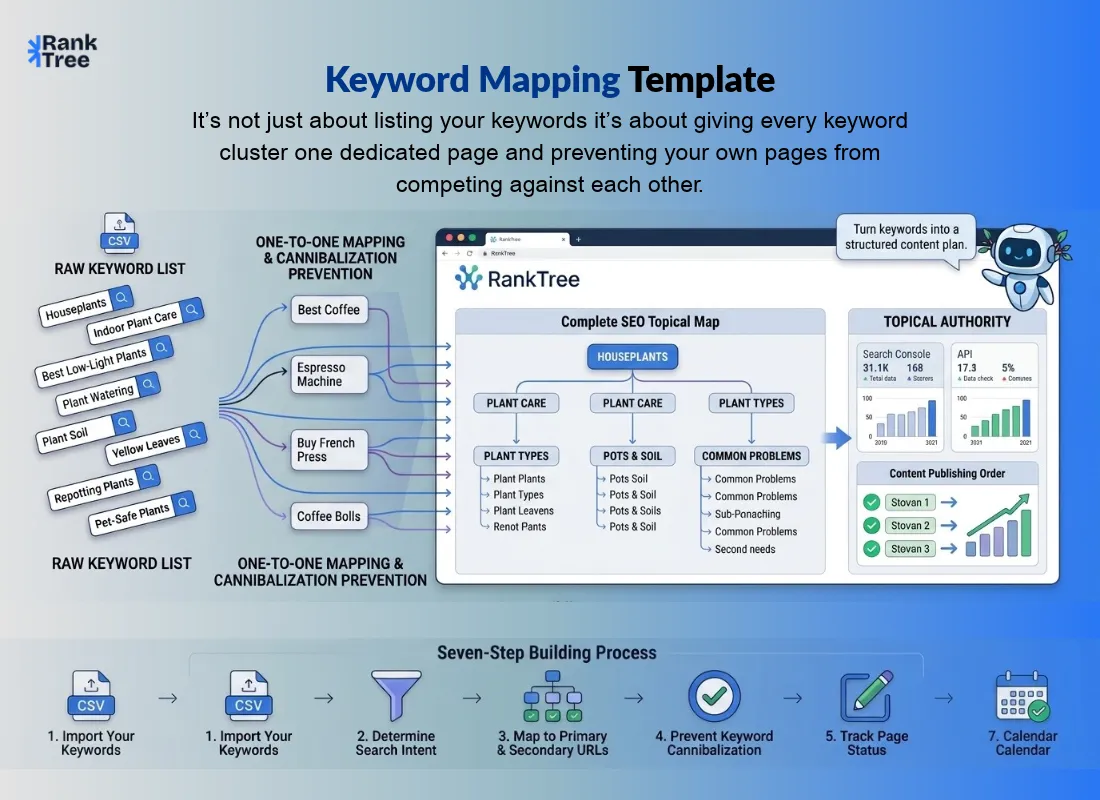
A keyword mapping template is a spreadsheet that gives every keyword or keyword cluster exactly one page to rank for. Copy the nine columns below and paste in your keywords.
The sheet records which page owns which topic, and settles ownership before two of your pages start competing for the same search.
It sits between two other steps. Keyword clustering groups keywords that belong together, and content briefs turn each mapped group into a page plan.
The map is the middle step: it gives each group one page, and the topical map shows how those pages connect. People skip it most, and two pages can quietly chase the same query for months before anyone notices.
What a Keyword Mapping Template Is?
A keyword mapping template is a ready-made spreadsheet layout for keyword mapping. It has one row per keyword or cluster. Its columns record the target URL, search intent, volume, difficulty, role and status.
You fill it in once. It becomes the single document that says which page should rank for which keyword.
It is not a keyword list. A list only records what people search for. A map records a decision: this cluster belongs to this URL, with this intent, and this status.
That decision stops cannibalization, when two of your pages compete for the same query and neither ranks as well as it could. Every query gets exactly one owner.
For the background, read what keyword mapping is.
The Template: Nine Columns You Need
Build the sheet with these nine columns. Copy the header row below, then paste it into your sheet. Use one row per keyword or cluster.
Keyword, Target URL, Search intent, Monthly volume, Keyword difficulty, Role, Page type, Status, Last updated
Paste the row, then split it into nine cells. In Google Sheets, use Data, then Split text to columns, then Comma. In Excel, use Data, then Text to Columns, then Delimited, then Comma.
Each row is one cluster. The Keyword column holds the cluster head, and secondary keywords for that cluster go in rows that point at the same target URL. That is how the "One URL, two clusters" check works.
Column | What you put in it |
Keyword | The exact search term or cluster head |
Target URL | The one page that should rank for it |
Search intent | Informational, commercial, transactional, or navigational |
Monthly volume | Average monthly searches, from your keyword tool |
Keyword difficulty | KD score from your keyword tool |
Role | Primary (the page's main keyword) or Secondary |
Page type | Guide, product page, category page, comparison, or tool page |
Status | Published, To Optimize, To Create, or Merge |
Last updated | The date you last reviewed this row |
Each column earns its place. Volume and difficulty set the build order. Intent and page type catch mismatches. Role stops a page collecting three "main" keywords. Status and last-updated date stop the map going stale.
Small blog? Start with five columns: Keyword, Target URL, Search intent, Volume, Status. Add the other four when the map grows. The lean version runs three of the five checks. The primaries and intent checks need the Role and Page type columns.
A Filled Example: Mapping a Real Cluster
Here is the template filled in with a real cluster from this site: the "keyword clustering" topic. Every URL below is a live RankTree page, except the last row. Volumes and KD scores are samples. Replace them with your own tool's numbers.
Keyword | Target URL | Search intent | Volume (sample) | KD (sample) | Role | Status |
keyword clustering | /blog/keyword-clustering-the-complete-guide-for-seo-success | Informational | 2,900 | 41 | Primary | Published |
keyword clustering tools | /blog/keyword-clustering-tools | Commercial | 480 | 28 | Primary | Published |
how to do keyword clustering | /blog/keyword-clustering-the-complete-guide-for-seo-success | Informational | 390 | 35 | Secondary | Published |
semantic keyword gaps | /blog/semantic-keyword-gaps-in-seo | Informational | 210 | 30 | Secondary | To Optimize |
keyword clustering in python | /blog/keyword-clustering-in-python-a-technical-guide-for-seo-automation | Informational | 170 | 22 | Primary | Published |
keyword clustering examples | /blog/keyword-clustering-examples (planned page, do not link) | Informational | 110 | 24 | Primary | To Create |
Three decisions jump out.
First, "how to do keyword clustering" is a secondary keyword on the complete guide, not its own page. The guide already answers it.
Second, "semantic keyword gaps" sits on the semantic gaps article as To Optimize, a job for the next update round.
Third, the "examples" row is marked To Create. Check the complete guide first. If it already covers examples well enough, delete the row.
How to Fill the Template in 5 Steps?
Start from your clusters, not from a keyword list
Group your keywords first. Our complete guide to keyword clustering walks through the process. Then paste one cluster at a time into the template.
Assign one target URL per row
If the page exists, paste its URL. If it does not, write the URL you plan to create and set the status to To Create. Never leave the URL blank. Never assign two URLs to one row.
Label intent and page type together
Read the keyword and decide its search intent: what the searcher wants. To learn, to compare, to buy, or to reach a site. Then ask whether the page type fits. A transactional keyword on a blog guide is the most common mismatch. This step catches it.
Pick one primary keyword per URL
The primary keyword shapes the title, the H1, and the opening paragraph. Everything else on that URL is secondary. Two primaries on one URL means split the row or demote one.
Set the status and the date
Published means the page is live and mapped. To Optimize means the page exists but does not yet match its keywords. To Create means the page is planned. Merge means two pages cover the same cluster and one should redirect. Write today's date in Last updated on every row you touch.
5 Checks That Catch Mistakes Before You Publish
You do not need formulas to check the map. Run these five checks by eye. Do it before the map becomes your content plan. These five checks adapt the five rules in MLforSEO's keyword mapping template, run by eye instead of by formula.
Check | What to look for | Fix |
Duplicate keyword | The same keyword on two rows with different target URLs | Keep one row. Delete or reassign the other. |
Too many primaries | One URL with two or more Primary rows | Demote all but one to Secondary, or split the page. |
Intent mismatch | A transactional keyword mapped to a guide, or an informational keyword mapped to a product page | Move the keyword to a page whose type fits its intent. |
One URL, two clusters | A URL holding keywords from two different clusters | Check whether the clusters should merge, or the page should split. |
Ranking URL is not the target | Google already ranks a different page of yours for this keyword | Check Search Console first, then either change the target to the page that ranks, or plan a redirect and internal links to move the ranking. |
Check 5 is the only one you run outside the sheet. Open Search Console, look up the keyword, and compare the ranking URL with your target. A content gap analysis shows what your pages already cover and what they miss.
Check 5 is the one we run most. This article's own Search Console data shows why: it earned 105 impressions for mapping queries in 28 days with zero clicks, at an average position of 70. When the ranking URL is not your target, add a tenth column, Ranking URL today, and write down the page Google actually ranks. That column is what this check reads next time.
The first check matters most. A duplicate keyword in the sheet is cannibalization planned in advance. Fix it in the sheet and it costs a minute. Fix it after publishing and it costs a redirect and weeks of split rankings.
The same discipline, one owner per target, caught 65 double links across 33 pages on this site in November 2026. We fixed all 65.
Common Keyword Mapping Template Mistakes
Mapping one keyword per page. Modern pages rank for dozens of related terms. Map clusters, not single keywords.
Leaving Status blank. A row with no status is a row nobody owns. Every row gets Published, To Optimize, To Create, or Merge, even if the answer is uncomfortable.
Filling the sheet once and forgetting it. Search results and your own pages change. Review the map once a quarter, and update it the same day you publish, merge, or delete a page.
Build Your Map Faster with RankTree
Filling the template by hand works. The slow part is the step before it: grouping hundreds of keywords into clusters with the same intent. A tool that groups your keywords into intent-based clusters does that part for you.
Upload your keyword list, and paste the clusters into the template above. The map is half built before you start assigning URLs.
Once the map is set, turn it into a visual topical map you can refine and export. The same generator also covers "keyword map generator" searches: give it a topic and it builds the hub-and-subtopic structure, which is the map this template records. The template itself stays a spreadsheet. Tools change. The map is the record of your decisions. If you want that map as a sheet instead of a tool, our topical map template lays out the same hub-and-subtopic structure you can fill in.
Final Words
A keyword mapping template does one thing. It writes down, in a single place, which page owns which keyword. Nine columns, five checks, one review a quarter.
That is the whole system. Copy the template, fill it with one cluster, and run the five checks. It sits in our Keyword Optimization Strategy hub, beside the guides it works with.
FAQs
Is there a free keyword mapping template?
Yes. The nine-column template in this article is free to copy. Paste the headers into Google Sheets or Excel and fill in your own keywords. No download or sign-up is needed.
What columns should a keyword mapping template include?
At minimum: keyword, target URL, search intent, monthly volume, and status. For a full map, add keyword difficulty, role, page type, and last-updated date.
How is a keyword mapping template different from keyword clustering?
Clustering groups keywords that share a meaning or a results page. A mapping template assigns each group to a specific URL, with a page type, a role, and a status. Clustering answers "which keywords belong together?" The template answers "which page does each group belong to?"
How often should I update my keyword map?
Review it once a quarter, and update it the same day you publish, merge, or delete an important page. The last-updated column shows which rows are fresh and which ones need a second look.
Can two pages target the same keyword in the template?
No. Each keyword gets exactly one target URL in the map. If two pages could both serve a keyword, pick one as the primary owner and make the other target a narrower variation.