How to Find Trending Keywords (Free Google Trends Method)
By RankTree Team · 2026-11-17 · Updated 2026-11-17
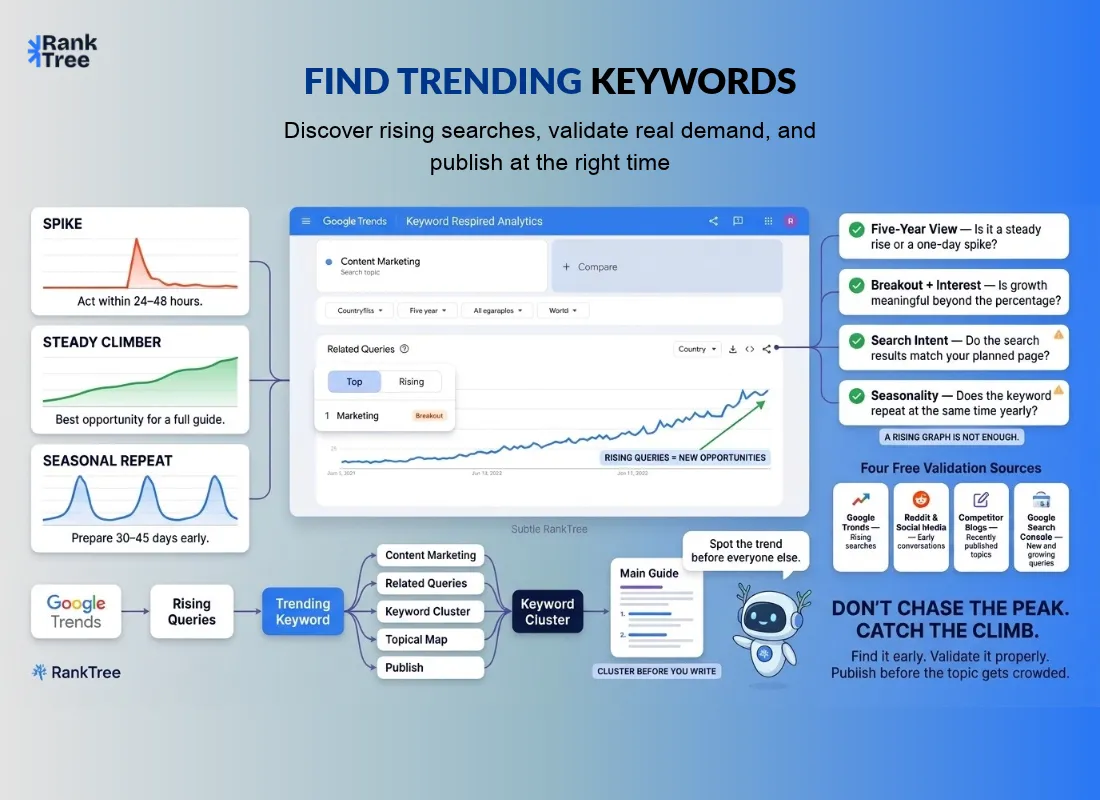
A trending keyword is a search term whose interest is rising right now. Most SEOs find it after it peaks, when the big sites have already covered it.
This article shows you how to find it while it is still rising using Google Trends, which is free, and how to check it is real before you spend a day writing about it.
What Is a Trending Keyword?
A trending keyword is a search term that is gaining searches over a short period. It is not the same as a popular keyword. A popular keyword has high volume every month.
A trending keyword has volume that is climbing, and that climb is the opportunity. When you publish while the climb is still happening, you compete against fewer pages, and you can rank before the topic is crowded.
3 Types of Trending Keywords (and When to Act on Each)
Not every rising keyword behaves the same way. The type tells you how fast to move.
Type | What it looks like | When to act |
Spike | A sudden vertical surge. Usually breaking news a viral moment or a product launch. | Within 24 to 48 hours or skip it. A short reaction post is enough. |
Steady climber | Consistent month-over-month growth. An emerging topic that has not reached the mainstream yet. | This is the best type. You have time to write a full guide. |
Seasonal repeat | A keyword that spikes at the same time every year like "Black Friday deals". | Prepare early. Update your existing page 30 to 45 days before the spike so it has time to rank. |
Spend most of your time on steady climbers. And don't mix up a spike in search interest with SERP volatility. One is demand going up. The other is positions changing.
How to Find Trending Keywords With Google Trends?
Google Trends is the core method in this article. It shows how interest in a search term changes over time and it costs nothing. Follow these five steps.
Step 1: Open Trending Now
Go to trends.google.com and open the Trending Now page. It updates every 10 minutes so what you see is what people are searching for right now. Filter by your country so the trends match your audience.
Step 2: Start with a seed topic not a blank page
Enter a broad topic from your niche for example "keyword research" or "content marketing". Google Trends shows an interest-over-time graph for that topic. A flat line means nothing is moving. A line climbing to the right means something is rising.
Step 3: Open Related Queries and switch to Rising
Scroll to the Related Queries section at the bottom. It has two tabs: Top and Rising. Top shows the most popular related searches. Rising shows the terms with the fastest growth. Rising is where trending keywords live. Queries labeled "Breakout" have grown by more than 5000 percent and they are the strongest signals on the page.
Step 4: Compare up to five keywords side by side
Google Trends lets you compare five terms at once. Add your candidate and four related terms. The comparison shows which one is actually climbing and which one only looks busy because it started from a high base. Pick the climber not the biggest number.
Step 5: Zoom out to five years
Before you commit change the date range to five years. A real trend shows a clear rise in the recent part of the graph. A one-day spike shows a flat line with a single sharp peak. The five-year view is the fastest way to tell them apart.
4 More Free Ways to Spot Rising Keywords
Google Trends finds the trend. These four methods confirm it from another angle. Use at least one of them before you write.
1. Social media and Reddit
Trends often start on social platforms days before they show up in search data. On Reddit sort posts by "Top: This Week" inside subreddits in your niche. The threads that keep appearing show you the exact words people use. If a topic is trending on only one platform it's a guess. Two or more and it's real.
2. Your competitors' new content
When several competitors publish about the same topic in the same week that topic is trending. Check their blogs not their old pages. One competitor is a hint. Three is a signal. To find your competitors keywords start with their recent posts then check which terms you don't cover yet.
3. Your own Search Console data
In Search Console go to Performance and sort your queries by impressions over the last 28 days. Look for queries that are new or climbing. A query with rising impressions and a weak position is a page waiting to be written.
4. The SERP itself
Search the candidate keyword. If the top results are forums Reddit threads or thin pages the topic is new and no strong page owns it yet. That's an opening. If the top results are polished guides from big sites the trend has already peaked. SERP analysis tools can speed up this check but the manual look takes two minutes.
How to Check a Trending Keyword Is Real ? (Before You Write)
A rising graph is not proof. Run these four checks before you commit a day of writing.
1. Is it rising or just spiking?
Use the five-year view from Step 5 above. A steady climb is real. A single-day peak is noise.
2. Is it Breakout or just Rising?
A Breakout label means growth over 5000 percent. That is strong but it can also mean the term started from almost zero. Check the absolute interest too. A term that went from 2 searches to 100 is Breakout but it is still tiny.
3. Does the intent match your site?
Read the top results. If people searching the term want news and you write a guide you will not rank. The intent has to match the page you plan to write.
4. Is it seasonal?
Check the same months last year. If the term spiked last year at the same time it is a seasonal repeat. That is still worth targeting but update an existing page instead of writing a new one.
If a keyword passes all four checks write about it. If it fails two or more skip it and check the next candidate. Trending keywords are cheap to find and expensive to write about so the filter matters more than the discovery.
What to Do With a Trending Keyword? (Cluster It First)
A single trending keyword is one page. Its rising related queries are a cluster and that cluster is worth more than the page alone because Google reads a topic as a set of related questions not one phrase.
Start with the trending keyword then take the top five Rising queries for that term. Those six terms are your cluster. Before you write group the trending keywords into clusters so each page covers one angle and no two pages compete.
If you want the full method keyword clustering explains how to group keywords by intent and build the cluster structure.
Then map the cluster to pages. The main keyword gets the main guide. Each related query gets a section inside it or its own short page if it needs a full answer. Don't write six separate pages for six near-identical queries. That's how cannibalization starts.
How to Track It After You Publish?
Check Search Console in the first two to four weeks after publishing. If impressions are climbing and position is improving add a related section while the trend is still warm. If impressions are flat after three weeks the trend has passed.
Track keyword visibility over the same period. It shows whether the page is being seen at all even before clicks arrive. A page with rising visibility and zero clicks needs a better title not a better article.
Final Words
Finding trending keywords is not about luck. It's a routine: check Google Trends read the Rising queries validate with a five-year view cluster the terms then write. The whole routine takes 15 to 30 minutes a week and it costs nothing.
Start with one method this week. Open Trending Now pick one topic in your niche and find one steady climber. Write the guide cluster its related queries and check Search Console in two weeks. That loop repeated weekly is how a small site catches trends before the big sites do.
FAQs
Why are trending keywords important for SEO?
Trending keywords match what people are actively searching for right now. They usually have lower competition than established terms so a new page can rank quickly before larger competitors target the same topic.
How can I use Google Trends to find trending keywords?
Enter a topic into Google Trends and look at the interest-over-time graph. Open Related Queries and switch to the Rising tab. Terms labeled "Breakout" have grown by more than 5000 percent. Filter by region category and time range.
How do I know if a trending keyword is worth targeting?
Run four checks: a five-year view to confirm it is rising and not a one-day spike the Breakout label plus absolute interest the search intent behind the top results and whether it's seasonal. If it passes all four write about it. If it fails two or more skip it.
How often should I look for new trending keywords?
A weekly check of 15 to 30 minutes is enough for most businesses. In fast-moving niches like technology check daily.
Do trending keywords work with AI Overviews?
Yes if the page is structured for them. AI Overviews are common on informational queries. Use clear headings and direct answers at the start of each section so the page can be cited in AI-generated summaries.