What Is a Content Brief? Benefits Examples & SEO Best Practices
By RankTree Team · 2026-08-05
Part of the Content Strategy and Briefs : The Complete Guide to Building Content That Ranks guide →
Content briefs are the foundation of a strong SEO content strategy. Without a structured brief, content often fails to rank, convert, or drive organic traffic.
A content brief is a strategic document that defines what to write, who the content is for, what problem it solves, and how it should be optimized for search engines. It connects SEO strategy with content execution, ensuring writers, editors and strategists work toward the same goal.
In simple terms, a content brief removes guesswork. It provides a clear roadmap based on keyword research, search intent, competitor analysis and business objectives.
A well structured content brief ensures every piece of content supports a larger SEO system. It helps build topical authority, improves internal linking, and increases search visibility over time.
What Is a Content Brief and Why It Matters for SEO Content Brief Strategy?
A content brief is a structured SEO document that outlines all the essential instructions required to create high quality search optimized content.
Unlike a basic outline a content brief goes deeper into strategic direction. It includes keyword targeting search intent content structure audience insights, tone of voice competitor gaps and technical SEO requirements.
The primary goal of content briefs is to remove uncertainty from the content creation process. When writers understand exactly what to write and why they are writing it the final output becomes more consistent, more relevant and more optimized for search engines.
From an SEO perspective content briefs ensure that:
Content aligns with search intent
Keyword usage is natural and structured
Semantic SEO coverage is complete
Content structure is easy for Google to understand
User experience is improved through clarity and flow
For SaaS websites this is essential because ranking alone is not enough. Content must also guide users through a funnel from awareness to consideration to conversion.
Content Brief Example (Real SEO Example)
Example Content Brief:
Primary Keyword: content brief template
Search Intent: Informational
Word Count: 2000 words
Target Audience: SaaS marketers
Outline:
What is a content brief
Key elements
Examples
Template
Internal Links:
search intent article
Content Brief vs Content Strategy in SEO Content Brief System
Many beginners confuse content strategy with content briefs but both serve completely different roles in SEO execution.
A content strategy defines the big picture roadmap. It includes:
Which topics to target
Which keywords to rank for
How content clusters are structured
What business goals content supports
On the other hand a content brief focuses on execution. It translates strategy into actionable writing instructions.
If content strategy is the blueprint of a building the content brief is the engineering instruction for constructing each room.
Both are essential because:
Strategy without briefs leads to poor execution
Briefs without strategy lead to directionless content
Together they create a complete SEO content system that scales effectively
Key Elements of a High Quality Content Brief
A high performing content brief includes essential SEO and strategic components that guide the entire writing process.
Primary Keyword: The primary keyword defines the main topic and search focus. Secondary keywords and semantic variations strengthen relevance and improve ranking potential.
Search Intent: Understanding whether the query is informational, commercial, or transactional helps shape tone, structure and depth.
Target Audience: A clearly defined audience ensures the content directly addresses user needs and pain points.
Content Structure: Headings, subheadings and logical flow improve readability and help search engines understand content hierarchy.
Additional SEO Elements: Internal linking, competitor gap analysis, tone of voice and technical SEO guidelines ensure the content is fully optimized before writing begins.
Benefits of Using Content Briefs
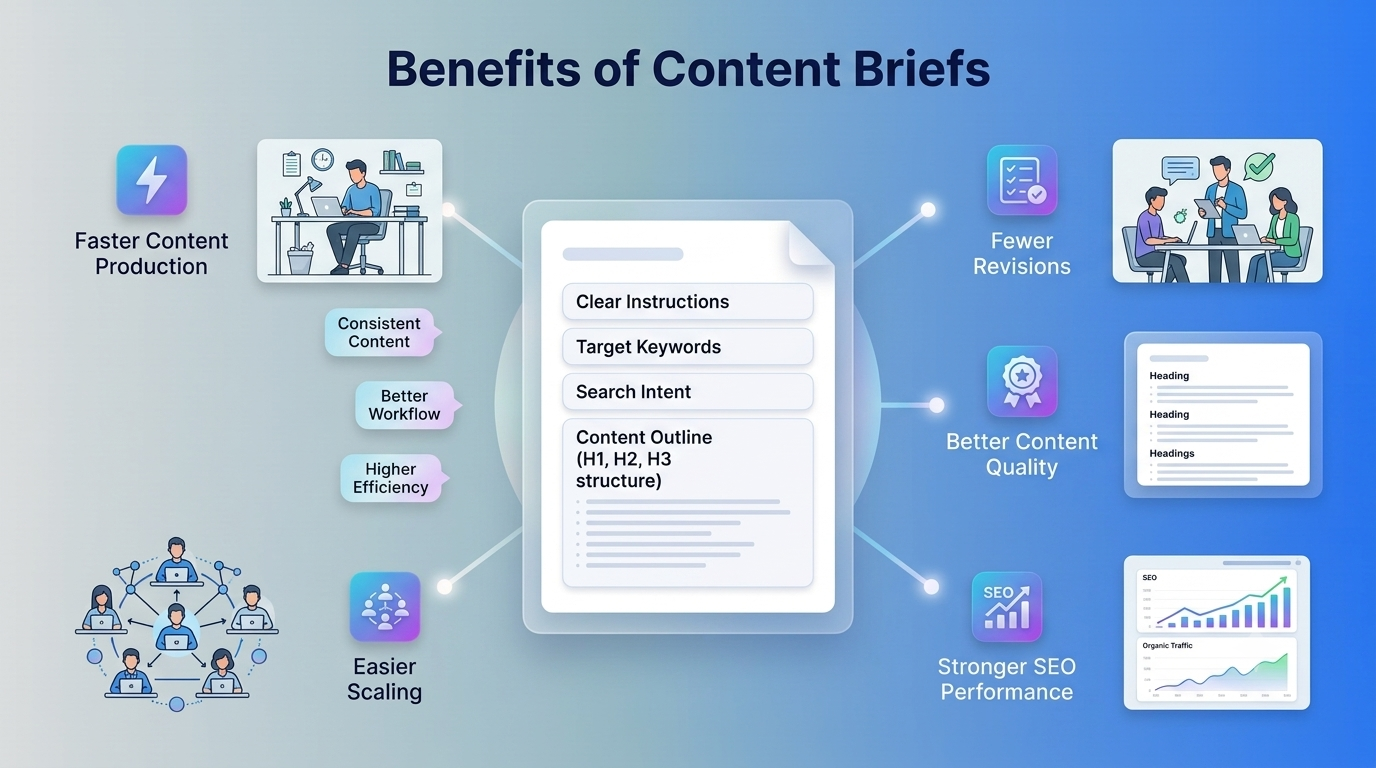
Content briefs offer advantages beyond SEO optimization. They improve the entire content production process.
Faster Content Production
Writers spend less time researching requirements and more time creating content because expectations are clearly defined from the start.
Fewer Revisions
Clear instructions reduce misunderstandings between strategists, editors and writers minimizing costly rewrites.
Better Content Quality
When writers understand the audience needs search intent and business objectives the final content becomes more useful and comprehensive.
Stronger SEO Performance
Content briefs ensure important keywords entities, semantic topics and internal links are included naturally throughout the content.
Easier Scaling
For SaaS companies publishing large volumes of content briefs creates consistency across multiple writers, freelancers and content teams.
How to Create a Content Brief for SEO Content Brief Optimization?
Creating a high quality content brief involves a step by step SEO process that starts with keyword research and ends with strategic optimization.
The first step is identifying a primary keyword that aligns with both search demand and business goals. This keyword becomes the foundation of the entire content piece.
Next comes search intent analysis. By studying top ranking pages SEO professionals can understand what type of content Google prefers for that keyword. This ensures content aligns with user expectations.
Competitor analysis is another crucial step. Instead of copying competitors the goal is to identify content gaps. These gaps represent opportunities to create better, more detailed and more valuable content.
Once research is complete the content structure is created. This includes defining the H2 and H3 flow ensuring logical progression and readability.
Finally technical SEO requirements are added including meta guidance internal linking instructions and semantic keyword placement strategy.
Types of Content Briefs
Blog Post Content Briefs
Blog post content briefs are designed for informational SEO content. They focus on answering user queries in detail while maintaining strong keyword optimization and structured formatting. These briefs are ideal for building topical authority and driving organic traffic.
Landing Page Content Briefs
Landing page content briefs are conversion focused. They emphasize persuasive messaging, strong value propositions and clear calls to action. Unlike blog briefs these are designed to drive leads signups or sales rather than informational traffic.
Product Page Content Briefs
Product page briefs focus on highlighting features, benefits and use cases. They help users make informed decisions by providing structured product information comparisons and trust building elements.
SEO Content Briefs
SEO content briefs are the most advanced type. They combine keyword research semantic SEO competitor analysis and technical optimization.
These briefs are designed specifically to maximize search rankings and organic visibility.
SEO content briefs are widely used in SaaS companies because they ensure every piece of content contributes to long term organic growth.
Common Mistakes in Content Briefs
One of the most common mistakes in content briefs is focusing only on keywords without considering structure or user intent. This leads to content that may target keywords but fails to satisfy user needs.
Another major mistake is ignoring search intent. If content does not match what users expect it will struggle to rank regardless of quality.
Lack of structure is also a critical issue. Without a clear outline content becomes disorganized and difficult to read.
Some content briefs are too vague providing little direction to writers while others are overly complex making execution difficult. The ideal content brief balances clarity with simplicity.
Advanced SEO Factors in Content Briefs
Modern SEO content briefs go beyond basic keyword placement. They include semantic SEO coverage, NLP based keyword variations and topic clustering strategies.
Top performing content briefs also include internal linking structures that connect related articles within the same topic cluster. This helps search engines understand website architecture and improves crawl efficiency.
Another advanced factor is competitor gap analysis. Instead of simply matching competitors, high quality content briefs identify missing elements in top ranking pages and use them as opportunities for differentiation.
AI and Content Briefs in Modern SEO

AI has significantly transformed the way content briefs are created. It can analyze large datasets, identify keyword opportunities and generate structured outlines within seconds.
However AI cannot replace strategic thinking. While it is excellent at data processing it lacks contextual understanding of brand voice audience psychology and business objectives.
The best SEO strategies combine AI efficiency with human expertise. AI handles research and structure while humans refine strategy tone and intent alignment.
Final Thoughts on Content Briefs and SEO Success
Content briefs are not optional in modern SEO they are essential.
They ensure that every piece of content is aligned with user intent optimized for search engines and connected to business goals.
Without content briefs content creation becomes inconsistent and unpredictable. With them it becomes a scalable structured and performance driven system.
For SaaS companies aiming to grow organic traffic and build authority content briefs are one of the most powerful tools available.
They transform content from random writing into a strategic SEO asset that delivers long term results.
FAQs
What should a content brief include?
A content brief includes the primary keyword search intent target audience outline word count internal links and SEO guidelines. It works as a clear roadmap for content creation.
How long should a content brief be?
There is no fixed length. A good content brief is detailed enough to guide the writer without being too complex, usually around one to three pages.
Are content briefs necessary for SEO?
Yes, content briefs are important for SEO because they align content with search intent, ensure proper keyword use and maintain a structured format.
Can AI create content briefs?
Yes AI can generate content briefs using data and analysis but human input is needed for strategy and brand alignment.
What are the benefits of using a content brief?
Content briefs improve quality, reduce revisions, speed up production and keep content aligned with SEO goals.
In this guide
- SEO Content Brief: The Complete Guide With Template Example and Scoring System
- SEO Content Strategy: The Complete Framework for 2026 (With Examples)
- Content Brief Tools and Generators: What They Are and How They Work
- Content Workflow Automation: How to Build a Scalable SEO Content System with AI & Smart Workflows