Content Workflow Automation: Build a Scalable SEO Content System
By RankTree Team · 2026-09-02 · Updated 2026-10-07
Part of the SEO Content Brief: Template, Example and Scoring System guide →
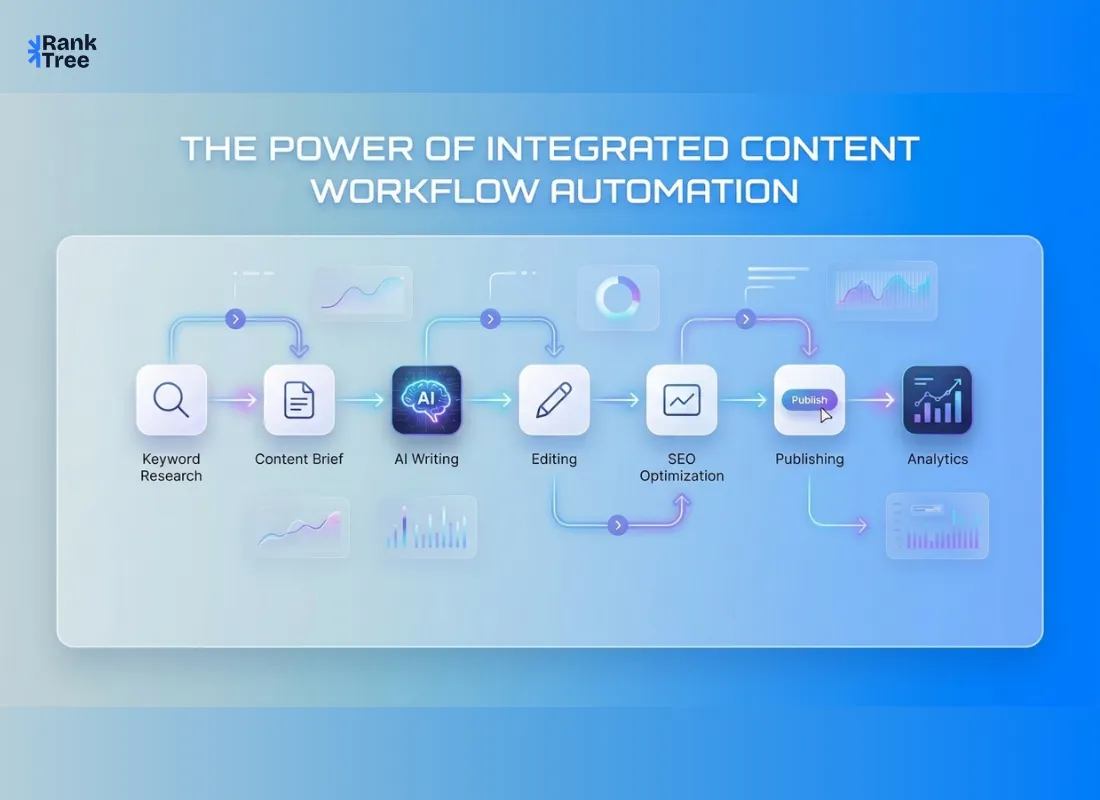
Creating content at scale is not just about producing more articles. The real challenge is building a system where every piece of content is planned, optimized and published in a structured flow that consistently supports SEO growth.
This is where content workflow automation becomes essential. It connects keyword research content briefs AI writing editing publishing and performance tracking into one streamlined system that reduces manual effort and improves SEO efficiency.
Instead of managing content as separate tasks automation turns it into a connected workflow that runs continuously with minimal friction.
Content workflow automation is the use of AI tools, integrations, and structured systems to move content from ideation through writing, editing, approval, publishing, and performance tracking as one connected flow, where each stage triggers the next without constant manual coordination. It runs through layered stages: a keyword and topic input layer that defines what to create, a brief-driven execution layer, an AI content generation layer for drafts, a human optimization layer for accuracy and EEAT, an SEO optimization layer for metadata and internal links, a publishing automation layer for distribution, and a performance tracking layer that feeds results back into future decisions. Compared to manual workflows, it replaces email handoffs and scattered file versions with automatic routing, a single source of truth, and real-time visibility, letting teams scale output without scaling headcount proportionally, provided human checkpoints stay in place for editing, tone, and final approval.
What Is Content Workflow Automation in SEO Systems?
Content workflow automation is the use of AI tools integrations and structured systems to automate the process of moving content from ideation to publishing and optimization.
It works by connecting every stage of content production into a single automated flow where each step triggers the next without manual effort or dependency.
This means once an idea is created it can automatically move through writing editing approval publishing and performance tracking without constant human coordination.
From an SEO perspective this system ensures that content is not only produced faster but also stays fully aligned with key SEO elements such as:
Keyword clusters and topic group mapping
Search intent alignment for every content piece
Content optimization rules (on page SEO structure headings meta data)
Scheduled publishing across multiple platforms
Continuous performance tracking and reporting
This makes content workflow automation especially powerful for SaaS and digital businesses where scalability consistency and SEO alignment are essential for long term organic growth.
How Content Workflow Automation Works in a Real SEO Pipeline?
A proper content automation system is built in structured layers. Each layer handles a specific stage of the content production flow.
Keyword and Topic Input Layer
At the foundation SEO data defines what content should be created.
This layer includes inputs like:
Keyword clusters
SERP insights
This ensures content creation starts with data-driven demand signals instead of manual guessing.
Brief-Driven Content Execution Layer
In workflow systems, content briefs act as input instructions that guide the creation process.
They mainly provide:
Target keyword direction
Basic content structure guidance
Detailed briefing frameworks are handled separately in dedicated content brief systems.
AI Content Generation Layer
AI transforms structured inputs into draft content by generating:
Section-based article drafts
Headings and subheadings
Supporting explanations
AI works only as an execution layer, guided by structured SEO inputs to maintain relevance and consistency.
Human Optimization Layer
Even in automated systems human oversight is essential for quality control.
Editors refine content by:
Improving clarity and readability
Removing generic or repetitive AI patterns
Ensuring factual accuracy
Strengthening EEAT signals
This layer ensures the final content maintains both SEO strength and user trust.
SEO Optimization Layer
Before publishing content is optimized for search performance.
This includes:
Internal linking placement
Structural improvements for readability
The goal is to ensure search engines can easily understand content hierarchy and relevance.
Publishing Automation Layer
Once optimized content is automatically distributed across platforms such as:
CMS systems
Blogs
Email platforms
Social channels
This removes manual publishing tasks and ensures consistent content distribution across all channels.
Performance Tracking Layer
After publishing the system continuously tracks:
Organic traffic performance
Keyword ranking changes
User engagement signals
Conversion behavior
This data feeds back into the system to improve future content decisions and keyword targeting.
Manual Workflow vs. Automated Workflow
Factor | Manual Workflow | Automated Workflow |
Task handoffs | Emails Slack messages manual reminders | Automatic routing and notifications |
Version control | Multiple file copies risk of working on outdated drafts | Single source of truth tracked versions |
Approval time | Days often stalled waiting on one person | Hours with automatic escalation |
Scaling output | Requires proportionally more people | Requires better systems not just more headcount |
Visibility | Status lives in someone's head or inbox | Real time dashboard visible to the whole team |
Reporting | Manually pulled from each platform | Aggregated automatically across channels |
Key Benefits of Content Workflow Automation
Faster production cycles
Removing manual handoffs is usually where the biggest time savings come from not the writing itself but the waiting between steps.
Scalability without proportional headcount growth
A defined automated workflow lets a team increase output because the system handles coordination not because more people are added to chase down approvals.
Fewer bottlenecks and stalled drafts
Automatic reminders and escalation rules mean a draft sitting in someone's inbox for a week becomes far less common.
Stronger cross team collaboration
A shared automated pipeline replaces scattered spreadsheets and email chains with one place where strategists, writers , editors and marketers can see exactly where a piece stands.
Consistency at scale
When every piece moves through the same automated stages, brief draft review SEO check approval quality and formatting stay consistent even as output volume grows or new freelancers join the team.
Data driven iteration
Automated reporting closes the feedback loop showing which topics and formats are working so planning for the next cycle is based on evidence rather than guesswork.
Common Challenges and Mistakes in Content Workflow Automation
Most guides on this topic list benefits and stop there. In practice teams run into a specific set of problems when they automate without planning for them:
Automating a broken process. If workflow is unclear automation only speeds up the problem instead of fixing it.
Over automating human stages. Editing tone and final approval still need human review. Full automation can reduce quality.
Tool sprawl. Using multiple unconnected tools creates fragmentation instead of improving workflow.
No team training. Without proper training teams ignore the system and return to manual processes.
No system ownership. Without ongoing management workflows become outdated and less effective over time.
How to Implement Content Workflow Automation?
Audit your current process. Map every stage from idea to published piece and note where drafts typically stall that's where automation will have the biggest impact.
Define clear goals. Decide what success looks like: faster turnaround, higher output volume fewer revision rounds or better cross team visibility.
Choose tools that integrate with your stack. Look for a platform that connects your CMS project management tool and analytics rather than adding another disconnected system.
Build the workflow stage by stage. Start with the biggest bottleneck often approvals rather than trying to automate everything at once.
Keep human checkpoints where judgment matters. Editorial review, final approval and brand voice checks should stay manual even when everything around them is automated.
Train the team and monitor adoption. A workflow only works if people actually use it; track adoption alongside output metrics in the first few weeks.
Review and refine regularly. Revisit the workflow every quarter as team size tools or content volume change.
How Workflow Automation, Strategy and Briefs Fit Together
These three terms get used loosely but each answers a different question:
Content strategy answers: what should we create and why?
A content brief answers: what does this one piece need to say and how should it be structured?
Content workflow automation answers: how does work actually move from idea to publish and what can happen without manual intervention?
A strong content operation needs all three working together. Strategy sets the direction briefs give each writer clear instructions and workflow automation makes sure ideas and briefs don't get stuck in someone's inbox on the way to publication.
FAQs
What is content workflow automation?
Content workflow automation is the use of software and AI to manage the full content lifecycle planning creation review approval publishing and reporting while reducing manual coordination.
Is content workflow automation the same as content strategy?
No. Content strategy defines what to create and why while workflow automation defines how that content moves through systems and teams after planning.
What’s the difference between a content brief and content workflow automation?
A content brief defines instructions for a single piece of content while workflow automation manages how that brief and all related tasks move through the production pipeline automatically.
Does automation reduce content quality?
No if human review is included. Automation should handle repetitive tasks while humans maintain quality accuracy and editorial control.
RankTree Team — The RankTree team writes about SEO strategy, keyword clustering, and topical authority to help you build content that ranks.