Semantic Keyword Clustering: What It Is & Why It Wins
By RankTree Team · 2026-06-24
A few years ago SEO was straightforward. Target a keyword. Repeat it in the article. Watch rankings climb.
That approach no longer works and the reason is not algorithm complexity. It is because search engines have fundamentally changed what they are trying to do. They are no longer matching strings of text.
They are interpreting the meaning, context and the intent behind a query. Two users typing completely different phrases can be looking for the exact same thing and Google knows it.
Semantic keyword clustering is the content planning method built for this reality. It is not just a better way to organize keywords, it is a completely different way of thinking about what a page should cover and why.
What Is Semantic Keyword Clustering?
Semantic keyword clustering is the process of grouping keywords by shared meaning and user intent rather than word overlap or surface level topic similarity.
Traditional keyword grouping places terms together because they share common words. For example "content marketing strategy" and "content marketing tips" would be grouped because both contain "content marketing." This approach is pattern based; it identifies similar wording not similar user goals.
Semantic clustering takes a different approach. It focuses on whether people searching those terms share the same objective.
If they do, the keywords belong on the same page. If they don't they require separate pages regardless of how similar the wording appears.
For example "cloud security software" "cloud security compliance tools" and "cloud security solutions for enterprises" all target users evaluating cloud security options.
Creating separate pages for each splits authority and resources while grouping them into a single cluster allows one comprehensive page to rank for all three.
The key difference between general keyword clustering and semantic clustering is intent analysis. Semantic clustering doesn't just group related terms, it ensures the cluster reflects the searcher's actual goal.
Why Semantic Clustering Matters?
Google's Hummingbird RankBrain and BERT updates all moved toward the same destination: an algorithm that understands why someone is searching, not just what they typed.
Each update shifted ranking signals away from keyword frequency and toward semantic relevance and topical coverage.
Single keyword targeting is fundamentally inefficient
A page targeting one keyword misses every semantically related variant the algorithm would credit it for. A semantic cluster page captures all of them.
Intent mismatches hurt more than they used to
A page that technically covers a keyword but serves the wrong intent triggers higher bounce rates, lower engagement and ranking suppression. Semantic clustering forces intent alignment before writing begins.
Topical authority requires breadth not just depth
Google rewards sites that cover a topic comprehensively from multiple angles. Semantic clusters organized into a pillar and cluster architecture create exactly the topical depth that signals subject matter expertise.
Semantic Clustering vs. Traditional Keyword Grouping
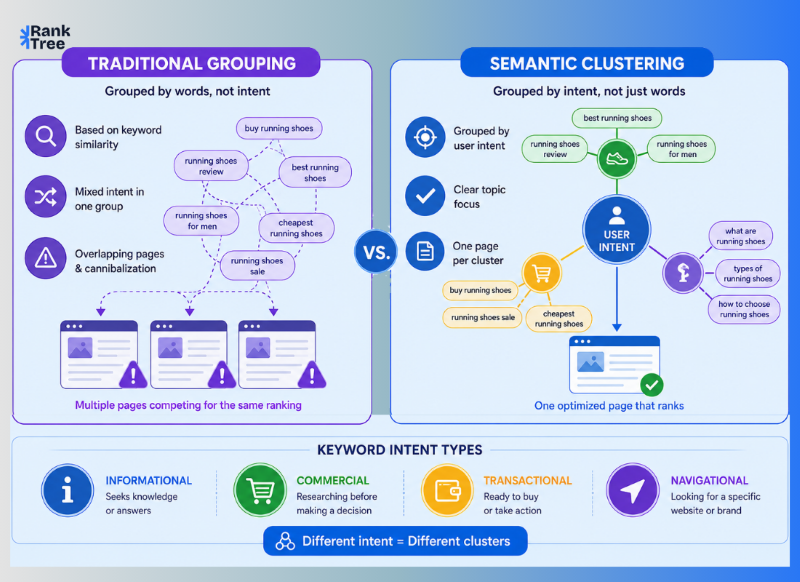
Traditional grouping organizes terms by theme or word pattern. It answers: what keywords are about the same subject? The output is a tidy list useful for content calendars but not reliable for building pages that rank.
Semantic clustering organizes terms by shared intent and conceptual relationship. It answers: which keywords represent the same underlying need?
Each cluster corresponds to a specific user goal and every keyword in it can be addressed on one page without contradicting the others.
The practical consequence shows up in cannibalization. Traditional grouping regularly produces overlapping pages with two articles claiming the same SERP territory splitting authority and confusing Google.
Semantic clustering prevents this because each cluster has a clearly bounded intent.
Understanding the different types of keywords informational, commercial, transactional, navigational is essential before semantic clustering can be done accurately.
Keywords from different intent categories almost never belong in the same cluster even when topically adjacent.
How Semantic Clustering Works?
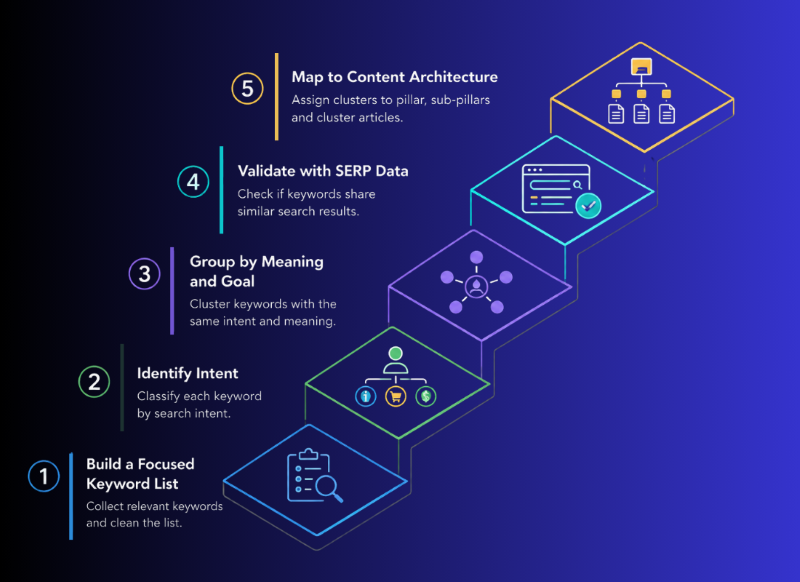
Step 1: Build a Focused Keyword List
Semantic clustering works best when the input list is focused on a specific topic rather than drawn from the broadest possible seed. A list of 300 keywords around "keyword clustering" produces better clusters than a list of 3000 keywords around "SEO."
Sources for your keyword list:
Google Search Console queries filtered by seed keyword
Keyword research tools (Ahrefs, Semrush, Google Keyword Planner)
People Also Ask results for your primary topic
Related searches and autosuggest variations
Before clustering clean the list: remove duplicates, fix spelling variants and delete clearly irrelevant terms.
Keep long tail variants and question based keywords these carry strong intent signals and often reveal the most valuable cluster opportunities.
Step 2: Identify Keyword Intent
Before assigning any keyword to a group, classify its intent by looking at the actual SERP. What content type is Google ranking in positions 1–5? Blog posts and guides signal informational intent.
Comparison pages signal commercials. Product landing pages signal transactional. Keywords with different intents must go into different clusters even when they share the same topic.
"Semantic keyword clustering" and "best semantic keyword clustering tools" are related but one is informational and one is commercial. One page cannot rank well for both.
Step 3: Group by Shared Meaning and Goal
With intent classified group keywords where both conceptual relationship and intent category match. Apply two tests before finalizing any group:
The single page test: Can every keyword in this group be covered on one focused page without the content feeling scattered? If yes the group is valid.
The intent test: Would the ideal page for every keyword in this group serve the same user goal in the same format? If not, split the group.
For large lists NLP based semantic tools group by meaning rather than word overlap surfacing relationships that pattern based methods miss. For a programmatic approach at scale keyword clustering with Python using spaCy or NLTK handles semantic grouping efficiently before manual validation.
Step 4: Validate Against SERP Data
Semantic clustering has one key limitation: it groups by linguistic meaning not by how Google actually treats queries.
Two semantically distinct keywords can return nearly identical SERP results meaning they need the same page regardless of what a semantic model suggests.
Validate by comparing top 10 results for each keyword pair within a proposed cluster. If they share 40 percent or more of the same URLs Google already treats them as the same intent.
This SERP validation step is what separates semantic clusters that look correct from clusters that actually perform.
Step 5: Map Clusters to Content
Each validated cluster maps to one page in your content hierarchy:
Pillar page clusters contain your highest volume head terms and anchor the entire topic
Sub pillar clusters cover specific angles of the main topic and link both up to the pillar and down to cluster articles
Cluster article groups target specific long tail queries within a subtopic your most focused detailed pieces
This hierarchy creates the internal linking structure that signals topical authority to Google and ensures every piece you publish reinforces the pages above and below it. For a complete guide on executing this structure see how to do keyword clustering.
The Semantic vs. SERP Based Clustering Decision
A common question among SEO professionals is whether to use semantic clustering or SERP based clustering and the honest answer is that they serve different purposes in the same workflow.
Semantic clustering is the right tool for:
Organizing large keyword lists into a workable initial structure
Building topical maps and content calendars
Understanding the conceptual landscape of a topic before writing
SERP based clustering is the right tool for:
Validating final cluster decisions before committing to page creation
Preventing cannibalization on an established site
Ensuring your page structure mirrors how Google actually interprets intent
The most effective workflow uses both in sequence: semantic clustering for fast initial organization at scale SERP based validation for final decisions on which keywords share a page.
Skipping the SERP validation step after semantic clustering is the most common reason semantically structured content still underperforms.
Dedicated keyword clustering tools that combine semantic and SERP methods handle this hybrid workflow automatically which is why they consistently outperform purely semantic or purely pattern based approaches in real world testing.
Common Semantic Clustering Mistakes That Kill Rankings
Grouping by topic instead of intent. "Keyword clustering for beginners" and "best keyword clustering tools" look cohesive but contain two different intents. The resulting page ranks poorly for both.
Over clustering into mega pages. Combining too many keywords into one cluster usually means mixed intents are present. Pages trying to answer too many different questions simultaneously tend to rank for nothing.
Using semantic output as final decisions. Semantic tools group by meaning. Google ranks by intent. Always verify against live SERP data before publishing especially on competitive or commercial topics.
Never revisiting clusters. Search intent shifts over time. Clusters built on 12 month old SERP data can become misaligned as query behavior evolves quietly suppressing rankings on otherwise well produced content.
After Semantic Clustering: Next Steps
Building clusters is the planning phase. The value comes from execution:
Assign each cluster a content type based on its dominant intent blog post for informational comparison or roundup for commercial landing page for transactional. Getting this wrong is more damaging than weak on page optimization.
Prioritize clusters by business value not just search volume. A cluster with 500 monthly searches that maps directly to your product's use case is worth more than a 5000 search cluster that attracts entirely non converting traffic.
Build internal links between all cluster pages before publishing. Waiting until after publication to add internal links means some pages launch without the link equity they need to gain initial traction. Map the internal linking structure from your cluster architecture before writing begins.
Track performance at the cluster level not just by individual page. A cluster is working if the pillar page and its supporting articles are collectively gaining impressions and clicks across their full keyword group.
Individual page performance can be misleading; a cluster article might rank for ten keywords while the pillar captures fifty more.
Key Takeaways
Semantic clustering is about intent, not words
It improves rankings by aligning with user needs
It helps build topical authority
It prevents content cannibalization
Final Thoughts
Semantic keyword clustering is not a technical upgrade to keyword grouping. It is a different way of thinking about what content should exist and why.
When you build pages around shared intent rather than shared words you stop producing content that competes with itself and start building topical depth that search engines actively reward.
The architecture produces tightly organized intent aligned internally linked compounds over time. Every cluster article reinforces the pages above it. Every pillar gains authority from the clusters below it.
That compounding effect is what separates sites that build durable organic traffic from sites that endlessly chase individual rankings.
FAQs
What is the difference between semantic keyword clustering and traditional grouping?
Traditional grouping organizes keywords by word similarity or broad topic while semantic clustering groups them by shared search intent combining different looking keywords with the same goal and separating similar looking ones with different intent.
How many keywords should a semantic cluster contain?
There’s no fixed number. A valid cluster includes all keywords with the same intent that can be covered on one page typically 5–25. If the content feels unfocused the cluster should be split.
Can semantic clustering be done without a paid tool?
Yes. For under 200 keywords manual clustering works. For larger sets free tools (like thruuu) or Python libraries (spaCy NLTK) can help. In all cases SERP validation is essential before finalizing clusters.
How is semantic clustering related to topical authority?
Semantic clusters form the foundation of topical authority. Each cluster creates an intent focused page and when organized into a pillar cluster structure with internal linking they signal comprehensive topic coverage to Google.
How often should semantic clusters be updated?
Review clusters every 6–12 months or after major Google updates. Search intent changes over time and outdated clusters can reduce performance.
How does semantic keyword clustering improve content relevance?
It improves relevance by aligning your content with user intent, not just keywords. This ensures your page answers the actual query behind the search, leading to better engagement and rankings.