Topical Authority SEO: What It Is and How to Build It Step by Step
By RankTree Team · 2026-10-26 · Updated 2026-10-26
Part of the SEO Content Brief: Template, Example and Scoring System guide →
You publish one strong article. It ranks for a few weeks then slips while a smaller site keeps ranking for the whole topic. The gap is rarely that one page.
Topical authority SEO closes that gap. Instead of chasing single keywords, you plan a topic, group its subtopics, and connect your pages so search engines see what your site stands for.
This guide explains what topical authority is and how search engines judge it. It walks through the build, a worked example, AI search, and measuring progress.
What Is Topical Authority?
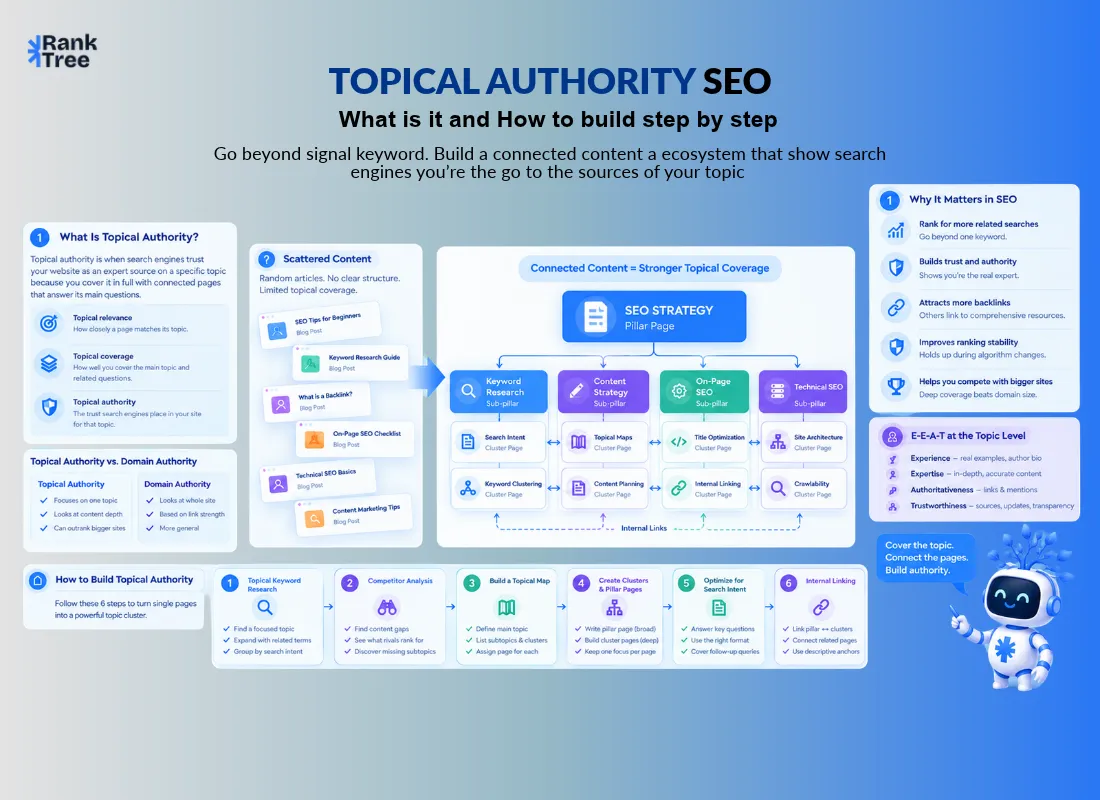
Topical authority is when search engines trust your website as an expert source on one specific topic because you cover that topic in full with connected pages that answer its main questions.
Topical relevance is how closely a page matches its topic and the entities readers link with it.
Topical coverage is the wider check whether your site covers the main topic and the questions around it or wrote one page and left the rest missing. A page can be relevant while your coverage stays thin.
Topical Authority vs. Domain Authority
Domain authority looks at the link strength of a whole site. Topical authority looks at your depth on one topic. That is why a small focused blog can outrank a big general site on a subject it covers well.
Why Topical Authority Matters in SEO
One good page can rank on its own. A full topic does more because each page supports the ones around it.
The gains look like this
You rank for more related searches beyond one target keyword
Readers can tell fast that your site knows this topic
Other sites on the same topic link to you more often
Your rankings hold up better when search results shift
You can compete with larger sites inside your niche
How Search Engines Judge Topical Authority?
Search engines give out no badge. They read patterns in your content, your site structure, and how other sites refer to you and decide how far to trust you.
E-E-A-T Signals at Topic Level
E-E-A-T stands for Experience, Expertise, Authoritativeness, and Trustworthiness judged on the topic not on your site as a whole.
Experience signals must be visible on the page name the author and their background on the topic show work you have actually done with your own examples, cite the sources behind claims, and update key pages when facts change.
This guide was built the same way planned from one topical map with every section sitting inside one cluster topical authority instead of jumping across random SEO topics.
Semantic SEO, Entities, and Search Intent
Semantic SEO works on meaning not on exact word match. Search engines link a topic to its entities, tools, methods, people, subtopics and check if your pages cover those links.
Search intent matters too. A page for a question must answer it clearly and a page for a method must give steps. Depth in the wrong format misses the reader.
How to Build Topical Authority?
Topical authority is built in a set order and the order matters. Research the topic, find the gaps, draw the map, write the pillar and cluster pages then link them together six steps that turn single pages into one strong topic.
Step 1: Start With Topical Keyword Research
Pick a seed topic narrow enough to own but wide enough to hold real subtopics. A seed like SEO is too wide.
Topical keyword research expands that seed into related terms, questions, and long tail searches. Group them by what the reader wants.
Step 2: Find Content Gaps With Competitor Analysis
Study the sites ranking for your topic what they cover well, thinly, and what they miss.
Competitor research tools show the keywords a rival ranks for that you do not. Those missing subtopics are your content gaps often your best cluster pages.
Step 3: Build Your Topical Authority Map
A topical map in SEO is a plan of the whole topic the main topic, its subtopics, and the page each one needs.
Turn your keyword list into topical keyword clusters one cluster for one search intent. Merge any two clusters that answer the same question.
Step 4: Turn the Map Into Topic Clusters and Pillar Pages
A pillar page covers the main topic at a broad level and links to the deeper pages under it. Cluster pages do the deep work one subtopic per page.
This is your content architecture pillar pages on top topic clusters under them.
Step 5: Write Topical Content That Matches Search Intent
Write the pillar page first then its cluster pages. Answer the main question early then cover the subtopic in full.
Good topical content answers the follow up questions a reader asks next and stops when the subtopic is covered.
Step 6: Connect Everything With Internal Linking
Internal linking ties it together. The pillar links down to each cluster page, cluster pages link back to the pillar, and related pages link to each other.
Use anchor text that names the linked page and fix pages no other page links to.
A Simple Topical Map Example
Take a small blog about brewing coffee at home with subtopics readers search one by one
Page Type | Page Topic | Target Keyword | Search Intent |
Pillar | Coffee Brewing | coffee brewing | Learn the topic |
Cluster | Espresso Basics | espresso basics | Learn a method |
Cluster | Pour Over Guide | pour over coffee | Follow the steps |
Cluster | Choosing a Grinder | coffee grinder for home | Compare options |
Cluster | Storing Coffee Beans | store coffee beans | Solve a problem |
Each cluster page owns one job, a method, the steps, a buying choice, and a problem. Each links back to the pillar and the method pages link across too.
Topical Authority for AI Search
AI search tools answer questions by leaning on sources they already link with a topic. Topical authority in LLMs grows the same way as in normal search clear steady coverage of one subject.
Post once on ten topics and these systems store no clear link. Cover one topic well and your site becomes an easy source to reach for.
Building an AEO Topical Authority System
An AEO topical authority system shapes that coverage for answer engines. Put a self contained answer under each heading, keep the same facts and terms, and use headings that match real questions.
A section that makes sense alone can be quoted cleanly in an AI answer. No format promises a place in that answer but clear sections give you the chance.
How to Measure Topical Authority?
Measure the topic as a whole. A cluster works when its pages rank together and pull traffic as a group.
A topical authority tool can show how much of a topic you cover, where you rank for it, and which subtopics you still miss. It cannot give you a score from Google because Google does not publish one. Treat that score as the tool's own view.
Track these signals each month
Related searches your cluster pages rank for
Rankings across the whole cluster not just the pillar page
Traffic to the pillar and cluster pages as one group
Mentions of your pages inside AI answers
Links from other sites on the same topic
Common Mistakes That Weaken Topical Authority
Scattering your effort is the top mistake. A post on a new topic may bring some traffic but it builds trust on no one topic.
Thin cluster pages leave holes in your coverage. Two pages for the same question split your strength and cluster pages that nobody links to look lost.
Conclusion
Topical authority is earned by covering one topic in full not by writing pages on more subjects. Relevance, coverage, and clear links turn single pages into a topic search engines can trust.
The build is plain work research, gaps, map, pillar and cluster pages then links the same steps the coffee map follows.
Pick the one topic your readers come to you for, map it, and publish inside that map. That focused coverage is how a site becomes the source for its subject.
FAQs
Is Topical Authority a Google Ranking Factor?
It is not one named factor you can switch on. It is the result of coverage, links, and trust on a topic building up together.
How Long Does It Take to Build Topical Authority?
It builds as your cluster is published, indexed, and linked through steady work over time. A narrow topic shows the pattern sooner than a broad one.
How Many Articles Do You Need to Build Topical Authority?
There is no fixed number. You need enough pages to cover the main questions in your topic with no gaps and no repeats.
Can a New Website Build Topical Authority?
Yes. Start with one narrow topic and cover it better than larger sites that treat it as a side topic then widen later.
Do You Still Need Backlinks If You Have Topical Authority?
Yes. Links from sites on the same topic still help search engines trust your pages. Depth and links work together.