SERP Volatility Tracker: How to Read Ranking Storms Before You React
By RankTree Team · 2026-10-31 · Updated 2026-10-31
Part of the SEO Content Brief: Template, Example and Scoring System guide →
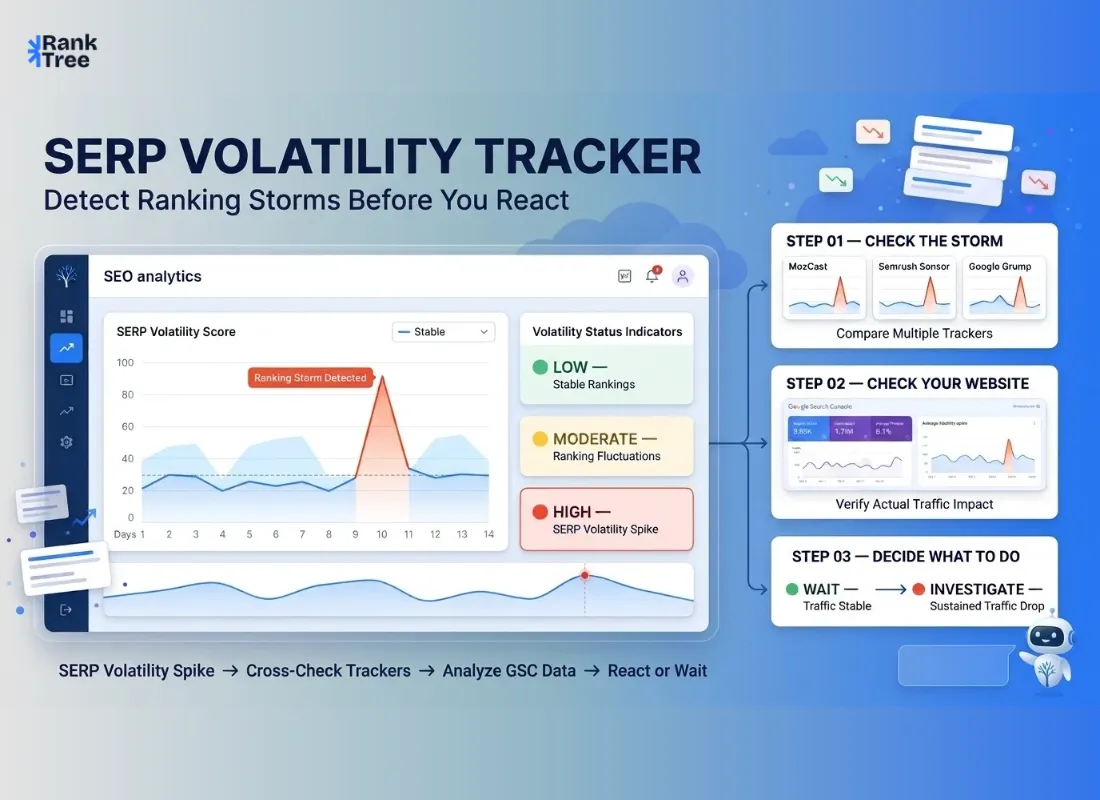
Your rankings dropped overnight. Your first instinct? Fix something fast. But first ask: did everyone else's rankings move too? A SERP volatility tracker answers that.
It watches thousands of search results daily and reports how much they're shifting, so you can tell a problem on your site apart from a storm across the whole search landscape.
In this guide: what these trackers measure, how the main tools differ, and how to read a spike without panicking. One rule runs through it: a spike is an early warning, not a diagnosis it says something moved, not why or what to change.
What Is SERP Volatility?
SERP volatility is the rate at which Google's search results change over a set period. On a calm day, most pages hold their positions. On a volatile day, many pages gain or lose positions at once across many searches.
Some movement is normal Google tests constantly, competitors publish, demand shifts with the news. Volatility matters only when movement is large, sudden and widespread: the day trackers that normally disagree all spike together.
That's a tracker's real value. One tool spiking alone could be a quirk of its keyword sample. Three spiking together? That's a signal worth investigating.
What a SERP Volatility Tracker Actually Measures?
Under the hood, every tracker does the same three things:
A fixed keyword basket, tracked daily.
Today's rankings vs yesterday's.
Changes rolled into one daily number temperature, score, or mood.
Most people miss this: the keyword basket matters more than the score. A tracker built from 10,000 US head terms won't move like one built from hundreds of thousands across many countries. When two disagree, neither is wrong they measure different slices of Google.
And trackers don't measure your site a weather tool reports the climate, not your garden. Whether a storm hit your pages, check your own data: Search Console clicks and impressions, or a rank tracker holding your keyword set.
The Tools Worth Knowing
Seven tools dominate you don't need all of them. Pick one daily check and one cross-check, and learn how each scores movement, so you never compare temperatures with moods.
Tool | What it measures | Best for | Watch out |
MozCast | Daily change across 10,000+ keywords in 5 US cities, as a temperature, plus domain tracking and SERP-feature graph | A quick daily "how stormy?" read | US-focused; calm ≈ 70°F — read it against its own history |
Semrush Sensor | Aggregate score plus industry/category scores and feature movement (snippets, Knowledge Panels, shopping) | Whether your industry moved more than average | Aggregate can hide a niche storm — check your category |
Algoroo | Daily fluctuation, with winning and losing sites | Spotting which sites gained in a shuffle | Shows who moved, not why |
AccuRanker Google Grump | Mood rating (chilled, cautious, grumpy, furious) by country, history back to 2015 | Country checks, long-term comparisons | A mood is a summary, not a measurement |
Advanced Web Ranking | Daily volatility across ~400,000 desktop and 200,000 mobile keywords, 1–10, by country and industry | Large-sample, international, device-split views | Big samples smooth out niche storms |
SERPmetrics | Flux charts vs 30-day medians | Judging whether today is unusual vs the last month | Slow median can make a long rollout look "normal" |
CognitiveSEO Signals | Daily signals from 170,000+ keywords (desktop, mobile, local), plus notes on confirmed changes | Pairing a spike with the official update record | Different sample/scoring scores aren't comparable |
Scope note: volatility trackers only. Tools analysing a single results page are a different job see our guide to SERP analysis tools.
Two cautions. Since September 2026, some providers report unreliable results from automated checks, so readings carry extra noise in exactly the periods you watch most closely.
And Google confirms updates days or weeks after a spike a tracker flags that something happened, not which update.
How to Read a Spike in Three Levels?
A spike is step one, not the conclusion run three levels before deciding:
1. Industry level: is the storm real?
Check two or three independent trackers. If MozCast, Semrush Sensor, and one other all spike the same day, the storm is real. If only one spikes, wait a day possibly a sample quirk.
Then check your industry, not just the aggregate: a shopping storm means little for a B2B blog.
2. Site level: did it hit you?
Open Search Console: check clicks and impressions over the same days. A real hit is sustained, not a one-day wobble.
If traffic held steady while trackers spiked, the storm passed you by. This is where keyword visibility tracking helps it shows whether your overall presence rose or fell.
3. Page level: which pages moved?
Drill into URLs. One page dropping while the rest hold steady points to that page stronger competitor, intent shift, or your own edit. Many dropping together on a spike day points outward.
That decides the move: a page-level fix for one page, patience for a site-wide drop in a confirmed storm.
What Else Causes Spikes Besides Algorithm Updates?
An algorithm update is the most talked-about cause and the least certain to claim. Rule out the others first:
News and seasonality. A major story rewrites results overnight; holiday, exam, or tax-season queries surge and settle on a calendar. Rankings didn't break demand changed.
SERP-feature changes. When Google adds or expands a feature snippet, AI Overview, shopping block positions below shift though no page got better or worse. Our guide on how to find SERP features shows how to check which changed.
Competitor moves. One strong new page, or one site publishing at scale, can shuffle a whole page Algoroo's winner/loser view helps here.
Intent shifts. A query's intent can drift an informational term starts returning product pages. Match the new intent, don't rewrite a fine page. See our guide to search intent for checking what a query wants now.
Your own site changes. A migration, redesign, or URL structure change can move rankings on a calm day. Check your change log before blaming Google.
Caution: trackers rebuild baskets and change methods over time, so a jump no other tool shows may be a method change, not a Google change.
The honest version of "there was an update": trackers spiked, my pages moved, no other explanation fits. Anything less is a guess and guesses get good pages "fixed" into worse ones.
React or Wait? A Decision Table
The most expensive mistake in volatility season is refactoring during the storm. Rankings often settle partway back as a rollout completes, and mid-storm changes can't be measured you'll never know whether recovery came from your fix or the storm passing. Wait one to two weeks, then check Search Console before changing anything.
Situation | React or wait? | What to do |
Trackers spike, your traffic is steady | Wait | Note the date, change nothing |
Trackers spike, your traffic drops for one day, then recovers | Wait | Log as storm effect, not site problem |
Trackers spike, your traffic drops and stays down after 1–2 weeks | React | Check Search Console by page/query, then fix what data points to |
One page drops, trackers are calm | React | Investigate: competitor, intent shift, or your own edit |
Many pages drop, trackers are calm | React | Check site-wide causes: technical issue, migration, manual action |
Trackers disagree with each other | Wait | Cross-check a third tool, give it a day |
When you react, change one thing at a time and record it, so recovery traces to the change.
A Simple Weekly Routine
No need to watch daily:
Monday: glance at your two trackers; note spike days from the past week.
Monday: compare those dates with Search Console — did clicks/impressions move the same days?
If yes: list moved pages; wait out the 1–2 week settling period.
If no: file it under "weather, not us" and move on.
Final Words
Think of a SERP volatility tracker as a weather report, not a repair manual. It stops you fixing what isn't broken and flags the days deserving a closer look.
Use two or three independent tools, cross-check every spike against Search Console, and give storms one to two weeks before changing anything.
The best update-season SEOs aren't the fastest to react they're the ones who know a storm from a diagnosis, and wait long enough to tell which they're looking at.
FAQs
What is a SERP volatility tracker?
A tool measuring how much Google's results change day to day: it tracks a fixed keyword set, compares today's rankings with yesterday's, and reports the change as a score, temperature, or mood.
Is a volatility spike proof of a Google update?
No, a spike is an early warning, not proof. News, seasonality, feature changes, competitor moves, and sample differences can all cause spikes. Google confirms updates days or weeks later, so treat a spike as a reason to investigate, not a conclusion.
How many trackers should I check?
Two or three independent ones. If they spike together, the storm is real; if only one spikes, it may be a sample quirk. Pick different samples US-focused and international so one sample can't mislead you.
How long should I wait after a spike before changing my pages?
Wait one to two weeks for rankings to settle, then check Search Console. Changing pages mid-storm makes effects unmeasurable you can't tell whether recovery came from your edit or the rollout finishing.
Do I need a paid tracker to monitor volatility?
No. Daily readings from MozCast, Semrush Sensor, AccuRanker Grump, and Advanced Web Ranking's volatility tool are free. Paid tools pay off for your own keyword set, alerts, or history not for asking whether today is stormy.