Local Search Intent: What It Is and How to Optimize for It
By RankTree Team · 2026-07-22 · Updated 2026-10-07
Part of the Search Intent: How Google Understands What Users Really Want guide →
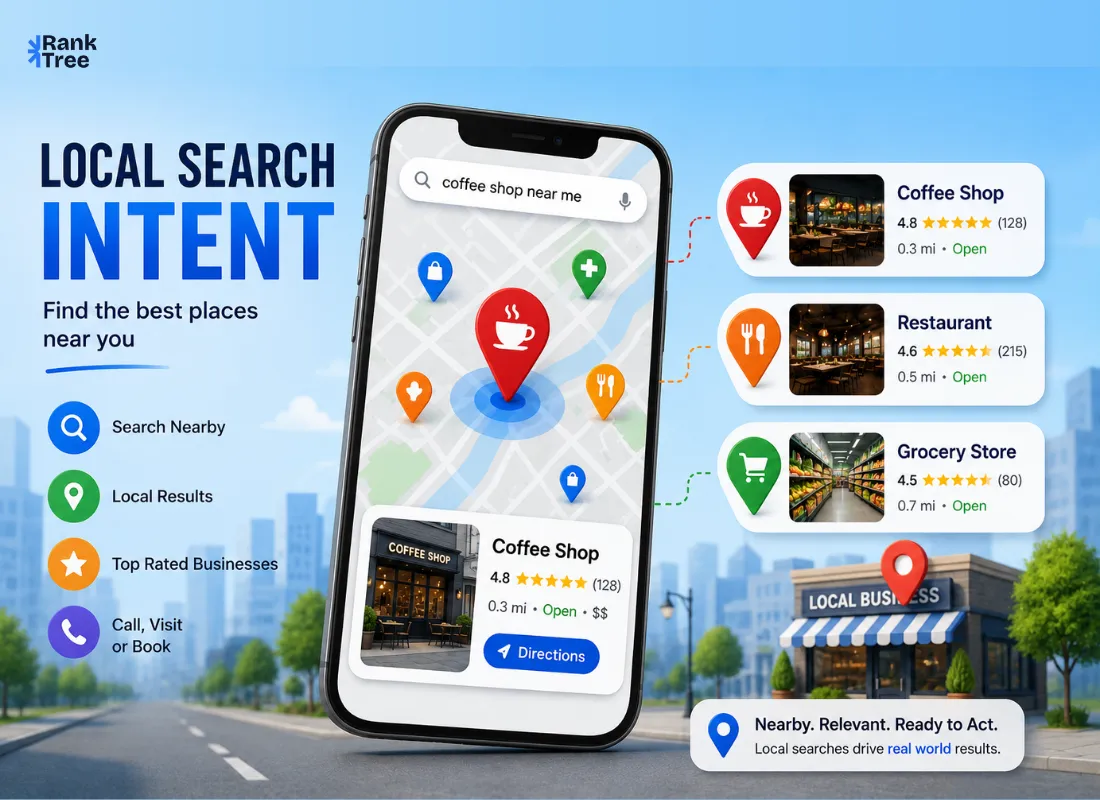
Most businesses don’t lose customers because of bad products. They lose them because they don’t show up when customers are searching nearby.
If your business has a physical location or a defined service area local search intent isn't a niche part of your SEO strategy it's nearly half of it. an estimated 46% of all Google searches now carry local intent, up from roughly 30% in 2019 according to commonly cited industry research, and businesses that don't optimize for it are invisible for almost half of the relevant demand in their market.
This guide covers what local search intent actually is the four types it falls into: how AI Overviews and voice search have changed the picture and a real worked example showing the full process.
Local search intent is the goal behind a query tied to a specific place, whether someone wants a nearby business right now or is researching options for later. It is not a separate category; it shows up across all four standard intent types, informational, commercial, transactional, and navigational, each carrying a geographic layer. Google detects it by combining query meaning through natural language processing with contextual signals like device location, time of day, and search history, then returns localized results such as map packs, local listings, or geo-targeted organic pages. Optimizing for it starts with fully building out a Google Business Profile, repeating location signals across titles, headers, and alt text, adding local business schema, and building off-page presence through directories and community platforms. Because AI Overviews now generate local answers using business profile data and reviews, that same optimization work increasingly feeds AI-generated results, not just the traditional local pack.
What Is Local Search Intent?
Local search intent is the underlying goal of a searcher looking for something tied to a specific place whether that's a nearby coffee shop they want right now or research on restaurants for a trip next month.
Google identifies local intent through explicit signals (a city name "near me" a neighborhood) and implicit ones (the searcher's device location) then returns localized results local pack listings map results or customized organic rankings accordingly.
The Four Types of Local Search Intent
Local intent isn't its own separate category; it shows up across all four standard search intent types each requiring a different response from your business.
Intent | Example Query | What They Want | Your Response |
Informational | "what are my county's ADU building codes" | Answers not a transaction yet | Educational blog content |
Commercial | "best phone carrier near me" | Comparison before deciding | Comparison content reviews differentiators |
Transactional | "book a manicure today in Austin" | Ready to act now | Fast frictionless booking/purchase path |
Navigational | "Dell laptop near me" or a specific business name | A specific brand or resource | Accurate consistent business listings |
A complete local strategy serves all four; a searcher's path rarely moves in a straight line and your digital presence needs to catch them at whatever stage they're in.
How to Do Local Keyword Research?
Local keyword research focuses on finding queries that show geographic intent or trigger local results in SERPs.
Start with your core service keywords, then combine them with location modifiers like city names, neighborhoods, or phrases such as “near me” and “open now,” since these reflect real high-intent user behavior.
Use tools like Google Search Console, Ahrefs or SEMrush to find keywords already generating impressions, especially those with location signals or local pack results.
Study local competitors to identify the keywords they rank for and uncover missed opportunities.
Finally, group keywords by intent informational, commercial and transactional so each page targets a single stage of the user journey instead of mixing multiple intents.
The Numbers That Make This Non Negotiable
An estimated 46% of all Google searches carry local intent (nearly half of total search volume), up from roughly 30% in 2019, according to commonly cited industry research
industry research has found that a large share of "near me" searches result in a business visit within a day, and most within a week — few other channels convert discovery to real world action this fast
The Local 3 Pack occupies the top position for the large majority of local intent queries making Google Business Profile optimization one of the highest leverage moves available
76% of voice searches seek local information a category almost entirely ignored in most local search intent guides
AI powered local packs are appearing in a rapidly growing share of mobile location queries meaning AI Overviews are now part of the local discovery layer not a side feature
How Google Determines Local Intent?
Google determines local search intent by combining query meaning with contextual signals like user location, device type, and search behavior. It then decides whether to show localized results such as maps, local pack listings or geo-targeted organic pages.
Google does not rely only on keywords like “near me.” It uses multiple layers of signals to detect whether a query has local intent.
First it analyzes the query meaning using NLP (Natural Language Processing).
It understands phrases like “coffee shop open now” as immediate local needs.
Then it adds context signals including:
User location (GPS or IP based)
Device type (mobile searches are more local)
Time (late night searches often signal urgency)
Search history
After this Google classifies the intent and decides what type of results to show. That’s why two users searching the same keyword can see completely different results.
The AI Overview Layer: What's Changed
The AI Overview layer is no longer a minor factor in local SEO. Google now generates AI Overviews using data from business profiles, reviews, and website content to answer local queries, often appearing above or alongside the local pack.
This means your Business Profile, reviews and on-page content are not just ranking factors anymore they act as source material for AI-generated answers.
Businesses with weak descriptions and limited reviews are increasingly at a disadvantage, even if their traditional rankings are strong.
How to Optimize for Local Search Intent?
1. Fully Build Out Your Google Business Profile
This remains the single highest leverage move for local visibility. Go beyond the basics:
Photos and videos proving location offerings and quality
A business description written around your customers' most common intent not generic marketing language
Product listings via Google Merchant Center where applicable
Active review management including owner responses
2. Reiterate Location Throughout On Page Content
The clearest differentiator between local and general SEO: every relevant asset title tags meta descriptions headers body copy alt text video transcripts should make the geographic connection explicit. Don't make Google or the searcher infer where you are.
3. Add Local Business Schema Markup
Structured data explicitly tells Google your business name address hours and service area rather than leaving it to be inferred from text. This supports both traditional local pack eligibility and AI systems pulling accurate business data into generated answers.
4. Build Off Page Local Presence
Visibility isn't limited to Google. Get listed and referenced on:
Other local directories (Apple Business Connect Yelp TripAdvisor)
Local news sites and "best of" roundup articles
Community platforms (Nextdoor local Facebook groups relevant subreddits)
Local podcasts blogs and video creators in your area
5. Remove Technical Friction
A fast mobile friendly site is table stakes. Beyond that audit:
Store locators for accuracy and usability
Booking and scheduling widgets for functionality
Checkout/fulfillment clarity (pickup delivery shipping options clearly stated)
Navigation menus linking clearly to location specific pages for multi location businesses
Why Local Search Intent Drives Real Business Growth?
Local search intent is one of the highest converting traffic sources. Unlike general SEO traffic local users often have immediate intent to act.
When optimized correctly it can:
Increase foot traffic to physical locations
Generate calls and bookings
Improve visibility in Google Maps
Drive high intent leads
Build long term local authority
The key difference is simple: Local SEO is not about traffic it’s about actionable traffic.
Real Local SEO Example (Step by Step)
To see how local search intent works in practice, take a dental clinic targeting “dentist near me.”
Google Search Console data showed impressions but low clicks, signaling weak visibility in local results.
The clinic improved its Google Business Profile with service-focused descriptions, updated images, and active review responses, while also creating a dedicated page for “emergency dentist in [city]” instead of relying on a generic homepage.
The page was structured around immediate user needs like pricing, availability, and booking, with internal links from related blog content to strengthen relevance.
Within six weeks, the page moved from outside the top 20 into the local pack and began generating direct calls from search, showing how intent alignment and structured optimization drive real results.
Local Search Intent vs General Search Intent
Local search intent is a subset of search intent with a geographic focus.
While general search intent answers questions local intent answers where to go or what to do nearby.
The difference is not just in keywords but in how results are displayed.
Local intent triggers:
Maps
Business listings
Directions
Contact actions
This makes it more action driven compared to informational searches.
How to Measure Local Search Intent Performance?
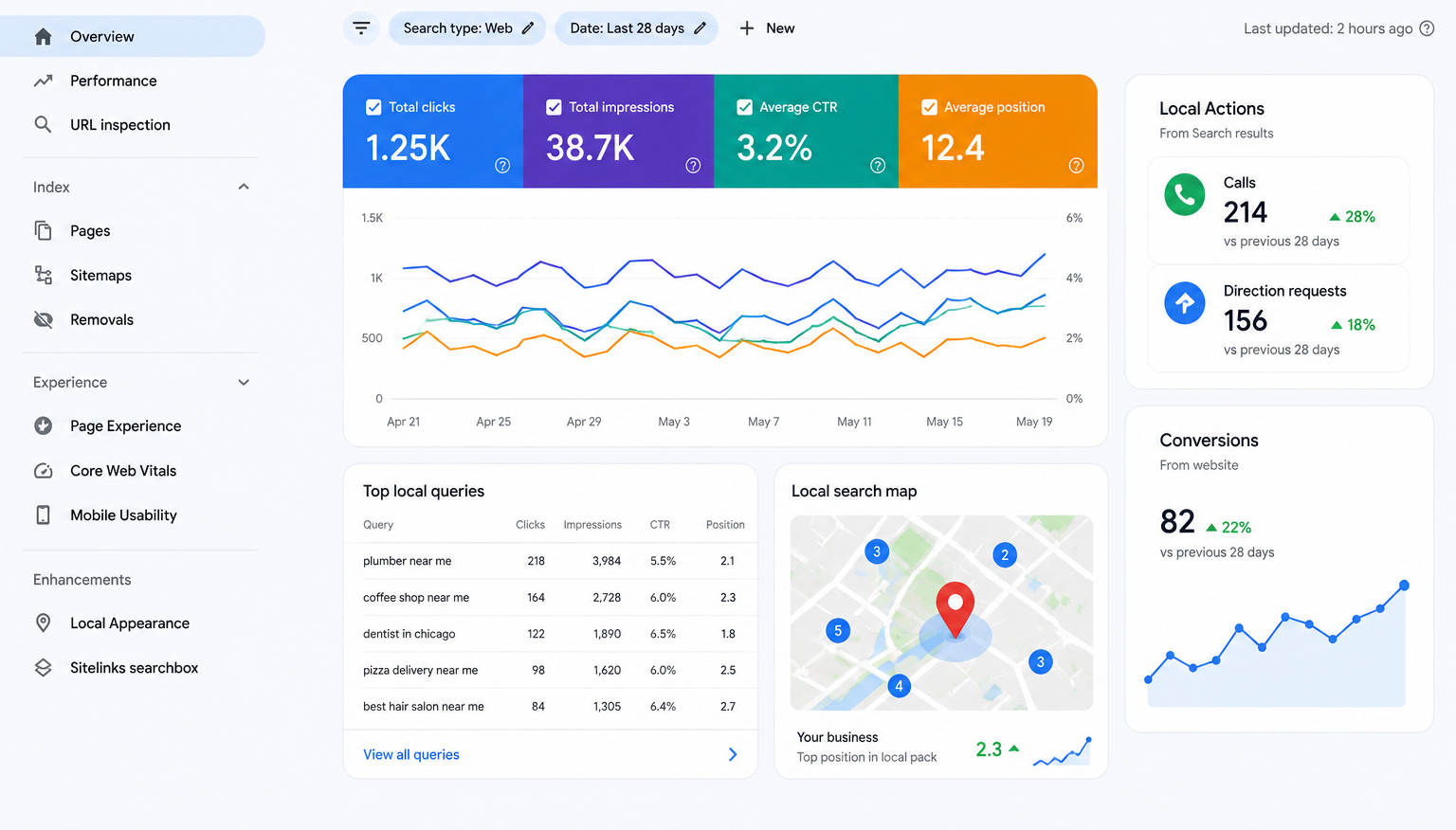
Once your content is optimized, tracking performance is essential.
Use tools like Google Search Console and Analytics to monitor:
Local keyword rankings
Click through rates
Impressions
Calls and direction requests
Conversion rates
If rankings are improving but conversions are not the issue is usually intent mismatch or UX.
Common Myths About Local Search Intent
"Local keywords are just regular keywords with a city name added." Wrong, it's about matching intent not just geography. "Dentist in [city]" and "dental history" aren't the same searcher.
"You need dozens of local keywords per page." A handful of well matched terms outperforms a keyword stuffed page every time.
"Local SEO only applies to storefronts." Service area businesses without a physical storefront benefit just as much.
"Local rankings happen quickly." Google needs sustained signals over time; consistency beats short bursts of effort.
"AI Overviews have replaced the need for local pack optimization." They've added a layer not replacing the foundation Business Profile and citation accuracy still feed both.
Meet Searchers Wherever They Are in the Journey
Local search intent isn't a single moment to optimize for it's a journey a searcher moves through often non linearly across informational commercial transactional and navigational stages.
Use the checklist above to confirm you're covering all of them and revisit your AI Overview visibility regularly since that layer of local search is moving faster than almost any other part of SEO right now.
FAQs
What percentage of Google searches have local intent?
46% of all Google searches carry local intent as of 2026 up from around 30% in 2019 making it the single largest intent category on Google.
Is local search intent different from the four standard intent types?
No local intent isn't a fifth category. It appears across all four standard types (informational commercial transactional navigational) each just carrying a geographic component.
Do AI Overviews affect local search strategy?
Yes Google increasingly generates AI powered local answers pulling from Business Profile data reviews and site content meaning that content now needs to serve both traditional ranking factors and AI extraction quality.
How important is voice search for local businesses?
Significant and often overlooked roughly three in four voice searches seek local information so content should be structured to answer full conversational questions not just keyword fragments.
RankTree Team — The RankTree team writes about SEO strategy, keyword clustering, and topical authority to help you build content that ranks.