Anchor Text Optimization: How to Balance Relevance and Safety
By RankTree Team · 2026-10-10 · Updated 2026-10-10
Part of the Orphan Pages: What They Are and How to Find & Fix Them guide →
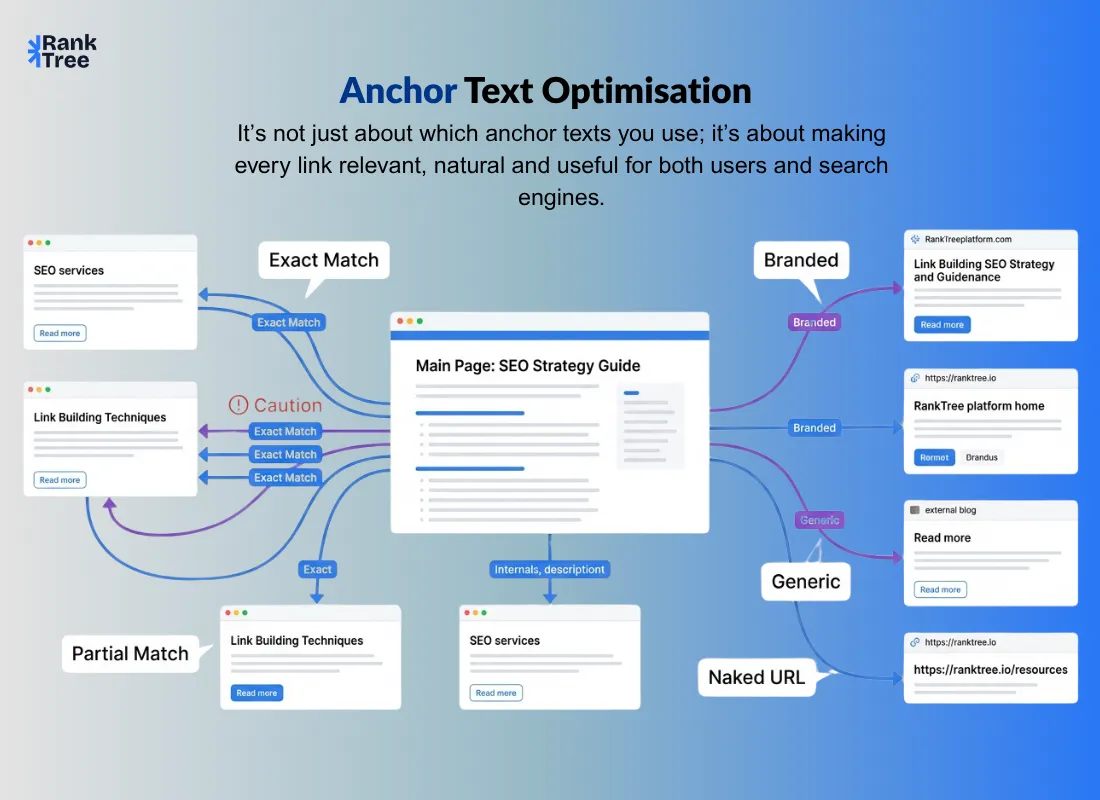
Anchor text optimization means deliberately choosing and diversifying the clickable text of your links internal and external so each one clearly describes the page it points to without looking engineered to Google.
Get it right and your pages gain topical relevance and rankings. Stuff every link with keywords and you'll trip spam filters instead.
In this guide you'll learn the 7 anchor types the ratios that actually work (different for internal links vs backlinks most guides miss this) a practical audit workflow and the mistakes that get sites penalised.
You'll also see how smart anchors power internal linking and fix issues like orphan pages.
What Is Anchor Text Optimization?
Anchor text is simply the clickable link text of a hyperlink the words users see and click. In this HTML:
<a href="https://ranktree.io/blog/what is orphan pages">orphan pages guide</a>
…the anchor text is "orphan pages guide".
Optimization is the discipline of managing that text across your site and backlink profile. Three things matter:
Descriptive the anchor tells users and Google what the linked page is about
Varied not the same keyword phrase on every single link
Safe nowhere near over optimization territory
That's the whole game. Descriptive enough to pass relevance natural enough to avoid looking manufactured. Everything below is about striking that balance.
Why Anchor Text Still Matters for SEO?
Google has become better at understanding content, but anchor text still helps clarify a linked page's topic and relevance.
It explains the linked page. Descriptive anchors like "orphan pages guide" help Google and readers understand the destination.
It adds context to links. Unlike "click here," descriptive anchors explain how a linked page relates to the surrounding content.
It helps users navigate. Anchors like "see our topical map workflow" tell readers what to expect, making it easier to find relevant information.
Use clear, relevant anchor text to help users navigate your site and understand how your pages connect.
The 7 Types of Anchor Text
Type | Example | When to use it |
Exact match | "anchor text optimization" | Rarely strongest signal highest risk |
Partial match | "guide to optimising anchor text" | Often keyword relevance without the risk |
Branded | "RankTree" | Often the safest anchor there is |
Branded + keyword | "RankTree's keyword clustering tool" | Often descriptive and safe |
Generic | "click here" "learn more" "this guide" | For diversity adds little relevance |
Naked URL | "ranktree.io/blog/what is orphan pages" | For diversity mostly in backlinks |
Image (alt text) | Alt text of a linked image | Google reads image alt as the anchor never leave it empty |
Here's the thing most people miss: a healthy profile needs all seven. The second one type starts dominating especially exact match you've got a problem brewing.
How to Think About Anchor Text Ratios?
Here's an uncomfortable truth: Google has never published an "ideal" anchor text percentage. Any guide handing you exact safe thresholds is presenting opinion as fact so let's not do that here.
What Google actually says is refreshingly simple: keep link text descriptive reasonably concise and relevant to the page it points to. That's the official guidance. Everything else is working from principles:
Prioritise branded and partial-match anchors. Natural anchor profiles include varied brand names and descriptive keyword phrases. Maintain variation rather than repeating the same keywords.
Keep exact-match backlinks in perspective. Descriptive exact-match anchors are natural in internal links you control. However, excessive identical commercial keywords in backlinks can indicate manipulative link building.
Benchmark competitors, not fixed percentages. Use Ahrefs or Semrush to compare your anchor profile with two or three competitors ranking above you. An unusually high share of exact-match anchors may warrant investigation.
Watch for suspicious patterns. Numerous links using identical commercial anchors within a short period can look manufactured, especially when combined with other signs of manipulative link building.
Internal vs external still differ: because you control internal anchors be descriptive without fear. For backlinks you didn't earn naturally diversity branded generic naked URL is what makes a profile look legitimately earned.
How to Optimise Anchor Text: A Practical Workflow?
Step 1: Export what you actually have
You can't fix what you can't see. Pull your real data first:
Internal anchors: crawl your site with Screaming Frog (free up to 500 URLs) and export the Inlinks report it shows every anchor pointing at every page.
Backlink anchors: Ahrefs' Anchors report or Semrush's Backlink Analytics gives you the full distribution across referring domains.
Free shortcut: Google Search Console → Links → Top linking text shows your most common internal and external anchors. Crude but it catches the obvious problems in two minutes.
Step 2: Classify and do the maths
Drop every anchor into one of the 7 types and work out the percentages. Then benchmark against two or three competitors ranking above you real data beats generic percentages. You're hunting for two red flags:
Exact match sitting above the safe threshold
The same anchor text pointing to multiple different pages this genuinely confuses Google about which page deserves to rank for that term
Step 3: Fix what's broken
Internal links the easy win because you own them:
Rewrite repetitive exact match anchors into partial match variations
Make sure each important keyword phrase points to exactly one page
Swap generic "click here" anchors on important pages for descriptive ones
Backlinks fewer levers but they exist:
Dilute: earn fresh links with branded generic and naked URL anchors to drag the exact match percentage down
Ask: email webmasters about the worst offenders and request a change this works more often than SEOs admit
Disavow almost never for anchor ratios: Google is explicit that most sites never need the Disavow tool (Google's guidance). Never disavow legitimate links just because your exact match share looks high dilution and outreach are the fix for that. Consider disavow only for a genuinely spammy or artificial link scheme a manual action or a strong documented risk of one. When in doubt leave it alone.
Step 4: Plan anchors before you publish
This is where most sites go wrong they treat anchors as an afterthought. Flip it: when a new page goes live decide upfront which 2–3 existing pages will link to it and with what anchor text and which pages it will link out to.
Far easier when your content is planned as topic clusters. The cluster structure tells you exactly which pages connect and what each anchor should say before you've written a word.
Step 5: Re audit on a schedule
Anchor profiles drift. You publish you earn links guest posts go live with anchors you didn't choose. Re run the export quarterly monthly if you're actively building links and correct drift while it's small.
Anchor Text for Internal Links: The Cluster Playbook
Anchor optimization is most effective on your own site, where you control every link.
Every internal anchor should describe its target page using natural variations of its primary keyword. Consistent anchors across a topic cluster help Google understand page relationships and reinforce topical relevance.
Five rules to follow:
One phrase, one destination. Avoid using the same keyword anchor for multiple pages, as this can make it harder to distinguish their relevance.
Vary your phrasing. Use 3–4 natural variations, such as "anchor text guide," "optimising anchor text," and "anchor text best practices."
Match search intent. Ensure the anchor accurately describes the destination and aligns with its search intent.
Prioritise contextual links. Place descriptive anchors in relevant body content, where visibility and context can influence clicks, rather than relying only on footer or navigation links.
Fix orphan pages. Add 2–3 relevant, descriptively anchored internal links from related pages to help reconnect orphan pages to your site structure.
A topical map makes this easier by connecting supporting articles to pillar pages and vice versa, creating a clearer site structure with fewer orphan pages.
Good vs Bad Anchor Text: Side by Side
Don't do this | Do this instead | Why it works |
Click here | See our anchor text optimization checklist | Descriptive users and Google know what's coming |
best SEO tool best SEO software | RankTree's keyword clustering tool | Branded + keyword natural not stuffed |
orphan pages | How to find and fix orphan pages | Partial match carries richer context than the bare keyword |
this article | Our guide to internal linking for topic clusters | Describes the destination's real topic |
cheap backlinks buy links | (don't link it at all) | Spam phrasing like this is penalty bait |
keyword clustering | keyword clustering | Exact match is fine occasionally just not everywhere |
6 Mistakes That Get Sites in Trouble
Same exact match anchor on repeat. The single fastest way to look manipulative. Vary it every time.
One anchor multiple destinations. Splits relevance and confuses rankings. One phrase → one page always.
Image links with empty alt text. Google reads the alt as the anchor. Empty alt = wasted signal (or worse a confusing one).
Generic anchors on money pages. "Learn more" is fine for a CTA button. Your key pages deserve anchors that actually describe them.
Set and forget profiles. Sites don't get penalised overnight they drift for a year nobody checks and then traffic falls off a cliff. Audit on a schedule.
Writing rambling anchors. A tight 2–5 word descriptive phrase beats a full sentence every time. Long clumsy link text dilutes the signal and looks unnatural.
Final Word
Anchor text optimization isn't about tricking algorithms, it's about being clear. Descriptive varied anchors help people navigate and help Google map your site's structure.
Audit what you have, fix the imbalances, plan anchors before you publish and let your internal linking anchors pointing up through your topic clusters compound your topical authority over time.
And if that audit turns up pages with no internal links at all you already know what those are: orphan pages. Two or three well anchored contextual links is often all it takes to bring them back to life.
Want your internal linking to plan itself? Generate a free topical map from your keyword list every page gets its place in the cluster and every anchor gets its job before you publish a single word.
FAQs
What is anchor text optimization in SEO?
Anchor text optimization means choosing varied descriptive clickable text for internal links and backlinks while keeping it natural and relevant.
What is a good anchor text ratio?
Google has no official ideal ratio. Use varied descriptive anchors favour branded and partial match text and compare your profile with top ranking competitors.
How many exact match anchors are safe?
There’s no official safe percentage. Avoid excessive identical keyword anchors in backlinks especially when they appear rapidly across many domains.
Can I recover from anchor text over optimization?
Yes. Rewrite repetitive internal anchors earn diverse backlinks request changes to problematic links and disavow only clear spam when necessary.
Should internal and external anchors follow the same rules?
No. Internal anchors can be descriptive and relevant while backlinks should show natural variation in branded generic and keyword based text.