LSI Keywords: What They Are and How to Actually Use Them
By Areeba Mahboob · 2026-10-24 · Updated 2026-10-24
Part of the Complete Keyword Optimization Strategy for System guide →
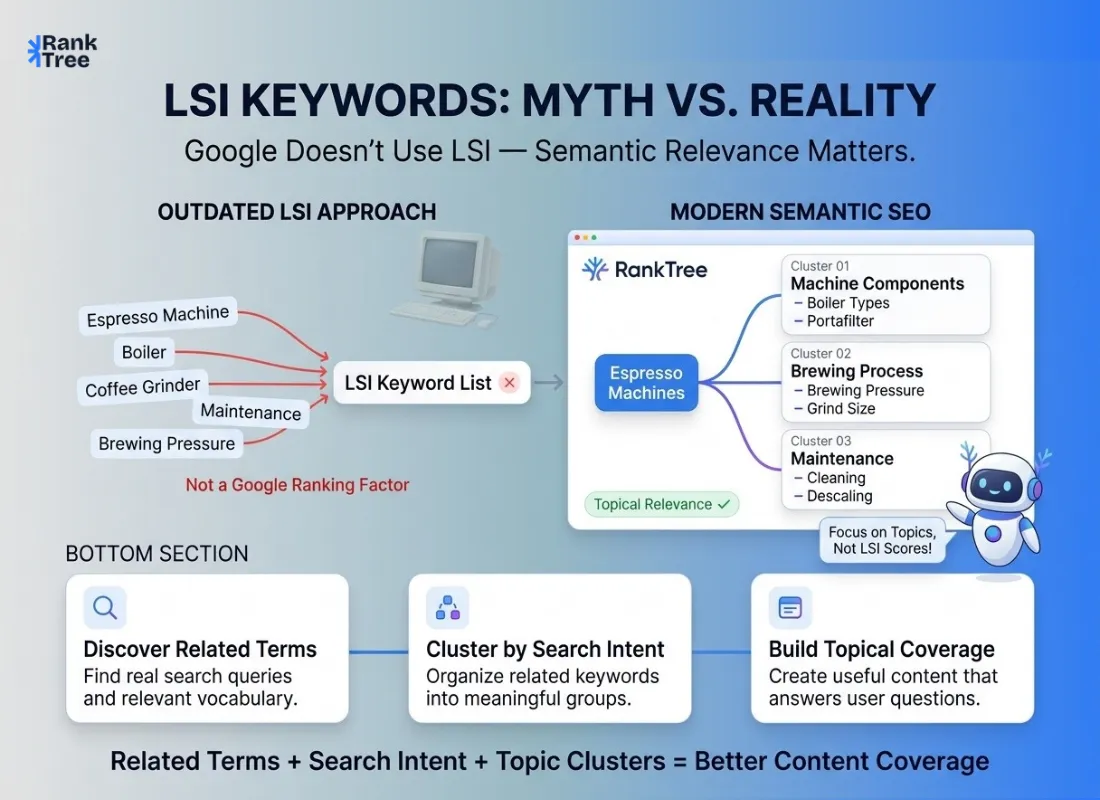
Ask ten SEOs what LSI keywords are and you'll hear the same confident answer: related words that help Google understand your page. Now ask Google. Google's own team has said more than once that LSI keywords aren't a thing it uses.
So who's right? Both sort of. This guide covers what LSI keywords are where the term came from and how to use related terms the simple way that actually helps.
LSI keywords is the name SEOs give to the related vocabulary that surrounds a topic. Write about espresso machines and words like "port pressure" "single boiler" and "tamping" show up those are your so called LSI keywords.
The name comes from Latent Semantic Indexing a document analysis technique from the 1980s. Google doesn't run on LSI. But Google does read for meaning and meaning travels in exactly this kind of vocabulary.
Where the LSI Term Came From?
Latent Semantic Indexing is real. Researchers built it in the late 1980s so computers could group documents by concept instead of exact wording.
An LSI system could work out that a page about "automobiles" and a page about "cars" were about the same thing even when they never used the same word.
SEO borrowed the name in the 2000s and turned it into a writing tactic: weave related terms through your content and Google will get the picture — and rank you for it.
The tactic stuck around. The name is where it falls apart because it describes machinery Google never installed.
The Honest Part: Google Doesn't Use LSI
This isn't opinion. People on Google's search team have said it plainly and publicly: there's no such thing as LSI keywords in Google ranking.
Whatever Google runs on today modern language systems that work with topics entities and intent it left 1980s document maths behind a long time ago.
So why use related terms at all? Because the habit hiding under the myth is a good one.
Pages that cover a topic in its full natural vocabulary really do tend to rank for more searches. The vocabulary isn't a trick you perform on Google. It's just what complete coverage looks like when Google reads it.
Why Related Terms Still Help?
Drop the label. Four benefits survive:
Depth you can point to. Write about espresso machines without ever mentioning boilers pressure or grind size and the page feels thin to a reader and to a search engine lining it up against complete pages.
No ambiguity. "Jaguar" the animal and "Jaguar" the car share a word. The words around it tell Google and your reader which page this is.
Queries you never chased. Every related term is something somebody types into Google. Natural coverage is how a page ends up ranking for dozens of searches nobody "optimized" it for.
Snippet and AI answer material. Quoted answers come from direct clearly labelled coverage of sub questions. Those sub questions usually live inside the related vocabulary.
None of that asks for a special technique. It asks you to learn your topic's vocabulary before you write a research job not a writing trick. Same principle behind semantic search really: Google matches meaning first exact words second.
How to Find Related Terms? (Without an "LSI Generator")
Skip the generators. Five sources give you the topic's real vocabulary:
Autocomplete and related searches. Start typing your seed keyword into Google and read what it suggests. Those are real phrases in searchers' own words.
Bolded words in the top results. Google bolds terms it treats as matches for the query. Skim the top five pages and collect the related words that keep turning up that's vocabulary Google already ties to the topic.
People Also Ask. Every question there is a sub topic your page probably has to answer written the way people actually ask it.
Competitor headings. The H2s on ranking pages are a free map of the sub topics. You're not copying them; you're checking your own coverage against what's already winning.
Keyword tools then clustering. Tools hand you the full query set around a seed. Keyword clustering then sorts those queries by intent so the terms arrive grouped into sections instead of one flat useless list.
Use two or three of these and you'll have more genuine related terms than any generator spits out and every one of them traces back to a real search or a real page.
One more thing worth clearing up while you're at it: LSI isn't a keyword type. Among the types of keywords in SEO it doesn't sit anywhere it's a way of expanding whichever type you're already targeting.
How to Use Them on the Page?
Let them plan your sections. A cluster of related terms is a candidate H2. If a group has nothing real to say it doesn't become a section. The terms serve the content never the other way round.
Put them where they belong. A maintenance term goes in the maintenance section. Not sprinkled through the intro because someone set a target count.
Turn questions into FAQs. The question shaped terms from People Also Ask are ready made FAQ entries. Answer each in two to four sentences.
The sentence wins. If a term makes a sentence clumsy drop the term. Readers punish forced vocabulary and so do rankings eventually.
Mistakes People Make With "LSI Keywords"
Working from a generated list like it's a quota. Forty "LSI keywords" pasted into a page is keyword stuffing wearing a lab coat. A term earns its place by earning its sentence. Otherwise it stays out.
Mistaking synonyms for coverage. Saying the same claim five ways makes a page longer not deeper. Readers can tell. So can Google.
Chasing an LSI score. Some tools will happily grade your page on it. The grade measures how much the tool likes your page. Google was never consulted.
Bottom Line
LSI keywords: a myth with a decent habit buried inside. Google doesn't use Latent Semantic Indexing and there's no list to add to your pages whatever the generators promise.
What helps is older and duller learn the full vocabulary of your topic organize it into real sections write the complete page. Do that and the "LSI keywords" look after themselves. They were just your topic described properly the whole time.
FAQs
Are LSI keywords real?
The words are real; the label isn't. Latent Semantic Indexing is a genuine technique from the 1980s but Google doesn't use it — its team has said so in public. What SEOs call LSI keywords is just the related vocabulary around a topic.
Does Google use LSI keywords for ranking?
No. Google works with modern language understanding: topics, entities intent. Related vocabulary still matters because complete coverage is written in it — but there's no LSI signal sitting there waiting to be optimized.
How many LSI keywords should a page have?
Nobody can tell you because nobody's counting. Cover the topic's real sub topics and questions and the terms come along for free. If you're counting keywords you're doing the wrong job.
What is the best tool to find LSI keywords?
Any solid keyword research tool because the job is really related term research. Start free: autocomplete People Also Ask the bolded terms in the results. Then let a keyword tool — or a clustering tool — organize the full set by intent.